

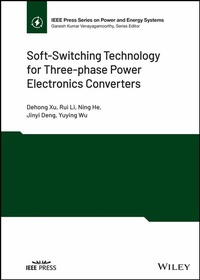
Soft-Switching Technology for Three-phase Power Electronics Converters
Description

Discover foundational and advanced topics in soft-switching technology, including ZVS three-phase conversion
In Soft-Switching Technology for Three-phase Power Electronics Converters, an expert team of researchers delivers a comprehensive exploration of soft-switching three-phase converters for applications including renewable energy and distribution power systems, AC power sources, UPS, motor drives, battery chargers, and more. The authors begin with an introduction to the fundamentals of the technology, providing the basic knowledge necessary for readers to understand the following articles.
The book goes on to discuss three-phase rectifiers and three-phase grid inverters. It offers prototypes and experiments of each type of technology. Finally, the authors describe the impact of silicon carbide devices on soft-switching three-phase converters, studying the improvement in efficiency and power density created via the introduction of silicon carbide devices.
Throughout, the authors put a special focus on a family of zero-voltage switching (ZVS) three-phase converters and related pulse width modulation (PWM) schemes.
The book also includes:
* A thorough introduction to soft-switching techniques, including the classification of soft-switching for three phase converter topologies, soft-switching types and a generic soft-switching pulse-width-modulation known as Edge-Aligned PWM
* A comprehensive exploration of classical soft-switching three-phase converters, including the switching of power semiconductor devices and DC and AC side resonance
* Practical discussions of ZVS space vector modulation for three-phase converters, including the three-phase converter commutation process
* In-depth examinations of three-phase rectifiers with compound active clamping circuits
Perfect for researchers, scientists, professional engineers, and undergraduate and graduate students studying or working in power electronics, Soft-Switching Technology for Three-phase Power Electronics Converters is also a must-read resource for research and development engineers involved with the design and development of power electronics.
More details
Other editions
Additional editions
Persons
Dehong Xu, PhD, is Full Professor in College of Electrical Engineering at Zhejiang University.
Rui Li, PhD, is Full Professor in the Department of Electrical Engineering, School of Electronics, Information and Electrical Engineering at Shanghai Jiao Tong University.
Ning He, PhD, is Firmware Design Principal Engineer in Delta Electronics (Shanghai) Co., Ltd.
Jinyi Deng is a PhD student in Power Electronics in the College of Electrical Engineering at Zhejiang University.
Yuying Wu is a PhD student in Power Electronics in the College of Electrical Engineering at Zhejiang University.
Content
Preface xiii
Nomenclature xv
Part 1 Fundamental of Soft-switching 1
1 Introduction 3
1.1 Requirement of Three-phase Power Conversions 3
1.1.1 Three-phase Converters 3
1.1.2 Switching Frequency vs. Conversion Efficiency and Power Density 5
1.1.3 Switching Frequency and Impact of Soft-switching Technology 9
1.2 Concept of Soft-switching Technique 10
1.2.1 Soft-switching Types 11
1.2.2 Soft-switching Technique for Three-phase Converters 13
1.3 Applications of Soft-switching to Three-phase Converters 14
1.3.1 Renewable Energy and Power Generation 14
1.3.2 Energy Storage Systems 17
1.3.3 Distributed FACTS Devices 19
1.3.4 Uninterruptible Power Supply 19
1.3.5 Motor Drives 21
1.3.6 Fast EV Chargers 21
1.3.7 Power Supply 22
1.4 The Topics of This Book 22
References 23
2 Basics of Soft-switching Three-phase Converters 27
2.1 Introduction 27
2.2 Switching Characteristics of Three-phase Converters 28
2.2.1 Control of Three-phase Converters 28
2.2.2 Switching Transient Process and Switching Loss 31
2.2.3 Diode Turn-off and Reverse Recovery 34
2.2.4 Stray Inductance on Switching Process 35
2.2.5 Snubber 38
2.3 Classification of Soft-switching Three-phase Converters 39
2.4 DC-side Resonance Converters 40
2.4.1 Resonant DC-link Converters 40
2.4.2 Active-clamped Resonant DC-link (ACRDCL) Converter 45
2.4.3 ZVS-SVM Active-clamping Three-phase Converter 46
2.4.3.1 Active-clamping DC-DC Converter 46
2.4.3.2 Active-clamping Three-phase Converter 52
2.5 AC-side Resonance Converters 54
2.5.1 Auxiliary Resonant Commutated Pole Converter 55
2.5.2 Coupled-inductor Zero Voltage-transition (ZVT) Inverter 59
2.5.3 Zero-current Transition (ZCT) Inverter 62
2.6 Soft-switching Inverter with TCM Control 62
2.7 Summary 66
References 67
3 Soft-switching PWM Control for Active Clamped Three-phase Converters 71
3.1 Introduction 71
3.2 PWM of Three-phase Converters 72
3.3 Edge-aligned PWM 76
3.4 ZVS Active-clamping Converter with Edge-aligned PWM 77
3.4.1 Stage Analysis 78
3.4.2 ZVS Conditions 88
3.4.2.1 The First Resonant Stage 88
3.4.2.2 The Second Resonant Stage 91
3.4.2.3 Steady Conditions 93
3.4.3 Impact of PWM Scheme and Load on ZVS Condition 99
3.5 Control Diagram of the Converter with EA-PWM 105
3.6 ZVS-SVM 107
3.6.1 Vector Sequence 109
3.6.2 ZVS-SVM Scheme 111
3.6.3 Characteristics of the Converter with ZVS-SVM 113
3.7 Summary 115
References 116
Part 2 ZVS-SVM Applied to Three-phase Rectifiers 119
4 Three-phase Rectifier with Compound Active-clamping Circuit 121
4.1 Introduction 121
4.2 Operation Principle of CAC Rectifier 122
4.2.1 Space Vector of Three-phase Grid Voltage 122
4.2.2 Space Vector Modulation of Three-phase Converter 124
4.2.3 Switching Scheme of CAC Rectifier 126
4.3 Circuit Analysis 134
4.3.1 Operation Stage Analysis 134
4.3.2 Resonant Stages Analysis 138
4.3.3 Steady State Analysis 142
4.3.4 Soft-switching Condition 144
4.3.5 Control Technique of Compound Active-clamping Three-phase Rectifier 145
4.4 Prototype Design 147
4.4.1 Specifications of a 40 kW Rectifier 147
4.4.2 Parameter Design 147
4.4.3 Experiment Platform and Testing Results 151
4.5 Summary 156
References 156
5 Three-phase Rectifier with Minimum Voltage Active-clamping Circuit 159
5.1 Introduction 159
5.2 Operation Principle of MVAC Rectifier 159
5.2.1 Space Vector Modulation of Three-phase Converter 159
5.2.2 Switching Scheme of MVAC Rectifier 162
5.3 Circuit Analysis of MVAC Rectifier 168
5.3.1 Operation Stage Analysis 168
5.3.2 Resonant Stages Analysis 173
5.3.3 Steady State Analysis 177
5.3.4 Soft-switching Condition 179
5.3.5 Control Technique of Minimum Voltage Active-clamping Three-phase Rectifier 182
5.4 Prototype Design 184
5.4.1 Specifications of a 30 kW Rectifier 184
5.4.2 Parameter Design 184
5.4.3 Experiment Platform and Testing Results 187
5.5 Summary 191
References 192
Part 3 ZVS-SVM Applied to Three-phase Grid Inverters 193
6 Three-phase Grid Inverter with Minimum Voltage Active-clamping Circuit 195
6.1 Introduction 195
6.2 Operation Principle of MVAC Inverter 195
6.2.1 Space Vector of Three-phase Grid Voltage 195
6.2.2 Space Vector Modulation of Three-phase Inverter 197
6.2.3 Switching Scheme of MVAC Inverter Under Unit Power Factor 200
6.2.4 Generalized Space Vector Modulation Method of MVAC Inverter with Arbitrary Output 206
6.3 Circuit Analysis 210
6.3.1 Operation Stage Analysis 210
6.3.2 Resonant Stages Analysis 214
6.3.3 Steady-state Analysis 217
6.3.4 Soft-switching Condition 218
6.3.5 Control Technique of MVAC Inverter 219
6.4 Design Prototype 221
6.4.1 Specifications of a 30-kW Inverter 221
6.4.2 Parameter Design 222
6.4.3 Experiment Results 225
6.5 Summary 230
References 230
7 Three-phase Inverter with Compound Active-clamping Circuit 231
7.1 Introduction 231
7.2 Scheme of ZVS-SVM 232
7.2.1 Switch Commutations in Main Bridges of Three-phase Inverter 232
7.2.2 Derivation of ZVS-SVM 233
7.3 Circuit Analysis 238
7.3.1 Operation Stage Analysis 238
7.3.2 Resonant Stages Analysis 243
7.3.3 Steady-state Analysis 247
7.3.4 Soft-switching Condition 250
7.3.5 Resonant Time Comparison 250
7.4 Implementation of ZVS-SVM 252
7.4.1 Regulation of Short Circuit Stage 252
7.4.2 Implementation in Digital Controller 252
7.4.3 Control Block Diagram with ZVS-SVM 255
7.5 Prototype Design 256
7.5.1 Specifications of a 30-kW Inverter 256
7.5.2 Parameter Design 256
7.5.2.1 Requirement of Diode Reverse Recovery Suppression 256
7.5.2.2 Requirement of Voltage Stress 257
7.5.2.3 Requirement of Reducing Turn-off Loss in Auxiliary Switch 257
7.5.2.4 Requirement of Minimum Resonant Capacitance 258
7.5.2.5 Requirement of Resonant Time 258
7.5.3 Experiment Platform and Testing Results 259
7.6 Summary 263
References 263
8 Loss Analysis and Optimization of a Zero-voltage-switching Inverter 265
8.1 Introduction 265
8.2 Basic Operation Principle of the CAC ZVS Inverter 266
8.2.1 Operation Stage Analysis 266
8.2.2 ZVS Condition Derivation 272
8.3 Loss and Dimension Models 276
8.3.1 Loss Model of IGBT Devices 276
8.3.1.1 Conduction Loss of IGBT Devices 276
8.3.1.2 Switching Loss of the IGBT Devices 278
8.3.2 Loss and Dimension Models of Resonant Inductor 281
8.3.3 Loss and Dimension Models of the Filter Inductor 283
8.3.4 Dimension Model of Other Components 284
8.3.4.1 Clamping Capacitor 284
8.3.4.2 Heat Sink 285
8.4 Parameters Optimization and Design Methodology 288
8.4.1 Objective Function 288
8.4.2 Constrained Conditions 289
8.4.3 Optimization Design 290
8.5 Prototype and Experimental Results 292
8.6 Summary 295
References 296
9 Design of the Resonant Inductor 297
9.1 Introduction 297
9.2 Fundamental of Inductor 297
9.3 Design Methodology 299
9.3.1 Cross-section Area of the Core A c 300
9.3.2 Window Area A e 300
9.3.3 Area-product A p 300
9.3.4 Turns of Winding N 301
9.3.5 Length of the Air Gap l g 301
9.3.6 Winding Loss P dc 301
9.3.7 Core Loss P core 302
9.3.8 Design Procedure 303
9.4 Design Example 303
9.4.1 Barrel Winding Discussion 305
9.4.1.1 Winding Position Discussion 306
9.4.1.2 Winding Thickness Discussion 310
9.4.2 Flat Winding Discussion 311
9.4.2.1 Different Structures Comparison 311
9.4.2.2 Winding Position Discussion 314
9.5 Design Verification 317
9.5.1 Simulation Verification 317
9.5.2 Experimental Verification 318
9.6 Summary 320
References 320
Part 4 Impact of SiC Device on Soft-switching Grid Inverters 321
10 Soft-switching SiC Three-phase Grid Inverter 323
10.1 Introduction 323
10.2 Soft-switching Three-phase Inverter 324
10.2.1 SVM Scheme in Hard-switching Inverter 324
10.2.2 ZVS-SVM Scheme in Soft-switching Inverter 326
10.2.3 Operation Stages and ZVS Condition of Soft-switching Inverter 326
10.2.3.1 Operation Stages Analysis 326
10.2.3.2 ZVS Condition Derivation 329
10.3 Efficiency Comparison of Hard-switching SiC Inverter and Soft-switching SiC Inverter 334
10.3.1 Parameters Design of Soft-switching SiC Inverter 334
10.3.1.1 AC Filter Inductor 335
10.3.1.2 Resonant Parameters 335
10.3.1.3 dc Filter Capacitor 338
10.3.1.4 Clamping Capacitor 338
10.3.1.5 Cores Selection 341
10.3.1.6 Switching Loss Measurement 342
10.3.2 Comparison of Two SiC Inverters 344
10.3.2.1 Loss Distributions 345
10.3.2.2 Efficiency Stiffness 347
10.3.2.3 Passive Components Volumes 348
10.3.3 Experimental Verification 348
10.3.3.1 Efficiency Test 348
10.3.3.2 Passive Components Volumes Comparison 350
10.4 Design of Low Stray Inductance Layout in Soft-switching SiC Inverter 350
10.4.1 Oscillation Model 350
10.4.2 Design of Low Stray Inductance 7-in-1 SiC Power Module 353
10.4.3 7-in-1 SiC Power Module Prototype and Testing Results 356
10.4.3.1 Stray Inductance Measurement 356
10.4.3.2 Voltage Stress Comparison 358
10.5 Design of Low Loss Resonant Inductor in Soft-switching SiC Inverter 359
10.5.1 Impact of Distributed Air Gap 359
10.5.2 Optimal Flux Density Investigation 360
10.5.3 Optimal Winding Foil Thickness Investigation 360
10.5.4 Resonant Inductor Prototypes and Loss Measurement 364
10.6 Summary 368
References 368
11 Soft-switching SiC Single-phase Grid Inverter with Active Power Decoupling 371
11.1 Introduction 371
11.1.1 Modulation Methods for Single-phase Inverter 371
11.1.2 APD in Single-phase Grid Inverter 372
11.2 Operation Principle 376
11.2.1 Topology and Switching Scheme 376
11.2.2 Stage Analysis 379
11.3 Circuit Analysis 385
11.3.1 Resonant Stages Analysis 385
11.3.2 Steady-state Analysis 387
11.3.3 Soft-switching Condition 388
11.3.4 Short Circuit Current 388
11.4 Design Prototype 390
11.4.1 Rated Parameters of a 1.5-kW Inverter 390
11.4.2 Parameter Design 391
11.4.3 Experimental Platform and Testing Results 393
11.5 Summary 398
References 398
12 Soft-switching SiC Three-phase Four-wire Back-to-back Converter 401
12.1 Introduction 401
12.2 Operation Principle 402
12.2.1 Commutations Analysis 403
12.2.2 Operation Scheme 403
12.2.3 Stage Analysis 405
12.3 Circuit Analysis 414
12.3.1 Resonant Stage Analysis 414
12.3.2 Steady State Analysis 417
12.3.3 ZVS Condition 422
12.4 Design Prototype 423
12.4.1 Parameters Design 423
12.4.2 Loss Analysis 427
12.4.3 Experimental Results 431
12.5 Summary 440
References 440
Appendix 441
A.1 Basic of SVM 441
A.2 Switching Patterns of SVM 12 446
A.3 Switching Patterns of ZVS-SVM 448
A.4 Inverter Loss Models 450
A.4.1 Loss Model of Hard-switching Three-phase Grid Inverter 450
A.4.1.1 Conducting Loss 450
A.4.1.2 Switching Loss 453
A.4.1.3 AC Filter Inductor Loss and Volume Estimations 454
A.4.2 Loss Model of Soft-switching Three-phase Grid Inverter 456
A.4.2.1 Loss in Main Switches 456
A.4.2.2 Loss in Auxiliary Switch 458
A.4.2.3 Loss and Volume of Filter Inductor and Resonant Inductor 459
A.5 AC Filter Inductance Calculation 459
A.6 DC Filter Capacitance Calculation 462
Index 469
1
Introduction
In this chapter, an overview of soft-switching technology for three-phase power electronics converters and its evolution are briefly introduced, and the challenges and trends in the soft-switching three-phase converters are discussed.
1.1 Requirement of Three-phase Power Conversions
Three-phase converters are widely used as grid connecting inverters for renewable energy systems, rectifiers, or inverters for uninterruptible power supply (UPS) for data centers, rectifiers for electrical vehicle (EV) fast charging stations, inverters for EV, inverters for industrial motor drives, etc. For these applications, power flow is quickly and accurately controlled because the power converter is composed of power semiconductor devices, which can be turn on or off within less than a microsecond. With the application of the converters, we can realize high efficiency power conversion between sources and loads or vice versa. In addition, if a converter system operates at high frequency, its volume or weight is reduced due to size reduction of passive components such as inductors, capacitor, electric motors, etc. The higher the switching frequency, the smaller are the passive components. Thus the power density, processing power per liter, of the converter is increased [1, 2]. In addition, the dynamics of converter systems are enhanced with increased switching frequency.
1.1.1 Three-phase Converters
Three-phase converters are used as either grid converters to connect the utility or inverters to drive a motor or supply high-quality alternating current (AC) power to the load as shown in Figure 1.1. When a grid converter is used to convert the utility AC voltage into direct current (DC) voltage, it is usually called a rectifier. When it converts DC voltage to the grid AC voltage, it is usually called an inverter. Actually, it is the same entity, but it has two names. It is sometimes confusing for new learners. In most applications such as battery storage systems, the grid converter is required to control power flow bidirectionally. It can operate in either rectifier mode or inverter mode according to the system requirement. When a three-phase converter is used to drive a motor or supply AC power to a load, it is usually called as an inverter since it converts the DC bus voltage into three-phase AC voltages. In the book, a general name "converter" is used, which covers names such as rectifier, inverter, bidirectional converter that swaps between the inverter mode and the rectifier mode according to operation requirement.
Figure 1.1 Three-phase converters: (a) grid converters; (b) inverter.
The three-phase converter is one of the most important power conversion building blocks in power electronic systems. It is widely used in various applications due to its distinct advantages as follows:
- It has the simplest converter topology that can realize DC/AC or AC/DC conversions with minimum number of power switches. It has lower cost.
- It has lower voltage stress on the power devices because the maximum voltage on them is capped by the DC bus. It has lower current stress on the device for AC loads/sources to operate at current continuous mode (CCM).
- There are well-established pulse-width-modulation (PWM) control methods such as sinusoidal PWM (SPWM), third harmonics injected SPWM, space vector modulation (SVM), etc.
- It has well-established system control methods for the converter under abc static frame, aß static frame, and dq synchronous rotating frame.
Because of these advantages, the three-phase converters have been used almost everywhere from low power to high power such as disk drives, inverters for pumps, inverters for EV, drive inverters for bullet trains, solar inverters, wind turbines, UPS, etc. For these applications, there is an ever increasing demand for the performance of the converter. In addition to basic functions such as AC to DC or DC to AC conversion and output power quality, following demands are critical for the converter.
First, it is expected that the converter has higher efficiency, which has become a more stringent requirement than ever before due to increasing public concern of impact of energy consumption on the environment. Besides, high efficiency can also bring economic benefits to the users. A Photovoltaic (PV) inverter with high efficiency can harvest more electricity and also improves the utilization of the PV panel. A UPS with high efficiency can save the operating cost of data centers. It also can reduce the footprint of the power supply due to lower energy loss. An EV power train with high efficiency increases the utilization of the kWh of the battery and extends mileage at the same time.
Second, we hope that the converter has small size. It is especially critical for moving vehicles such as electric vehicles, electric railway, boats, and airplanes or aerospace applications. Smaller size means less use of material, copper, iron, isolation material, etc., which cuts down the cost. For users, it can reduce space, which is expensive in many large cities. Usually, you may hear the word power density. It means the ratio of power capacity to the volume or weight of the converter. It represents the ability of a converter to process the power at a given size. For a given power capacity of a converter, the higher the power density, the smaller is the size of the converter.
Third, the converter is required to have good dynamics. The dynamics of a converter mainly depends on bandwidth of the close loop control systems. It is mainly constrained by the switching frequency of the converter. Generally speaking, power electronic converters have high dynamics since they use power semiconductor devices as the switch. In many applications such as ultra-high-speed pumps and compressors in industrial applications, power generation for aeronautics, EV, etc., it is required that the converter drives the motor to reach ultra-high speed from tens to hundreds of thousands rpm. In some applications such as moving vehicles, the size of the electric machines can be reduced by increasing their operating frequency. To increase the fundamental frequency of the converter, it is natural to increase switching frequency. What is the limit of the switching? We will discuss it in detail later.
Another demand is lower cost. The cost of a converter or a converter system should be optimized. A converter system is generally composed of power semiconductor devices and passive components. Size of the passive components depends on operating frequency. If we can increase the frequency, their size can be reduced.
Actually, switching frequency is a critical parameter for the converter. It plays an important role in efficiency, power density, dynamics, and cost reduction.
1.1.2 Switching Frequency vs. Conversion Efficiency and Power Density
In this section, we will discuss the effects of the switching frequency on the converter. First, an inverter used for UPS is taken as an example. The main circuit of UPS is back to back (BTB) converter as shown in Figure 1.2. It is composed of three-phase grid converter as the rectifier cascaded with a three-phase converter as the inverter to provide high-quality power to the load. To satisfy the load requirement, output voltage of UPS needs to be an almost sinusoidal waveform. Its output voltage quality is usually described by total harmonic distortion (THD). Filters are installed in load sides. In addition, to satisfy the grid standard, filters in utility side are also installed. Filter cost ranges from 15 to 30% of total material expenditure in the UPS (excluding the battery cost). Besides, it also occupies a large footprint. Size of the passive components depends on operating switching frequency. If we can increase the switching frequency, their size will be reduced.
Figure 1.2 Circuit diagram of UPS.
It is assumed that a UPS equipment has rated power 100 kVA at load power factor PF = 0.8. Both the input grid phase voltage and output phase voltage are 220 Vrms. Internal DC bus voltage is 750 Vdc. THD of output voltages is less than 5%. Inductor-capacitor filters are used to improve output voltage waveform. The filter inductors are designed with amorphous core, and their maximum magnetic flux density is Bmax = 1.2 T.
According to the aforementioned assumption, filter inductance of the output converter is designed with different switching frequency as shown in Figure 1.3a. It is observed that the filter inductance decreases with an increase in the switching frequency. Similarly, the size of the filter inductor is also reduced with an increase in the switching frequency as shown in Figure 1.3b. The shaded bar shows the weight of the magnetic core of the filter. The blank bar shows the weight of the copper winding of the filter. The weight of the inductor is reduced about to one of the fifth by increasing switching frequency from 10 to 100 kHz. Figure 1.3c shows total loss of three output filter inductors vs. the switching frequency. The inductor loss also decreases with an increase in the switching frequency. It is because we use a smaller inductance when the switching frequency is higher. A smaller inductance means it has short length of winding so that copper loss is reduced. A smaller inductance needs a smaller core,...
