

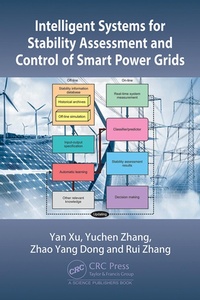
Intelligent Systems for Stability Assessment and Control of Smart Power Grids
Security Analysis, Optimization, and Knowledge Discovery
1st Edition
Published on 10. December 2020
302 pages
978-1-351-66415-8 (ISBN)
Description

Power systems are evolving towards the Smart Grid paradigm, featured by large-scale integration of renewable energy resources, e.g. wind and solar power, deeper participation of demand side, and enhanced interaction with electric vehicles. While these emerging elements are inherently stochastic in nature, they are creating a challenge to the system's stability and its control. In this context, conventional analysis tools are becoming less effective, and necessitate the use alternative tools that are able to deal with the high uncertainty and variability in the smart grid.
Smart Grid initiatives have facilitated wide-spread deployment of advanced sensing and communication infrastructure, e.g. phasor measurement units at grid level and smart meters at household level, which collect tremendous amount of data in various time and space scales. How to fully utilize the data and extract useful knowledge from them, is of great importance and value to support the advanced stability assessment and control of the smart grid.
The intelligent system strategy has been identified as an effective approach to meet the above needs. This book presents the cutting-edge intelligent system techniques and their applications for stability assessment and control of power systems. The major topics covered in this book are:
Intelligent system design and algorithms for on-line stability assessment, which aims to use steady-state operating variables to achieve fast stability assessment for credible contingencies.
Intelligent system design and algorithms for preventive stability control, which aims at transparent and interpretable decision-making on preventive control actions to manipulate system operating condition against possible contingencies.
Intelligent system design and algorithms for real-time stability prediction, which aims to use synchronized measurements to foresee the stability status under an ongoing disturbance.
Intelligent system design and algorithms for emergency stability control, which aims at fast decision-making on stability control actions at emergency stage where instability is propagating.
Methodologies and algorithms for improving the robustness of intelligent systems against missing-data issues.
This book is a reference and guide for researchers, students, and engineers who seek to study and design intelligent systems to resolve stability assessment and control problems in the smart grid age.
Smart Grid initiatives have facilitated wide-spread deployment of advanced sensing and communication infrastructure, e.g. phasor measurement units at grid level and smart meters at household level, which collect tremendous amount of data in various time and space scales. How to fully utilize the data and extract useful knowledge from them, is of great importance and value to support the advanced stability assessment and control of the smart grid.
The intelligent system strategy has been identified as an effective approach to meet the above needs. This book presents the cutting-edge intelligent system techniques and their applications for stability assessment and control of power systems. The major topics covered in this book are:
Intelligent system design and algorithms for on-line stability assessment, which aims to use steady-state operating variables to achieve fast stability assessment for credible contingencies.
Intelligent system design and algorithms for preventive stability control, which aims at transparent and interpretable decision-making on preventive control actions to manipulate system operating condition against possible contingencies.
Intelligent system design and algorithms for real-time stability prediction, which aims to use synchronized measurements to foresee the stability status under an ongoing disturbance.
Intelligent system design and algorithms for emergency stability control, which aims at fast decision-making on stability control actions at emergency stage where instability is propagating.
Methodologies and algorithms for improving the robustness of intelligent systems against missing-data issues.
This book is a reference and guide for researchers, students, and engineers who seek to study and design intelligent systems to resolve stability assessment and control problems in the smart grid age.
More details
Edition
1. Auflage
Language
English
Place of publication
London
United Kingdom
Publishing group
Taylor & Francis Ltd
Target group
College/higher education
Professional and scholarly
Illustrations
63 Tables, black and white; 8 Illustrations, color; 130 Illustrations, black and white
ISBN-13
978-1-351-66415-8 (9781351664158)
Copyright in bibliographic data and cover images is held by Nielsen Book Services Limited or by the publishers or by their respective licensors: all rights reserved.
Schweitzer Classification
Other editions
Additional editions
Yan Xu | Yuchen Zhang | Zhao Yang Dong
Intelligent Systems for Stability Assessment and Control of Smart Power Grids
Book
06/2022
1st Edition
CRC Press
€116.60
Shipment within 15-20 days
Yan Xu | Yuchen Zhang | Zhao Yang Dong
Intelligent Systems for Stability Assessment and Control of Smart Power Grids
Security Analysis, Optimization, and Knowledge Discovery
Book
12/2020
1st Edition
CRC Press
€274.84
Shipment within 10-20 days
Persons
Yan Xu obtained his B.E. and M.E degrees from South China University of Technology, Guangzhou, China in 2008 and 2011, respectively, and a Ph.D. from The University of Newcastle, Australia, in 2013. He is now the Nanyang Assistant Professor at School of Electrical and Electronic Engineering, Nanyang Technological University (NTU), and a Cluster Director at Energy Research Institute at NTU, Singapore. His research areas are power system stability and control, microgrid, and data-analytics for smart grid applications. Dr Xu is an Editor for IEEE Transactions on Smart Grid, IEEE Transactions on Power Systems, IEEE Power Engineering Letters, and an Associate Editor for CSEE Journal of Power and Energy Systems, and IET Generation, Transmission and Distribution.
Yuchen Zhang obtained his B.E., B.Com., and Ph.D. degrees from the University of New South Wales, Sydney, Australia, in 2013, 2013, and 2018, respectively. He is currently a research associate at the University of New South Wales, Sydney, Australia. His research interests include power system stability and control, condition monitoring and fault diagnostics, data analytics, and machine learning applications in power engineering.
Zhao Yang Dong obtained his Ph.D. degree in electrical engineering from the University of Sydney, Australia, in 1999. He is currently a Professor of energy systems with the School of Electrical Engineering and Telecommunications, University of New South Wales, Sydney, Australia. He was previously Ausgrid Chair and Director of the Center for Intelligent Electricity Networks, The University of Newcastle, Australia, and is currently a Conjoint Professor there. He also held academic and industrial positions with the University of Sydney, and Transend Networks (now TAS Networks), Australia. His research interest includes smart grid, power system planning, power system security, electricity market, and computational intelligence and its application in power engineering. Prof. Dong is an IEEE Fellow.
Rui Zhang received the B.E. degree from the University of Queensland, and the Ph.D. degree from the University of Newcastle, Australia, in 2009 and 2014, respectively. She is currently a research associate at the University of New South Wales, Sydney, Australia. Her research interests include power system operation, control, and stability.
Yuchen Zhang obtained his B.E., B.Com., and Ph.D. degrees from the University of New South Wales, Sydney, Australia, in 2013, 2013, and 2018, respectively. He is currently a research associate at the University of New South Wales, Sydney, Australia. His research interests include power system stability and control, condition monitoring and fault diagnostics, data analytics, and machine learning applications in power engineering.
Zhao Yang Dong obtained his Ph.D. degree in electrical engineering from the University of Sydney, Australia, in 1999. He is currently a Professor of energy systems with the School of Electrical Engineering and Telecommunications, University of New South Wales, Sydney, Australia. He was previously Ausgrid Chair and Director of the Center for Intelligent Electricity Networks, The University of Newcastle, Australia, and is currently a Conjoint Professor there. He also held academic and industrial positions with the University of Sydney, and Transend Networks (now TAS Networks), Australia. His research interest includes smart grid, power system planning, power system security, electricity market, and computational intelligence and its application in power engineering. Prof. Dong is an IEEE Fellow.
Rui Zhang received the B.E. degree from the University of Queensland, and the Ph.D. degree from the University of Newcastle, Australia, in 2009 and 2014, respectively. She is currently a research associate at the University of New South Wales, Sydney, Australia. Her research interests include power system operation, control, and stability.
Content
Power System Stability: Definitions, Phenomenon and Classification. Stability Assessment and Control: Problem Descriptions and Classifications. Intelligent system-based Stability Analysis Framework. Intelligent System for On-line Stability Assessment. Intelligent System for Preventive Stability Control. Intelligent System for Real-Time Stability Assessment. Intelligent System for Emergency Stability Control. Addressing Missing-Data Issues. Bibliography.
