

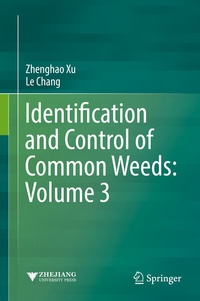
Identification and Control of Common Weeds: Volume 3
Description

This book introduces readers to nearly 600 common weeds. In addition to essential information, each chapter includes photos for a specific type of weed to show its morphology in different growth periods, such as seedling, root, flower, fruit, and mature plant. The book also discusses control measures, including agricultural, chemical, physical, biological, and comprehensive methods. The Volume 3 mainly focuses on 252 Species of Dicotyledonous and Monocotyledonous Weeds along with 2 Species of Liverworts and Mosses.
With the development of society and economics, weeds have become a recurring problem. In particular, the exotic, invasive, and quarantine weeds have spread dramatically and rapidly. On the other hand, many people, even those who are engaged in weed control, do not (or cannot) distinguish between weeds. Thus there is significant demand for illustrations of weed morphologies, as well as information on their control measures. This book offers a valuable, practical guide for all those working in the fields of crop cultivation, plant protection and quarantine management.
More details
Other editions
Additional editions
Persons
Zhenghao Xu is a professor of environmental and resource sciences at Zhejiang University, China. He graduated from Zhejiang Agricultural University, China in 1985 and completed his Master's degree at the same university in 1993. He subsequently engaged in weed research work at China Rice Research Institute for more than 10 years. He received his Ph.D. in Agriculture from China Agricultural University in 2003 and finished his post-doctoral research at Zhejiang University, China in 2006. His research chiefly focuses on weed management, biological invasion and allelopathy. Dr. Xu has published over 40 papers and 7 books, mainly dealing with weed research, control of invasive species and allelopathic mechanisms. He was recently honored with 4 Science and Technology Progress Awards in Zhejiang, China.
Hangying Qi graduated from Zhejiang Agricultural University, China in 1989. Her research focuses on crop science, weed management and invasive species. Shehas published over 23 papers and 5 books, mainly dealing with weed management in paddy fields, invasive weeds in China and the mechanisms influencing crop yield. She has won 14 Science and Technology Progress Awards in Zhejiang, China.
Content
198 Species in Dicotyledonous Class within 20 Families.- 54 Species in Monocotyledonous Class within 20 Families.- 1 Species of Liverworts within 1 Family.- 1 Species of Mosses within 1 Family.
