

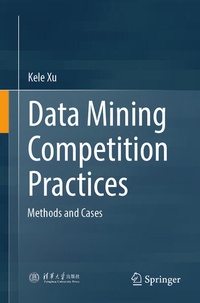
Data Mining Competition Practices
Description

This book aims to provide readers with a clear implementation process for data mining competition solutions and explains the key details involved. In addition to offering the necessary theoretical knowledge, it also provides plug-and-play code. By reading this book, readers will learn how to design a solution for a data mining competition, understand the various details and specific implementation methods of the solution, and learn how to continually refine and optimize it. The book also includes practical case studies to help readers grasp and reinforce these concepts. Data mining competitions offer datasets that closely resemble real-world scenarios, making this book an excellent choice for those who want to learn data mining techniques through hands-on practice.
At the same time, this book can also serve as a reference guide, providing various methods and techniques for the entire process from data input to obtaining final results in different scenarios, including structured data, natural language processing, computer vision, video understanding, and reinforcement learning. These practical methods and techniques can help readers significantly improve their performance on datasets and are applicable not only in data mining competitions but also in research and real-world business applications.
The translation was done with the help of artificial intelligence. A subsequent human revision was done primarily in terms of content.
For the English version of this book, please visit: https://github.com/anyawangqy/DataMiningCompetitionInActionEn
More details
Other editions
Additional editions
Person
Kele Xu has received the Ph.D. degree from Université Pierre et Marie CURIE, Paris, France, worked with Prof. Bruce Denby and Prof. Gerard Dreyfus (IEEE Fellow). His current research interests include Multimodal Machine Learning and Software Engineering. He is also interested in the applications of machine learning for audio signal processing, speech processing. During his part-time, he is a competition-driven researcher. He has won many data mining / machine learning competitions during the past years, including ACM KDD Cup, Kaggle, Tianchi and CCF BDCI (CCF Big Data Computing Intelligence Contest). He is also a Kaggle Grandmaster.
Content
Chapter 1: Introduction to Data Mining Competitions.- Chapter 2: Structured Data: Theoretical Part.- Chapter 3: Structured Data: Practical Part.- Chapter 4: Natural Language Processing: Theoretical Part.- Chapter 5: Natural Language Processing: Practical Part.- Chapter 6: Computer Vision (Image): Theoretical Part.- Chapter 7: Computer Vision (Image): Practical Part.- Chapter 8: Computer Vision (Video): Theoretical Part.- Chapter 9: Computer Vision (Video): Practical Part.- Chapter 10: Reinforcement Learning: Theoretical Part.- Chapter 11: Reinforcement Learning: Practical Part.
