

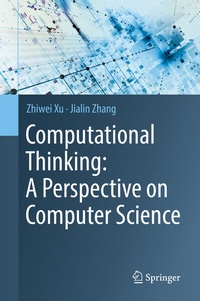
Computational Thinking: A Perspective on Computer Science
Description

This textbook is intended as a textbook for one-semester, introductory computer science courses aimed at undergraduate students from all disciplines. Self-contained and with no prerequisites, it focuses on elementary knowledge and thinking models. The content has been tested in university classrooms for over six years, and has been used in summer schools to train university and high-school teachers on teaching introductory computer science courses using computational thinking.
This book introduces computer science from a computational thinking perspective. In computer science the way of thinking is characterized by three external and eight internal features, including automatic execution, bit-accuracy and abstraction. The book is divided into chapters on logic thinking, algorithmic thinking, systems thinking, and network thinking. It also covers societal impact and responsible computing material - from ICT industry to digital economy, from the wonder of exponentiation to wonder of cyberspace, and from code of conduct to best practices for independent work.
The book's structure encourages active, hands-on learning using the pedagogic tool Bloom's taxonomy to create computational solutions to over 200 problems of varying difficulty. Students solve problems using a combination of thought experiment, programming, and written methods. Only 300 lines of code in total are required to solve most programming problems in this book.
Reviews / Votes
"The book companion website includes the course's lecture and project slides as well as Go source code. . Xu and Zhang validate the view that it is indeed more concerned with . CS instruction itself and provides an effective framework for teaching the subject from introductory to advanced courses. Thus they agree with other notable CT researchers and practitioners, such as Denning and Tedre [1], and their textbook is a most valuable contribution to CS education." (Harry J. Foxwell, Computing Reviews, October 12, 2022)"The book has a companion website from which readers can pull down over 200 MB of zip files with lecture notes, lab notes . and project notes. This is a puzzling book in some respects. On the one hand itcovers basic concepts and terminology for the beginning student, yet on the other hand plunges into sophisticated topics without drawing a breadth. Likewise, it claims that programing experience is not a prerequisite . ." (Anthony J. Duben, Computing Reviews, August 30, 2022)
"The most preeminent characteristic of this book is its 'thinking'-perspective, which the reader may or may not like, and which perhaps leads to a suboptimal arrangements of topics. . the material presented is impressive, and at least the fundamentals are covered in great detail." (Dieter Riebesehl, zbMATH 1490.68001, 2022)
More details
Other editions
Additional editions
Persons
Zhiwei Xu received his PhD from the University of Southern California (1987) and is a Professor at the Institute of Computing Technology, Chinese Academy of Sciences, Beijing, China. He is also a professor at the University of Chinese Academy of Sciences (UCAS). His main research areas include computer architecture and distributed systems. He has led over a dozen priority research projects in parallel and distributed computing. He has over 30 years of experience teaching undergraduate and graduate courses in computer architecture, computer organization, digital logic, distributed systems, introduction to computer science, and parallel processing.
Jialin Zhang received her PhD from Tsinghua University, Beijing, China (2010) and is a professor at the Institute of Computing Technology, Chinese Academy of Sciences, Beijing, China. She is also a professor at the University of Chinese Academy of Sciences (UCAS). Her main research areas include theoretical computer science and quantum computation. She has taught undergraduate and graduate courses in introductory computer science, design and analysis of algorithms, and advanced algorithms.
