

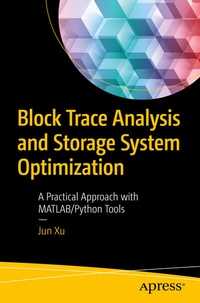
Block Trace Analysis and Storage System Optimization
Description

In the new era of IoT, big data, and cloud systems, better performance and higher density of storage systems has become crucial. To increase data storage density, new techniques have evolved and hybrid and parallel access techniques-together with specially designed IO scheduling and data migration algorithms-are being deployed to develop high-performance data storage solutions. Among the various storage system performance analysis techniques, IO event trace analysis (block-level trace analysis particularly) is one of the most common approaches for system optimization and design. However, the task of completing a systematic survey is challenging and very few works on this topic exist.
Block Trace Analysis and Storage System Optimization brings together theoretical analysis (such as IO qualitative properties and quantitative metrics) and practical tools (such as trace parsing, analysis, and results reporting perspectives). The book provides content on block-level trace analysis techniques, and includes case studies to illustrate how these techniques and tools can be applied in real applications (such as SSHD, RAID, Hadoop, and Ceph systems).
What You'll Learn
-
Understand the fundamental factors of data storage system performance
-
Master an essential analytical skill using block trace via various applications
-
Distinguish how the IO pattern differs in the block level from the file level
-
Know how the sequential HDFS request becomes "fragmented" in final storage devices
- Perform trace analysis tasks with a tool based on the MATLAB and Python platforms
Who This Book Is For
IT professionals interested in storage system performance optimization: network administrators, data storage managers, data storage engineers, storage network engineers, systems engineers
More details
Other editions
Additional editions
Person
Jun Xu got his B.S. in Mathematics and Ph.D. in Control from Southeast University (China) and Nanyang Technological University (Singapore), respectively. He is a Lead Consultant Specialist in Hongkong-Shanghai Banking Corporation (HSBC) and was a Principal Engineer in Western Digital. Before that, he was with Data Storage Institute, Nanyang Technological University, and National University of Singapore for research and development. He has multi-discipline knowledge and solid experiences in complex system modeling and simulation, data analytics, data center, cloud storage, and IoT. He has published over 50 international papers and 15 US patents (applications) and 1 monograph. He is an editor of the journal Unmanned Systems and was a committee member of several international conferences. He is a senior member of IEEE and a certificated FRM.
Content
Chapter 1: Introduction.- Chapter 2: Trace Characteristics.- Chapter 3: Trace Collection.- Chapter 4: Trace Analysis.- Chapter 5: Case Study: Benchmarking Tools.- Chapter 6: Case Study: Modern Disks.- Chapter 7: Case Study: RAID.- Chapter 8: Case Study: Hadoop.- Chapter 9: Case Study: Ceph.- Appendix A: Tools and Functions.- Appendix B: Blktrace and Tools
