

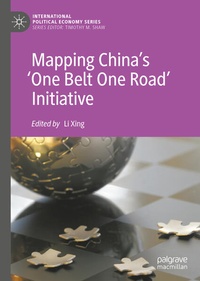
Mapping China's 'One Belt One Road' Initiative
Description

This book sets out to analyze how the OBOR initiative will influence the world's geo-political and geo-economic environment, with specific regard to the 'Belt and Road' countries and regions. It evaluates what opportunities the OBOR can offer them in light of the constraints they face, paying particular attention to how security issues may keep some nations from fully participating. Questions are also asked about the tension and conflict along the 'Belt' and 'Road', which, after all takes in the Middle East's most tumultuous regions, as well as the much disputed South China Sea. Finally, consideration is given as to how the world's other economic powers will react when the OBOR inevitably brings about capital and resource competitions.
Reviews / Votes
"The volume of Mapping China's 'One Belt One Road' Initiative is truly fascinating in its ability to unpack China's motives . . the book is a must-read for scholars who are interested in studying the rise of China and the One Belt One Road initiative." (Stepan Verkhovets, Rising Powers Quarterly, Vol. 4 (1), 2019)More details
Other editions
Additional editions
Person
Li Xing
is Professor and Director of the Research Centre on Development and International Relations at the Department of Culture and Global Studies, Aalborg University, Denmark. He is also Editor-in-Chief of
Journal of China and International Studies
.
Content
Chapter 1: China's pursuit of the One Belt One Road initiative: A new world order with Chinese characteristics?.- Chapter 2: Understanding the multiple facets of China's One Belt One Road initiative.- Chapter 3: A framework for the study of the One Belt One Road initiative as a medium of principle-diffusion.- Chapter 4: The One Belt One Road initiative and China's multilayer multilateralism.- Chapter 5: The One Belt One Road initiative and the changing multi-scalar governance of trade in China.- Chapter 6: China's momentum: The One Belt One Road's triple securitization.- Chapter 7: Unpacking economic motivations and non-economic consequences of connectivity infrastructure under the One Belt One Road initiative.- Chapter 8: The One Belt One Road initiative: Reintegrating Africa and the Middle East into China's system of accumulation.- Chapter 9: Changing regional order and railway diplomacy in Southeast Asia with a case study of Thailand.- Chapter 10: A power shift underway in Europe? China's relations with Central and Eastern Europe under the One Belt One Road initiative.- Chapter 11: Conclusion: The One Belt One Road and the politics of fear and hope.
