

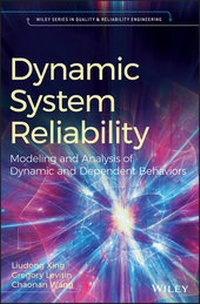
Dynamic System Reliability
Description

This book focuses on hot issues of dynamic system reliability, systematically introducing the reliability modeling and analysis methods for systems with imperfect fault coverage, systems with function dependence, systems subject to deterministic or probabilistic common-cause failures, systems subject to deterministic or probabilistic competing failures, and dynamic standby sparing systems. It presents recent developments of such extensions involving reliability modelling theory, reliability evaluation methods, and features numerous case studies based on real-world examples. The presented dynamic reliability theory can enable a more accurate representation of actual complex system behavior, thus more effectively guiding the reliable design of real-world critical systems.
Dynamic System Reliability: Modelling and Analysis of Dynamic and Dependent Behaviors begins by describing the evolution from the traditional static reliability theory to the dynamic system reliability theory, and provides a detailed investigation of dynamic and dependent behaviors in subsequent chapters. Although written for those with a background in basic probability theory and stochastic processes, the book includes a chapter reviewing the fundamentals that readers need to know in order to understand contents of other chapters which cover advanced topics in reliability theory and case studies.
* The first book systematically focusing on dynamic system reliability modelling and analysis theory
* Provides a comprehensive treatment on imperfect fault coverage (single-level/multi-level or modular), function dependence, common cause failures (deterministic and probabilistic), competing failures (deterministic and probabilistic), and dynamic standby sparing
* Includes abundant illustrative examples and case studies based on real-world systems
* Covers recent advances in combinatorial models and algorithms for dynamic system reliability analysis
* Offers a rich set of references, providing helpful resources for readers to pursue further research and study of the topics
Dynamic System Reliability: Modelling and Analysis of Dynamic and Dependent Behaviors is an excellent book for undergraduate and graduate students, and engineers and researchers in reliability and related disciplines.
More details
Other editions
Additional editions
Persons
Liudong Xing, PhD, is a Full Professor in the Department of Electrical and Computer Engineering at University of Massachusetts (UMass) Dartmouth, USA.
Gregory Levitin, PhD, is a senior expert in the Reliability Department at The Israel Electric Corporation, Israel, and a distinguished visiting professor at University of Electronic Science and Technology of China.
Chaonan Wang, PhD, is a Full Professor at the College of Information Science and Technology at Jinan University, Guangzhou, China.
Content
Foreword ix
Preface xi
Nomenclature xv
1 Introduction 1
References 4
2 Fundamental Reliability Theory 7
2.1 Basic Probability Concepts 7
2.1.1 Axioms of Probability 7
2.1.2 Conditional Probability 7
2.1.3 Total Probability Law 8
2.1.4 Bayes' Theorem 9
2.1.5 Random Variables 9
2.2 Reliability Measures 10
2.2.1 Time to Failure 11
2.2.2 Failure Function 11
2.2.3 Reliability Function 11
2.2.4 Failure Rate 11
2.2.5 Mean Time to Failure 11
2.2.6 Mean Residual Life 12
2.3 Fault Tree Modeling 12
2.3.1 Static Fault Tree 13
2.3.2 Dynamic Fault Tree 13
2.3.3 Phased-Mission Fault Tree 14
2.3.4 Multi-State Fault Tree 15
2.4 Binary Decision Diagram 16
2.4.1 Basic Concept 17
2.4.2 ROBDD Generation 17
2.4.3 ROBDD Evaluation 18
2.4.4 Illustrative Example 19
2.5 Markov Process 20
2.6 Reliability Software 22
References 22
3 Imperfect Fault Coverage 27
3.1 Different Types of IPC 27
3.2 ELC Modeling 28
3.3 Binary-State System 29
3.3.1 BDD Expansion Method 29
3.3.2 Simple and Efficient Algorithm 32
3.4 Multi-State System 34
3.4.1 MMDD-Based Method for MSS Analysis 35
3.4.2 Illustrative Example 36
3.5 Phased-Mission System 37
3.5.1 Mini-Component Concept 37
3.5.2 PMS SEA 38
3.5.3 PMS BDD Method 40
3.5.4 Summary of PMS SEA 42
3.5.5 Illustrative Example 42
3.6 Summary 43
References 45
4 Modular Imperfect Coverage 49
4.1 Modular Imperfect Coverage Model 49
4.2 Non repairable Hierarchical System 51
4.3 Repairable Hierarchical System 55
4.4 Summary 58
References 58
5 Functional Dependence 61
5.1 Logic OR Replacement Method 61
5.2 Combinatorial Algorithm 63
5.2.1 Task 1: Addressing UFs of Independent Trigger Components 63
5.2.2 Task 2: Generating Reduced Problems Without FDEP 63
5.2.3 Task 3: Solving Reduced Reliability Problems 64
5.2.3.1 Expansion Process 64
5.2.3.2 Reduced FT Generation Procedure 65
5.2.3.3 Dual Trigger-Basic Event Handling 65
5.2.3.4 Evaluation of P(system fails|ITEi) 65
5.2.4 Task 4: Integrating to Obtain Final System Unreliability 66
5.2.5 Algorithm Summary 66
5.2.6 Algorithm Complexity 66
5.3 Case Study 1: Combined Trigger Event 67
5.4 Case Study 2: Shared Dependent Event 70
5.5 Case Study 3: Cascading FDEP 73
5.5.1 Evaluation of P(system fails|ITE1) 74
5.5.2 Evaluation of P(system fails|ITE2) 75
5.5.3 Evaluation of URsystem 76
5.6 Case Study 4: Dual Event and Cascading FDEP 76
5.6.1 Evaluation of P(system fails|ITE1) 78
5.6.2 Evaluation of URsystem 79
5.7 Summary 79
References 80
6 Deterministic Common-Cause Failure 83
6.1 Explicit Method 84
6.1.1 Two-Step Method 84
6.1.2 Illustrative Example 84
6.2 Efficient Decomposition and Aggregation Approach 85
6.2.1 Three-Step Method 86
6.2.2 Illustrative Example 87
6.3 Decision Diagram-Based Aggregation Method 89
6.3.1 Three-Step Method 89
6.3.2 Illustrative Example 91
6.4 Universal Generating Function-Based Method 94
6.4.1 System Model 94
6.4.2 u-Function Method for Series-Parallel Systems 95
6.4.3 u-Function Method for CCFs 97
6.4.4 Illustrative Example 99
6.5 Summary 104
References 104
7 Probabilistic Common-Cause Failure 107
7.1 Single-Phase System 107
7.1.1 Explicit Method 108
7.1.2 Implicit Method 110
7.1.3 Comparisons and Discussions 115
7.2 Multi-Phase System 115
7.2.1 Explicit Method 115
7.2.2 Implicit Method 119
7.2.3 Comparisons and Discussions 123
7.3 Impact of PCCF 124
7.4 Summary 125
References 125
8 Deterministic Competing Failure 127
8.1 Overview 127
8.2 PFGE Method 128
8.2.1 s-Independent LF and PFGE 128
8.2.2 s-Dependent LF and PFGE 128
8.2.3 Disjoint LF and PFGE 129
8.3 Single-Phase System with Single FDEP Group 129
8.3.1 Combinatorial Method 129
8.3.2 Case Study 131
8.4 Single-Phase System with Multiple FDEP Groups 135
8.4.1 Combinatorial Method 135
8.4.2 Case Study 137
8.5 Single-Phase System with PFs Having Global and Selective Effects 141
8.5.1 Combinatorial Method 141
8.5.2 Case Study 144
8.6 Multi-Phase System with Single FDEP Group 150
8.6.1 Combinatorial Method 150
8.6.2 Case Study 153
8.7 Multi-Phase System with Multiple FDEP Groups 158
8.7.1 CTMC-Based Method 158
8.7.2 Case Study 159
8.8 Summary 166
References 167
9 Probabilistic Competing Failure 169
9.1 Overview 169
9.2 System with Single Type of Component Local Failures 170
9.2.1 Combinatorial Method 170
9.2.2 Case Study 172
9.3 System with Multiple Types of Component Local Failures 181
9.3.1 Combinatorial Method 181
9.3.2 Case Study 182
9.4 System with Random Failure Propagation Time 190
9.4.1 Combinatorial Method 190
9.4.2 Case Study: WSN System 192
9.5 Summary 198
References 199
10 Dynamic Standby Sparing 201
10.1 Types of Standby Systems 201
10.2 CTMC-Based Method 202
10.2.1 Cold Standby System 203
10.2.2 Warm Standby System 204
10.3 Decision Diagram-Based Method 205
10.3.1 Cold Standby System 205
10.3.2 Warm Standby System 208
10.4 Approximation Method 211
10.4.1 Homogeneous Cold Standby System 212
10.4.2 Heterogeneous Cold Standby System 214
10.5 Event Transition Method 216
10.5.1 State-Space Representation of System Behavior 217
10.5.2 Basic Steps 218
10.5.3 Warm Standby System 218
10.6 Overview of Optimization Problems 220
10.7 Summary 222
References 222
Index 229
Preface
Dynamic behavior and dependence are typical characteristics of modern engineering and computing systems and products. Specifically, system load, stress levels, redundancy levels, and other operating environment parameters can be changing with time, causing dynamics in failure behavior of system components and in reliability requirements of the entire system. In addition, system components may have significant dependencies or correlations in time or function during the mission process. Modeling effects of these dynamic and dependent behaviors is crucial for accurate system reliability modeling and analysis, and further design optimization and maintenance activities.
Traditional system reliability models can define only the static logical structure of a system, but not the dynamic and dependent behaviors of the system and its components. Thus, reliability analysis results obtained using the traditional reliability models often deviate from the actual system reliability performance significantly, misleading system design, operation, and maintenance efforts. Therefore, the traditional reliability theory must be extended and enhanced for addressing the dependent and dynamic behaviors. This book presents recent developments of such extensions involving dynamic system reliability modeling theory, reliability evaluation methods, and case studies based on real-world examples.
The topic of the book "Dynamic System Reliability" has gained increasing attention in the reliability and safety community in the past few decades. Research articles on this subject are continuously being published in peer-reviewed journals and conference proceedings. However, to the best of the authors' knowledge, the subject has never been adequately or systematically included in any reliability book. Therefore, there is a great need for such a book covering recent developments on the dynamic system reliability modeling and analysis techniques. With an increased and sustained interest in this subject, it is the right time to publish this book.
This book particularly focuses on hot issues of dynamic system reliability, systematically introducing the reliability modeling and analysis methods for systems with imperfect fault coverage, systems with functional dependence, systems subject to deterministic or probabilistic common-cause failures, systems subject to deterministic or probabilistic competing failures, and dynamic standby sparing systems.
In the Introduction, the book describes the evolution from the traditional static reliability theory to the dynamic system reliability theory, and provides an overview description of dynamic and dependent behaviors addressed in the subsequent chapters of the book.
In Chapter 2, the book reviews basic probability and reliability concepts, various reliability measures, different types of fault trees, fundamentals of binary decision diagrams (a combinatorial model for system reliability analysis), and Markov processes. Some reliability analysis software tools are also introduced.
Chapter 3 introduces an inherent behavior of fault-tolerant systems called imperfect fault coverage. Just like any system component, the recovery mechanism of a system is hard to be perfect; it can fail such that the system cannot adequately detect, locate, isolate, or recover from a fault occurring in the system. The uncovered component fault may propagate through the system, causing extensive damage to the system. Reliability models and evaluation methods for addressing the imperfect fault coverage in binary-state systems, multi-state systems, and phased-mission systems are discussed in this chapter.
Chapter 4 discusses an extension of the traditional imperfect fault coverage concept to the modular imperfect fault coverage for systems with hierarchical structures. Due to the layered recovery of hierarchical systems, the extent of the damage from an uncovered component fault may exhibit multiple levels. This chapter introduces the modeling of such a modular imperfect fault coverage behavior as well as methods for considering the behavior in the reliability analysis of nonrepairable and repairable hierarchical systems.
Chapter 5 focuses on the functional dependence (Functional DEPendence, FDEP) behavior of complex systems, where the failure of one component (or in general the occurrence of a certain trigger event) causes other components (referred to as dependent components) within the same system to become unusable or inaccessible. The OR-gate replacement method is discussed for systems with perfect fault coverage. The combinatorial algorithm is discussed for systems with imperfect fault coverage. Case studies involving combined trigger events, cascading effects, dual-role events, and shared dependent events are also presented in this chapter.
Chapter 6 focuses on the reliability modeling of traditional deterministic common-cause failures, where the occurrence of a root cause results in deterministic failures of multiple system components simultaneously or in a short time interval. Methods based on Decomposition and Aggregation, Decision Diagrams, and Universal Generating Functions are discussed.
Chapter 7 discusses the extension of the traditional common-cause failures to the probabilistic common-cause failures, where the occurrence of a root cause results in failures of multiple system components with different probabilities. Both explicit and implicit methods are discussed for single-phase and multi-phase systems.
Chapter 8 presents the deterministic competing failure behavior in systems with the FDEP. This behavior is concerned with competitions in the time domain between the failure isolation and failure propagation effects, causing distinct system statuses. Reliability modeling of the deterministic competing effects is discussed for different types of systems, including single-phase systems with a single FDEP group, single-phase systems with multiple FDEP groups, single-phase systems with both global and selective effects, multi-phase systems with a single FDEP group, and multi-phase systems with multiple FDEP groups.
Chapter 9 focuses on probabilistic competing failures, which extend the deterministic competing failure behavior by considering probabilistic or uncertain failure isolation effects (commonly found in systems involving relayed wireless communications). Systems with a single type of local component failures, multiple different types of local component failures, and random propagation times are modeled and illustrated with real-world examples from wireless sensor networks, body sensor systems, and smart homes.
Chapter 10 presents diverse methods for the reliability analysis of standby sparing systems, including the traditional Markov-based method, the decision diagrams-based method, the approximation method based on the central limit theorem, and the recently developed event transition method.
The book has the following distinct features:
- It is the first book systematically focusing on dynamic system reliability modeling and analysis theory.
- It provides a comprehensive treatment on imperfect fault coverage (single-level ormulti-level/modular), functional dependence, common-cause failures (deterministic or probabilistic), competing failures (deterministic or probabilistic), and dynamic standby sparing.
- It includes abundant illustrative examples and case studies based on real-world systems.
- It covers recent advances in combinatorial models and algorithms for dynamic system reliability analysis.
- It has a rich set of references, providing helpful resources for readers to pursue further study and research of the subjects.
The target audience of the book is undergraduate and graduate students, engineers and researchers in reliability and related disciplines. The readers should have a background in basic probability theory and stochastic processes. However, the book includes a chapter reviewing the fundamentals that the readers need to know for understanding the contents of the other chapters, covering advanced topics in reliability theory and case studies. The book can provide the readers with knowledge and insights on complex system reliability behaviors, as well as skills of modeling and analyzing these behaviors for guiding reliability design of real-world systems.
We would like to extend our sincere gratitude and appreciation to researchers who have developed some underlying concepts and models of this book, or have co-authored with us on some subjects of the book, to name a few, Professor Joanne Bechta Dugan and Professor Barry W. Johnson from the University of Virginia, Professor Kishor S. Trivedi from Duke University, Dr. Suprasad V. Amari from BAE Systems, USA, Dr. Akhilesh Shrestha from Autoliv Inc., USA, Dr. Ola Tannous from Illinois Institute of Technology, USA, Dr. Prashanthi Boddu from Global Prior Art Inc., USA, Dr. Yujie Wang from the University of Electronic Science and Technology of China, Ms. Guilin Zhao from the University of Massachusetts Dartmouth, USA, Professor Yuchang Mo from Huaqiao University, China, and Professor Rui Peng from the University of Science and Technology Beijing, China. There are many other researchers to mention. We have tried to recognize their contributions in the bibliographical references of this book.
Finally, it is our great pleasure to work with the editorial staff from Wiley, who have assisted in the publication of this book, their efforts and...
