

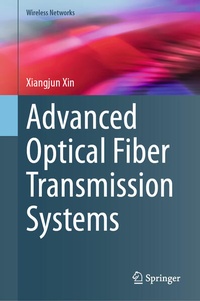
Advanced Optical Fiber Transmission Systems
Description

This book delves deeply into the key technologies and cutting-edge advancements of advanced optical fiber transmission systems. It focuses on the innovative methods and practical applications in core areas such as coding, modulation, amplification, equalization, and nonlinear compensation of optical fiber communication systems against the backdrop of high-speed and high-capacity communication demands. The book also systematically presents a comprehensive overview of optical fiber communication from fundamental theories to the latest technological developments, with particular emphasis on breakthroughs in high-order modulation, multi-dimensional signal processing, and artificial intelligence-assisted technologies.
Chapter 1, readers learn the historical background of optical fiber communication, its system architecture, and its core position in modern communication networks. Chapter 2 delves into advanced coding techniques, including probabilistic shaping, LDPC coding, and adaptive RS coding, which enhance system reliability and spectral efficiency. Chapter 3 focuses on advanced modulation techniques such as symbol slicing and multiplexing, Delta-Sigma modulation, and 4D ultra-high-order modulation, significantly increasing transmission capacity and system performance. Chapter 4 specifically introduces the basic principles of Raman amplifiers, pump configurations, and their crucial role in long-distance transmission. Chapter 5 covers modulation format recognition and OSNR monitoring technologies, combined with machine learning methods to achieve intelligent signal processing. Chapter 6 discusses advanced equalization techniques, including phase estimation based on principal component analysis and nonlinear compensation algorithms. Chapter 7 explores nonlinear compensation methods based on artificial intelligence, such as weighted K-means clustering and Gaussian mixture models, laying the foundation for the next generation of intelligent optical networks.
This book is suitable for researchers, engineers, senior undergraduates, and postgraduates in the field of optical communication. It aims to provide readers with a comprehensive technical perspective from the basics to the cutting-edge, promoting the continuous development of optical fiber communication technology in terms of capacity, distance, and intelligence.
More details
Other editions
Additional editions
Person
Xiangjun Xin received the PhD degree from the School of Electric Engineering, Beijing University of Posts and Telecommunications (BUPT), Beijing, China, in 2003. He is currently a professor at Beijing Institute of Technology. His research focuses on broadband optical transmission technologies, optical sensors, all-optical networking, and satellite communication networks. In these areas, he has authored numerous high-level papers in prestigious peer-reviewed journals and conferences, and holds dozens of authorized patents.
Content
Chapter 1 Introduction.- Chapter 2 Advanced Coding Technology.- Chapter 3 Advanced Modulation Technology.- Chapter 4 Raman Amplifier.- Chapter 5 Advanced Modulation Format Recognition technology.- Chapter 6 Advanced Equalization technology.- Chapter 7 Nonlinear Compensation Technology Based on Artificial Intelligence.
