

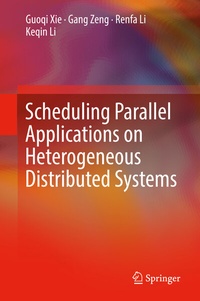
Scheduling Parallel Applications on Heterogeneous Distributed Systems
Description

The book offers a comprehensive and systematic treatment of high-performance, low energy consumption, and high reliability issues on heterogeneous distributed systems, making it a particularly valuable resource for researchers, engineers and graduate students in the fields of computer science and engineering, information science and engineering, and automotive engineering, etc. The wealth of motivational examples with figures and tables make it easy to understand.
More details
Other editions
Additional editions
Persons
Guoqi Xie received his Ph.D. degree in computer science and engineering from Hunan University, China, in 2014. He is currently an Assistant Professor and a Yuelu Scholar at Hunan University. He was a Postdoctoral Researcher at Nagoya University, Japan, from 2014 to 2015, and at Hunan University, from 2015 to 2017. He has received the best paper award from ISPA 2016. His major interests include embedded and cyber-physical systems, parallel and distributed systems, software engineering and methodology. He is a member of IEEE, ACM, and CCF.
Gang Zeng is an Associate Professor at the Graduate School of Engineering, Nagoya University. He received his Ph.D. degree in Information Science from Chiba University in 2006. From 2006 to 2010, he was a Researcher, and then Assistant Professor at the Center for Embedded Computing Systems (NCES), the Graduate School of Information Science, Nagoya University. His research interests mainly include power-aware computing and real-time embeddedsystem design. He is a member of IEEE, IPSJ and IEICE.
Renfa Li is a Professor of computer science and electronic engineering, Hunan University, China. He is the Director of the Key Laboratory for Embedded and Network Computing of Hunan Province, China. His major interests include computer architectures, embedded computing systems, cyber-physical systems, and Internet of things. He is a member of the council of CCF, a senior member of IEEE, and a senior member of ACM.
Keqin Li is a SUNY Distinguished Professor of computer science. His current research interests include parallel computing and high-performance computing, distributed computing, energy-efficient computing and communication, heterogeneous computing systems, cloud computing, big data computing, CPU-GPU hybrid and cooperative computing, multicore computing, storage and file systems, wireless communication networks, sensor networks, peer-to-peer file sharing systems, mobile computing, service computing, Internet of things and cyber-physical systems. He has published over 490 journal articles, book chapters, and refereed conference papers, and has received several best paper awards. He is currently or has served on the editorial boards of IEEE Transactions on Parallel and Distributed Systems, IEEE Transactions on Computers, IEEE Transactions on Cloud Computing, IEEE Transactions on Services Computing, IEEE Transactions on Sustainable Computing. He is an IEEE Fellow.
