

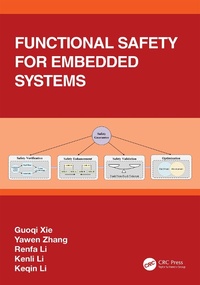
Functional Safety for Embedded Systems
1st Edition
Published on 28. June 2023
182 pages
978-1-000-88134-9 (ISBN)
Description

This book uses automotive embedded systems as an example to introduce functional safety assurance and safety-aware cost optimization. The book explores functional safety assurance from the perspectives of verification, enhancement, and validation.
The functional safety assurance methods implement a safe and efficient assurance system that integrates safety verification, enhancement, and validation. The assurance methods offered in this book could provide a reasonable and scientific theoretical basis for the subsequent formulation of automotive functional safety standards. The safety-aware cost optimization methods divide cost types according to the essential differences of various costs in system design and establish reasonable models based on different costs. The cost optimization methods provided in this book could give appropriate cost optimization solutions for the cost-sensitive automotive industry, thereby achieving effective cost management and control. Functional safety assurance methods and safety-aware cost optimization support each other and jointly build the architecture of functional safety design methodologies for automotive embedded systems.
The work aspires to provide a relevant reference for students, researchers, engineers, and professionals working in this area or those interested in hardware cost optimization and development cost optimization design methods based on ensuring functional safety in general.
The functional safety assurance methods implement a safe and efficient assurance system that integrates safety verification, enhancement, and validation. The assurance methods offered in this book could provide a reasonable and scientific theoretical basis for the subsequent formulation of automotive functional safety standards. The safety-aware cost optimization methods divide cost types according to the essential differences of various costs in system design and establish reasonable models based on different costs. The cost optimization methods provided in this book could give appropriate cost optimization solutions for the cost-sensitive automotive industry, thereby achieving effective cost management and control. Functional safety assurance methods and safety-aware cost optimization support each other and jointly build the architecture of functional safety design methodologies for automotive embedded systems.
The work aspires to provide a relevant reference for students, researchers, engineers, and professionals working in this area or those interested in hardware cost optimization and development cost optimization design methods based on ensuring functional safety in general.
More details
Edition
1. Auflage
Language
English
Place of publication
London
United Kingdom
Publishing group
Taylor & Francis Ltd
Target group
College/higher education
Professional and scholarly
Product notice
Reflowable
Illustrations
55 Tables, black and white; 50 Line drawings, black and white; 50 Illustrations, black and white
ISBN-13
978-1-000-88134-9 (9781000881349)
Copyright in bibliographic data and cover images is held by Nielsen Book Services Limited or by the publishers or by their respective licensors: all rights reserved.
Schweitzer Classification
Other editions
Additional editions
Guoqi Xie | Yawen Zhang | Renfa Li
Functional Safety for Embedded Systems
Book
12/2024
1st Edition
CRC Press
€67.40
Shipment within 10-20 days
Guoqi Xie | Yawen Zhang | Renfa Li
Functional Safety for Embedded Systems
Book
06/2023
1st Edition
CRC Press
€124.90
Shipment within 10-20 days
Persons
Guoqi Xie is currently a Professor with Hunan University. He received the Ph.D. degree in computer science and engineering from Hunan University, China, in 2014. He was a postdoctoral research fellow with Nagoya University, Japan. His current research interests include real-time systems, embedded system safety and security, and automotive software. He received the 2018 IEEE TCSC Early Career Researcher Award. He is an IEEE senior member and ACM senior member.
Yawen Zhang is currently pursuing a master's degree in electronic information with Hunan University, China. She is a member of the Key Laboratory for Embedded and Network Computing of Hunan Province, China. Her current research interests include embedded and cyber-physical systems, parallel and distributed systems, and functional safety of automotive embedded systems.
Renfa Li is a Professor of computer science and electronic engineering with Hunan University, Changsha, China. He is the Director of the Key Laboratory for Embedded and Network Computing of Hunan Province, China. He is also an expert committee member of the National Supercomputing Center, Changsha. His major interests include computer architectures, embedded computing systems, cyber-physical systems, and Internet of things. Dr. Li is a member of the council of the China Computer Federation and a senior member of the Association for Computing Machinery.
Kenli Li is currently the dean and a full professor of computer science and technology with Hunan University and the director of National Supercomputing Center in Changsha. His major research areas include parallel and distributed computing, edge computing, high-performance computing, grid, and cloud computing. He has published over 160 research papers in international conferences and journals. He is also a senior member of the IEEE.
Keqin Li is a SUNY Distinguished Professor of computer science with the State University of New York. He is also a National Distinguished Professor with Hunan University, China. His current research interests include cloud computing, fog computing and mobile edge computing, energy-efficient computing and communication, embedded systems, and cyber-physical systems. He is among the world's top five most influential scientists in parallel and distributed computing based on a composite indicator of the Scopus citation database. He is also an IEEE senior member.
Yawen Zhang is currently pursuing a master's degree in electronic information with Hunan University, China. She is a member of the Key Laboratory for Embedded and Network Computing of Hunan Province, China. Her current research interests include embedded and cyber-physical systems, parallel and distributed systems, and functional safety of automotive embedded systems.
Renfa Li is a Professor of computer science and electronic engineering with Hunan University, Changsha, China. He is the Director of the Key Laboratory for Embedded and Network Computing of Hunan Province, China. He is also an expert committee member of the National Supercomputing Center, Changsha. His major interests include computer architectures, embedded computing systems, cyber-physical systems, and Internet of things. Dr. Li is a member of the council of the China Computer Federation and a senior member of the Association for Computing Machinery.
Kenli Li is currently the dean and a full professor of computer science and technology with Hunan University and the director of National Supercomputing Center in Changsha. His major research areas include parallel and distributed computing, edge computing, high-performance computing, grid, and cloud computing. He has published over 160 research papers in international conferences and journals. He is also a senior member of the IEEE.
Keqin Li is a SUNY Distinguished Professor of computer science with the State University of New York. He is also a National Distinguished Professor with Hunan University, China. His current research interests include cloud computing, fog computing and mobile edge computing, energy-efficient computing and communication, embedded systems, and cyber-physical systems. He is among the world's top five most influential scientists in parallel and distributed computing based on a composite indicator of the Scopus citation database. He is also an IEEE senior member.
Content
1. Introduction Section I: FUNCTIONAL SAFETY ASSURANCE 2. Functional Safety Verification 3. Functional Safety Enhancement 4. Functional Safety Validation Section II SAFETY-AWARE COST OPTIMIZATION 5. Hardware Cost Optimization 6. Development Cost Optimization 7. Summary and Future Research
