

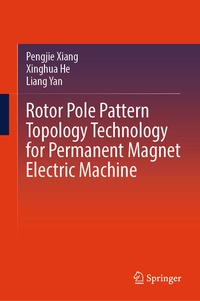
Rotor Pole Pattern Topology Technology for Permanent Magnet Electric Machine
Description

This book is dedicated to rotor pole pattern topology technology for permanent magnet (PM) synchronous machines, presenting a comprehensive introduction to various pole patterns categorized by their functions and application scenarios. These patterns not only effectively reduce torque ripple and enhance torque performance but also significantly increase the utilization of permanent magnets, thereby improving the efficiency of permanent magnet machines. Additionally, the book proposes two multi-objective optimization methods focused on material usage and efficiency to further enhance machine output performance. It systematically covers theoretical studies, numerical simulations, design optimization, and experimental work, offering a holistic perspective on the subject. The design concepts and analytical approaches presented can be readily applied to other linear and rotary machines with similar structures. This book will appeal to academics, researchers, R&D engineers, and graduate students in electronic and mechanical engineering who seek to understand the fundamental principles, methodologies, and applications of linear and rotary machines.
More details
Other editions
Additional editions
Persons
Pengjie Xiang received the B.S. degree in engineering from the Lanzhou University of Technology, Lanzhou, China, in 2020. He is currently working toward the Ph.D. degree in mechatronics from Beihang University, Beijing, China. His research interests include the design and control of permanent-magnet machines.
Liang Yan is the corresponding author for this book. Prof. Liang Yan(Senior Member, IEEE) received the B.S. degree from the North China Institute of Technology, Taiyuan, China, in 1995, the M.S. degree from the Beijing Institute of Technology, Beijing, China, in 1998, and the Ph.D. degree in mechatronics from Nanyang Technology University (NTU), Singapore, in 2006. He is currently with Beihang University, Beijing, China, as a Professor. His main research interests include robotics, actuators and mechatronic systems. Dr. Yan is the Member of Electrical Machines Technical Committee with IEEE Industrial Electronics Society.
Xinghua He received the B.S. and M.S. degrees in engineering from Liaoning Technical University, Fuxin, China, in 2014 and 2017, respectively. He is currently working toward the Ph.D. degree in mechatronics from Beihang University, Beijing, China. His research interests include electromagnetic actuators and permanent magnet machines.
Content
Chapter 1 Introduction.- Chapter 2 The Methods to Reduce Torque Ripple without Compromising the Average Torque.- Chapter 3 The Methods to Improve Output Characteristics while Controlling Vibration Char-acteristics.
