

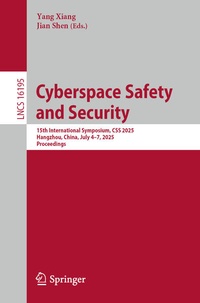
Cyberspace Safety and Security
Description

This book constitutes the proceedings of the 15th International Symposium on Cyberspace Safety and Security, CSS 2025, held in Hangzhou, China, on February 24, 2025.
The 28 full papers were presented in this volume were carefully reviewed and selected from 112 submissions. This conference focuses on Cyberspace Safety and Security, such as authentication, access control, availability, integrity, privacy, confidentiality, dependability and sustainability issues of cyberspace.
More details
Other editions
Additional editions
Content
.- Dynamic spectrum sharing scheme for anti-malicious user's queries based on blockchain.
.- Internet of Vehicle Privacy Protection Solution Based on Blockchain and Zero Knowledge Proof.
.- A New Asymmetric Three-Party Key Agreement Protocol Based on Secure Multiparty Computation.
.- TCAu:Time-Controllable Air-Space-Ground Authentication.
.- A NIZK-Based Linkable Ring Signature Scheme for Anonymous Blockchain System on Lattice.
.- CP-ABZP: A CP-ABE Cross-chain Privacy Protection Scheme Combined with Zero-Knowledge Proof.
.- A Novel Dual-layer Access Control Model based on Blockchain for the Case-involved Property Management.
.- MUSES: Secure Multi-User Encrypted Speech Search in Cloud-Edge-End Environments.
.- Efficient Group Key Management for Vehicle Ad Hoc Networks.
.- Privacy-Preserving Machine Learning Using Functional Encryptions for Multiple Models with Constant Ciphertext.
.- A Privacy-preserving Delegable Auditing Scheme with Edge-assisted Deduplication in IoT.
.- A Multi-KGC Certificateless Anonymous Cloud Sharing Scheme with Threshold-based Traceability.
.- A Differential Privacy Approach to Optimization for Protecting Large Models.
.- Unifying Physical-Layer Security and Post-Quantum Cryptography: An Optimized Authentication Encryption Protocol.
.- Anonymous Batch Authentication and Key Agreement for Internet of Things.
.- A lightweight Privacy-Preserving kNN Query Framework via Secret Sharing in Cloud Computing.
.- BiLSTMTimeGAN: Enhancing Side-Channel Attacks through Temporal Data Augmentation.
.- An encrypted anomaly traffic detection method integrating adversarial training and multi-scale contrastive learning.
.- MGtest: Python Coverage-Guided Model-Level Fuzzing for DL frameworks.
.- Collaborative Physical Layer Authentication for Vehicular Networks based on Dempster-Shafer Evidence Theory.
.- A Survey of Kernel Fuzzing.
.- Federated Learning against Dynamic Mixed Poisoning Attack and its Defense.
.- Robust Fake Image Detection via Incremental Training of Siamese Neural Networks.
.- Advancing Deepfake Detection through Head Pose Estimation on New-Generation Datasets.
.- A Verifiable and Privacy-Preserving Credit Risk Prediction under Secure Neural Network Scheme.
.- Security Assessment in Optical Networks: A Path Graph-based Framework for Attack-Induced Fault Diagnosis.
.- Machine Learning Model Construction and Multi-Dimensional Evaluation for Pop-up Text Sentiment Analysis.
.- Enhancing Double Ratchet Algorithm with Pre-Shared Key Mechanism and Optimal KDF Selection.
