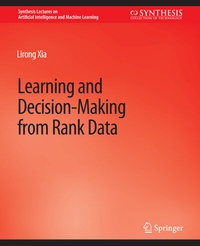
Learning and Decision-Making from Rank Data
Description

The ubiquitous challenge of learning and decision-making from rank data arises in situations where intelligent systems collect preference and behavior data from humans, learn from the data, and then use the data to help humans make efficient, effective, and timely decisions. Often, such data are represented by rankings .
This book surveys some recent progress toward addressing the challenge from the considerations of statistics, computation, and socio-economics. We will cover classical statistical models for rank data, including random utility models, distance-based models, and mixture models. We will discuss and compare classical and state-of-the-art algorithms, such as algorithms based on Minorize-Majorization (MM), Expectation-Maximization (EM), Generalized Method-of-Moments (GMM), rank breaking, and tensor decomposition. We will also introduce principled Bayesian preference elicitation frameworks for collecting rank data. Finally, we will examine socio-economic aspects of statistically desirable decision-making mechanisms, such as Bayesian estimators.
This book can be useful in three ways: (1) for theoreticians in statistics and machine learning to better understand the considerations and caveats of learning from rank data, compared to learning from other types of data, especially cardinal data; (2) for practitioners to apply algorithms covered by the book for sampling, learning, and aggregation; and (3) as a textbook for graduate students or advanced undergraduate students to learn about the field.
This book requires that the reader has basic knowledge in probability, statistics, and algorithms. Knowledge in social choice would also help but is not required.
More details
Other editions
Additional editions