

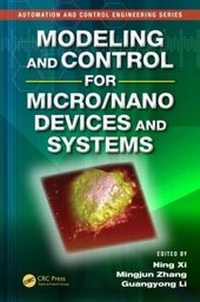
Modeling and Control for Micro/Nano Devices and Systems
1st Edition
Published on 19. December 2017
175 pages
978-1-4665-5406-1 (ISBN)
Description

Micro/nano-scale engineering-especially the design and implementation of ultra-fast and ultra-scale energy devices, sensors, and cellular and molecular systems-remains a daunting challenge. Modeling and control has played an essential role in many technological breakthroughs throughout the course of history. Therefore, the need for a practical guide to modeling and control for micro/nano-scale devices and systems has emerged.
The first edited volume to address this rapidly growing field, Modeling and Control for Micro/Nano Devices and Systems gives control engineers, lab managers, high-tech researchers, and graduate students easy access to the expert contributors' cutting-edge knowledge of micro/nanotechnology, energy, and bio-systems. The editors offer an integrated view from theory to practice, covering diverse topics ranging from micro/nano-scale sensors to energy devices and control of biology systems in cellular and molecular levels. The book also features numerous case studies for modeling of micro/nano devices and systems, and explains how the models can be used for control and optimization purposes. Readers benefit from learning the latest modeling techniques for micro/nano-scale devices and systems, and then applying those techniques to their own research and development efforts.
The first edited volume to address this rapidly growing field, Modeling and Control for Micro/Nano Devices and Systems gives control engineers, lab managers, high-tech researchers, and graduate students easy access to the expert contributors' cutting-edge knowledge of micro/nanotechnology, energy, and bio-systems. The editors offer an integrated view from theory to practice, covering diverse topics ranging from micro/nano-scale sensors to energy devices and control of biology systems in cellular and molecular levels. The book also features numerous case studies for modeling of micro/nano devices and systems, and explains how the models can be used for control and optimization purposes. Readers benefit from learning the latest modeling techniques for micro/nano-scale devices and systems, and then applying those techniques to their own research and development efforts.
Reviews / Votes
"The chapter authors are well-known researchers and the content is well organized and fits tightly together. In this emerging and fast-developing field, the fact that the book is an edited volume ... allows [it] to cover new topics that are still currently under research."- Frank L. Lewis, Automation and Robotics Research Institute, University of Texas at Arlington, USA
"I am convinced there is a strong need for a book on modeling and control of nano-scale devices, as this is a new, emerging area, and one for which there are no good books."
- Declan Bates, University of Leeds, UK
"... micro/nano devices and systems [is] a field that is expected to continue its rapid expansion. This is an excellent review with top-notch authors [and] broad coverage, and [it is] timely ... there is no competition, since this book is one of a kind."
- Hong Zhang, University of Alberta, Edmonton, Canada
More details
Series
Language
English
Place of publication
Baton Rouge
United States
Publishing group
Taylor & Francis Inc
Target group
College/higher education
Control engineers, researchers, and postgraduate students in systems biology.
Illustrations
63 s/w Abbildungen, 6 s/w Tabellen
6 Tables, black and white; 63 Illustrations, black and white
File size
6,14 MB
ISBN-13
978-1-4665-5406-1 (9781466554061)
Copyright in bibliographic data and cover images is held by Nielsen Book Services Limited or by the publishers or by their respective licensors: all rights reserved.
Schweitzer Classification
Other editions
Additional editions
Ning Xi | Mingjun Zhang | Guangyong Li
Modeling and Control for Micro/Nano Devices and Systems
Book
03/2017
1st Edition
CRC Press
€95.80
Shipment within 10-20 days
Ning Xi | Mingjun Zhang | Guangyong Li
Modeling and Control for Micro/Nano Devices and Systems
Book
12/2013
1st Edition
CRC Press
€231.20
Shipment within 15-20 days
Persons
Author of several award-winning papers in conference proceedings and recognized journals in his field, Ning Xi is the head and chair professor of the department of mechanical and biomedical engineering at City University of Hong Kong, Peoples' Republic of China. Previously he was a university distinguished professor and John D. Ryder professor of electrical and computer engineering at Michigan State University, East Lansing, USA, where he also served as the director of the robotics and automation laboratory. He received his D.Sc in systems science and mathematics from Washington University, St. Louis, Missouri, USA.
Guangyong Li is an associate professor in the department of electrical and computer engineering at University of Pittsburgh, Pennsylvania, USA. He received his Ph. D in electrical engineering from Michigan State University, East Lansing, USA. He has published numerous papers in peer-reviewed journals and conference proceedings on nanorobotic manipulation, nanoscale characterization, and multiscale simulation of organic solar cells.
A recipient of the U.S. Office of Naval Research's Young Investigator Award and the IEEE Robotics and Automation Society's Early Career Award, Mingjun Zhang is an associate professor at the University of Tennessee, Knoxville, USA. Research results from his group have been published in and highlighted by numerous journals in his field. He received his D.Sc from Washington University, St. Louis, Missouri, and his Ph.D from Zhejiang University, Hangzhou, Peoples' Republic of China.
Guangyong Li is an associate professor in the department of electrical and computer engineering at University of Pittsburgh, Pennsylvania, USA. He received his Ph. D in electrical engineering from Michigan State University, East Lansing, USA. He has published numerous papers in peer-reviewed journals and conference proceedings on nanorobotic manipulation, nanoscale characterization, and multiscale simulation of organic solar cells.
A recipient of the U.S. Office of Naval Research's Young Investigator Award and the IEEE Robotics and Automation Society's Early Career Award, Mingjun Zhang is an associate professor at the University of Tennessee, Knoxville, USA. Research results from his group have been published in and highlighted by numerous journals in his field. He received his D.Sc from Washington University, St. Louis, Missouri, and his Ph.D from Zhejiang University, Hangzhou, Peoples' Republic of China.
Content
On the Principles of Quantum Control Theory. Modeling and Simulation of Silicon Nanowire-Based Biosensors. Modeling and Simulation of Organic Photovoltaic Cells. Optimization of Organic Photovoltaic Cells. Developing a Dynamics Model for Epidermal Growth Factor (EGF)-Induced Cellular Signaling Events. Modeling and Experimental Verifications of Cell Tensegrity. Modeling Swimming Micro/Nano-Systems in Low Reynolds Number. Modeling and Analysis of the Cellular Mechanics Involved in the Pathophysiology of Disease/Injury. Hybrid Control for Micro/Nano Devices and Systems.
