

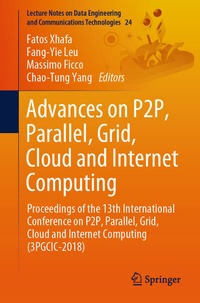
Advances on P2P, Parallel, Grid, Cloud and Internet Computing
Description

This book presents the latest research findings, as well as innovative theoretical and practical research results, methods and development techniques related to P2P, grid, cloud and Internet computing. It also reveals the synergies among such large scale computing paradigms.
P2P, Grid, Cloud and Internet computing technologies have rapidly become established as breakthrough paradigms for solving complex problems by enabling aggregation and sharing of an increasing variety of distributed computational resources on a large scale.
Grid computing originated as a paradigm for high-performance computing, offering an alternative to expensive supercomputers through different forms of large-scale distributed computing. P2P computing emerged as a new paradigm following on from client-server and web-based computing and has proved useful in the development of social networking, B2B (Business to Business), B2C (Business to Consumer), B2G (Business to Government), and B2E (Business to Employee). Cloud computing has been described as a "computing paradigm where the boundaries of computing are determined by economic rationale rather than technical limits". Cloud computing has fast become the computing paradigm with applicability and adoption in all domains and providing utility computing at large scale. Lastly, Internet computing is the basis of any large-scale distributed computing paradigm; it has very quickly developed into a vast and flourishing field with enormous impact on today's information societies and serving as a universal platform comprising a large variety of computing forms such as grid, P2P, cloud and mobile computing.
More details
Other editions
Additional editions
Content
Fault-tolerant Fog Computing Models in the IoT.- Semi-synchronocity Enabling Protocol and Pulsed Injection Protocol for a Distributed Ledger System.- Texture Estimation System of Snacks Using Neural Network Considering Sound and Load.- A Real-time Fog Computing Approach for Healthcare Environment.- A Model for Data Enrichment over IoT Streams at Edges of Internet.- Threshold Based Load Balancer for Efficient Resource Utilization of Smart Grid Using Cloud Computing.- A Fuzzy-based System for Selection of IoT Devices in Opportunistic Networks Considering Number of Past Encounters.- Hill Climbing Load Balancing Algorithm on Fog Computing.
