

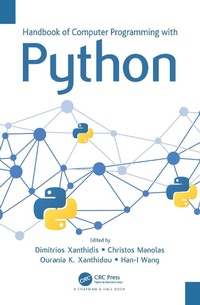
Handbook of Computer Programming with Python
1st Edition
Published on 12. December 2022
630 pages
978-1-000-61955-3 (ISBN)
Description

This handbook provides a hands-on experience based on the underlying topics, and assists students and faculty members in developing their algorithmic thought process and programs for given computational problems. It can also be used by professionals who possess the necessary theoretical and computational thinking background but are presently making their transition to Python.
Key Features:
Discusses concepts such as basic programming principles, OOP principles, database programming, GUI programming, application development, data analytics and visualization, statistical analysis, virtual reality, data structures and algorithms, machine learning, and deep learning
Provides the code and the output for all the concepts discussed
Includes a case study at the end of each chapter
This handbook will benefit students of computer science, information systems, and information technology, or anyone who is involved in computer programming (entry-to-intermediate level), data analytics, HCI-GUI, and related disciplines.
Key Features:
Discusses concepts such as basic programming principles, OOP principles, database programming, GUI programming, application development, data analytics and visualization, statistical analysis, virtual reality, data structures and algorithms, machine learning, and deep learning
Provides the code and the output for all the concepts discussed
Includes a case study at the end of each chapter
This handbook will benefit students of computer science, information systems, and information technology, or anyone who is involved in computer programming (entry-to-intermediate level), data analytics, HCI-GUI, and related disciplines.
More details
Edition
1. Auflage
Language
English
Place of publication
London
United Kingdom
Publishing group
Taylor & Francis Ltd
Target group
Professional and scholarly
Illustrations
58 Tables, black and white; 252 Line drawings, color; 207 Line drawings, black and white; 252 Illustrations, color; 207 Illustrations, black and white
ISBN-13
978-1-000-61955-3 (9781000619553)
Copyright in bibliographic data and cover images is held by Nielsen Book Services Limited or by the publishers or by their respective licensors: all rights reserved.
Schweitzer Classification
Other editions
Additional editions
Dimitrios Xanthidis | Christos Manolas | Ourania K. Xanthidou
Handbook of Computer Programming with Python
Book
12/2024
1st Edition
Chapman & Hall/CRC
€68.00
Shipment within 15-20 days
Dimitrios Xanthidis | Christos Manolas | Ourania K. Xanthidou
Handbook of Computer Programming with Python
Book
12/2022
1st Edition
Chapman & Hall/CRC
€139.60
Shipment within 15-20 days
Persons
Dimitrios Xanthidis holds a PhD in Information Systems from University College London. For the past 25 years, he has been teaching computer science subjects with a focus on programming and software development, and data structures and databases in various tertiary education institutions. Currently, he is working in Higher Colleges of Technology in Dubai, U.A.E. Dimitrios' research interests and work revolve around the topics of data science, machine learning/deep learning, virtual/augmented reality, and emerging technologies.
Christos Manolas holds a PhD in Stereoscopic 3D Media (University of York, UK), and degrees and qualifications in Postproduction (MA), Music Technology (MSc), Music Performance, Software Development, and Media Production. Christos' career includes work as a software developer, musician, audio producer, and educator for over 20 years. His research interests include multimodal (audiovisual) perception, spatial audio, interactive and immersive media (VR/AR/XR), and generally the impact and role of digital technologies on media production.
Ourania K. Xanthidou is a PhD researcher at Brunel University, London. She holds an MSc in Computer Science from the University of Malaya, Kuala Lumpur, Malaysia. She has more than 15 years of involvement with the IT industry in the form of supporting IT departments of SMEs and more than 5 years of teaching experience in tertiary education. Ourania's research interests are in the areas of eHealth, smart health, databases, web application development, and object-oriented programming with a focus on application development for VR/AR/XR.
Han-I Wang holds a PhD in Health Economics from the University of York, UK. Han-I has been working as a research fellow for over 10 years, starting at the Epidemiology & Cancer Statistics Group (ECSG) before joining the Mental Health and Addiction Research Group (MHARG) at the University of York, UK. Her area of expertise spans across cost analysis, health outcome research, and decision modeling using complex patient-level data, and her main research interests are related with the exploration of different decision-modeling techniques and their application to predict healthcare expenditure, patients' quality of life, and life expectancy.
Christos Manolas holds a PhD in Stereoscopic 3D Media (University of York, UK), and degrees and qualifications in Postproduction (MA), Music Technology (MSc), Music Performance, Software Development, and Media Production. Christos' career includes work as a software developer, musician, audio producer, and educator for over 20 years. His research interests include multimodal (audiovisual) perception, spatial audio, interactive and immersive media (VR/AR/XR), and generally the impact and role of digital technologies on media production.
Ourania K. Xanthidou is a PhD researcher at Brunel University, London. She holds an MSc in Computer Science from the University of Malaya, Kuala Lumpur, Malaysia. She has more than 15 years of involvement with the IT industry in the form of supporting IT departments of SMEs and more than 5 years of teaching experience in tertiary education. Ourania's research interests are in the areas of eHealth, smart health, databases, web application development, and object-oriented programming with a focus on application development for VR/AR/XR.
Han-I Wang holds a PhD in Health Economics from the University of York, UK. Han-I has been working as a research fellow for over 10 years, starting at the Epidemiology & Cancer Statistics Group (ECSG) before joining the Mental Health and Addiction Research Group (MHARG) at the University of York, UK. Her area of expertise spans across cost analysis, health outcome research, and decision modeling using complex patient-level data, and her main research interests are related with the exploration of different decision-modeling techniques and their application to predict healthcare expenditure, patients' quality of life, and life expectancy.
Content
Chapter 1 Introduction
Dimitrios Xanthidis, Christos Manolas, Ourania K. Xanthidou, and Han-I Wang
Chapter 2 Introduction to Programming with Python
Ameur Bensefia, Muath Alrammal, and Ourania K. Xanthidou
Chapter 3 Object-Oriented Programming in Python
Ghazala Bilquise, Thaeer Kobbaey, and Ourania K. Xanthidou
Chapter 4 Graphical User Interface Programming with Python
Ourania K. Xanthidou, Dimitrios Xanthidis, and Sujni Paul
Chapter 5 Application Development with Python
Dimitrios Xanthidis, Christos Manolas, and Hanene Ben-Abdallah
Chapter 6 Data Structures and Algorithms with Python
Thaeer Kobbaey, Dimitrios Xanthidis, and Ghazala Bilquise
Chapter 7 Database Programming with Python
Dimitrios Xanthidis, Christos Manolas, and Tareq Alhousary
Chapter 8 Data Analytics and Data Visualization with Python
Dimitrios Xanthidis, Han-I Wang, and Christos Manolas
Chapter 9 Statistical Analysis with Python
Han-I Wang, Christos Manolas, and Dimitrios Xanthidis
Chapter 10 Machine Learning with Python
Muath Alrammal, Dimitrios Xanthidis, and Munir Naveed
Chapter 11 Introduction to Neural Networks and Deep Learning
Dimitrios Xanthidis, Muhammad Fahim, and Han-I Wang
Chapter 12 Virtual Reality Application Development with Python
Christos Manolas, Ourania K. Xanthidou, and Dimitrios Xanthidis
Appendix: Case Studies Solutions
Dimitrios Xanthidis, Christos Manolas, Ourania K. Xanthidou, and Han-I Wang
Chapter 2 Introduction to Programming with Python
Ameur Bensefia, Muath Alrammal, and Ourania K. Xanthidou
Chapter 3 Object-Oriented Programming in Python
Ghazala Bilquise, Thaeer Kobbaey, and Ourania K. Xanthidou
Chapter 4 Graphical User Interface Programming with Python
Ourania K. Xanthidou, Dimitrios Xanthidis, and Sujni Paul
Chapter 5 Application Development with Python
Dimitrios Xanthidis, Christos Manolas, and Hanene Ben-Abdallah
Chapter 6 Data Structures and Algorithms with Python
Thaeer Kobbaey, Dimitrios Xanthidis, and Ghazala Bilquise
Chapter 7 Database Programming with Python
Dimitrios Xanthidis, Christos Manolas, and Tareq Alhousary
Chapter 8 Data Analytics and Data Visualization with Python
Dimitrios Xanthidis, Han-I Wang, and Christos Manolas
Chapter 9 Statistical Analysis with Python
Han-I Wang, Christos Manolas, and Dimitrios Xanthidis
Chapter 10 Machine Learning with Python
Muath Alrammal, Dimitrios Xanthidis, and Munir Naveed
Chapter 11 Introduction to Neural Networks and Deep Learning
Dimitrios Xanthidis, Muhammad Fahim, and Han-I Wang
Chapter 12 Virtual Reality Application Development with Python
Christos Manolas, Ourania K. Xanthidou, and Dimitrios Xanthidis
Appendix: Case Studies Solutions
