

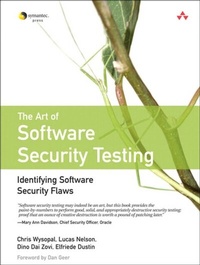
Art of Software Security Testing, The
Description

State-of-the-Art Software Security Testing: Expert, Up to Date, and Comprehensive
The Art of Software Security Testing delivers in-depth, up-to-date, battle-tested techniques for anticipating and identifying software security problems before the "bad guys" do.
Drawing on decades of experience in application and penetration testing, this book's authors can help you transform your approach from mere "verification" to proactive "attack." The authors begin by systematically reviewing the design and coding vulnerabilities that can arise in software, and offering realistic guidance in avoiding them. Next, they show you ways to customize software debugging tools to test the unique aspects of any program and then analyze the results to identify exploitable vulnerabilities.
Coverage includes
- Tips on how to think the way software attackers think to strengthen your defense strategy
- Cost-effectively integrating security testing into your development lifecycle
- Using threat modeling to prioritize testing based on your top areas of risk
- Building testing labs for performing white-, grey-, and black-box software testing
- Choosing and using the right tools for each testing project
- Executing today's leading attacks, from fault injection to buffer overflows
- Determining which flaws are most likely to be exploited by real-world attackers
All prices
More details
Other editions
Additional editions
Persons
Chris Wysopal is cofounder and CTO of Veracode, where he is responsible for the software security analysis capabilities of Veracode's technology. Previously he was vice president of research and development at @stake. As a member of the groundbreaking security research think tank L0pht Heavy Industries, he and his colleagues testified to the U.S. Senate that they could "take down the Internet in 30 minutes." They were praised as "modern-day Paul Reveres" by the senators for their research and warnings of computer security weaknesses. Wysopal has also testified to the U.S. House of Representatives and has spoken at the Defense Information Systems Agency (DISA), Black Hat, and West Point. He is coauthor of L0phtCrack, the password auditor used by more than 6,000 government, military, and corporate organizations worldwide. He earned his bachelor of science degree in computer and systems engineering from Rensselaer Polytechnic Institute in Troy, New York.
Lucas Nelson is the technical manager for Symantec's New York region, where he is responsible for all aspects of security consulting services delivery. Within Symantec he also leads the Application Security Center of Excellence, which develops application security practices and guidelines and trains new hires in the methodology of application testing. He has taught a number of classes on both attacking and defending computer systems to several groups, including state governments and large financial institutions. Nelson worked as a developer specializing in security for a number of small startups before joining Symantec/ @stake in 2002. He researched computer security at Purdue University's CERIAS lab under the guidance of professor Eugene Spafford, graduating with a degree in computer science.
Dino A. Dai Zovi is a principal member of Matasano Security, where he performs ShipSafe product penetration tests for software vendors and DeploySafe third-party software penetration tests for enterprise clients. He specializes in product, application, and operating system penetration testing and has done so in his previous roles at Bloomberg, @stake, and Sandia National Laboratories. He is also a frequent speaker on his computer security research, including presentations at the Black Hat Briefings, IEEE Information Assurance Workshop, Microsoft's internal Blue Hat Security Briefings, CanSecWest, and DEFCON. He graduated with honors with a bachelor of science in computer science and a minor in mathematics from the University of New Mexico.
Elfriede Dustin is author of Effective Software Testing and lead author of Automated Software Testing and Quality Web Systems, books that have been translated into various languages and that have sold tens of thousands of copies throughout the world. The Automated Testing Lifecycle Methodology (ATLM) described in Automated Software Testing has been implemented in various companies throughout the world. Dustin has written various white papers on software testing. She teaches various testing tutorials and is a frequent speaker at software testing conferences. In support of software test efforts, Dustin has been responsible for implementing automated test and has acted as the lead consultant/manager guiding the implementation of automated and manual software testing efforts. She is cochair of VERIFY, an annual international software testing conference held in the Washington, DC area. Dustin has a bachelor of science in computer science. She has more than 15 years of IT experience and currently works as an independent consultant in the Washington, DC area. You can reach her via her Web site at www.effectivesoftwaretesting.com.
Content
Foreword xiii
Preface xvii
Acknowledgments xxix
About the Authors xxxi
Part I: Introduction
Chapter 1: Case Your Own Joint: A Paradigm Shift from Traditional Software Testing 3
Chapter 2: How Vulnerabilities Get Into All Software 19
Chapter 3: The Secure Software Development Lifecycle 55
Chapter 4: Risk-Based Security Testing: Prioritizing Security Testing with Threat Modeling 73
Chapter 5: Shades of Analysis: White, Gray, and Black Box Testing 93
Part II: Performing the Attacks
Chapter 6: Generic Network Fault Injection 107
Chapter 7: Web Applications: Session Attacks 125
Chapter 8: Web Applications: Common Issues 141
Chapter 9: Web Proxies: Using WebScarab 169
Chapter 10: Implementing a Custom Fuzz Utility 185
Chapter 11: Local Fault Injection 201
Part III: Analysis
Chapter 12: Determining Exploitability 233
Index 251
