

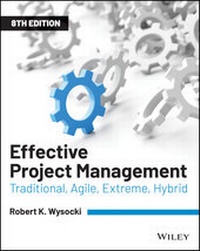
Effective Project Management
Traditional, Agile, Extreme, Hybrid
8th Edition
Published on 5. April 2019
656 pages
978-1-119-56278-8 (ISBN)
Description

The popular guide to the project management body of knowledge, now fully updated
Now in its eighth edition, this comprehensive guide to project management has long been considered the standard for both professionals and academics, with nearly 40,000 copies sold in the last three editions! Well-known expert Robert Wysocki has added four chapters of new content based on instructor feedback, enhancing the coverage of best-of-breed methods and tools for ensuring project management success.
With enriched case studies, accompanying exercises and solutions on the companion website, and PowerPoint slides for all figures and tables, the book is ideal for instructors and students as well as active project managers.
* Serves as a comprehensive guide to project management for both educators and project management professionals
* Updated to cover the new PMBOK® Sixth Edition
* Examines traditional, agile, and extreme project management techniques; the Enterprise Project Management Model; and Kanban and Scrumban methodologies
* Includes a companion website with exercises and solutions and well as PowerPoint slides for all the figures and tables used
* Written by well-known project management expert Robert Wysocki
Effective Project Management, Eighth Edition remains the comprehensive resource for project management practitioners, instructors, and students.
(PMBOK is a registered mark of the Project Management Institute, Inc.)
Now in its eighth edition, this comprehensive guide to project management has long been considered the standard for both professionals and academics, with nearly 40,000 copies sold in the last three editions! Well-known expert Robert Wysocki has added four chapters of new content based on instructor feedback, enhancing the coverage of best-of-breed methods and tools for ensuring project management success.
With enriched case studies, accompanying exercises and solutions on the companion website, and PowerPoint slides for all figures and tables, the book is ideal for instructors and students as well as active project managers.
* Serves as a comprehensive guide to project management for both educators and project management professionals
* Updated to cover the new PMBOK® Sixth Edition
* Examines traditional, agile, and extreme project management techniques; the Enterprise Project Management Model; and Kanban and Scrumban methodologies
* Includes a companion website with exercises and solutions and well as PowerPoint slides for all the figures and tables used
* Written by well-known project management expert Robert Wysocki
Effective Project Management, Eighth Edition remains the comprehensive resource for project management practitioners, instructors, and students.
(PMBOK is a registered mark of the Project Management Institute, Inc.)
More details
Other editions
Additional editions
Robert K. Wysocki
Effective Project Management: Traditional, Agile, Extreme, Hybrid
Traditional, Agile, Extreme, Hybrid
Book
04/2019
8th Edition
Wiley
€64.50
Shipment within 15-20 days
Previous edition
Garth G. F. Ward
Effective Project Management
Guidance and Checklists for Engineering and Construction
E-Book
06/2018
1st Edition
Wiley
€62.99
Available for download
Content
- Cover
- Title Page
- Copyright
- About the Author
- About the Technical Editor
- Credits
- Acknowledgments
- Contents
- Preface
- Introduction
- Why I Wrote This Book
- Education Market
- Training Market
- Consultant Market
- Practitioner Market
- How Is This Book Organized?
- Part I: Understanding the Project Management Landscape
- Part II: Traditional Project Management
- Part III: Complex Project Management
- Appendices
- Unique Value Propositions
- Co-Manager Model
- Integrated Continuous Improvement Process
- Requirements Elicitation
- Scope Triangle
- Project Set-up Phase
- Project Scope Bank
- Probative Swim Lanes
- Bundled Change Management
- Vetted Portfolio
- The Rationale for This Organization
- A Bottom-Up Learning Experience
- Learning about Process Groups
- Learning How Process Groups Form Life Cycle Processes
- Learning Effective Life Cycle Management Strategies
- Learning How to Adapt to the Realities of Projects
- Learning to Be a Thinking Project Manager
- How to Use This Book
- Introductory (Chapters 1-10)
- Intermediate (Chapters 6-15)
- Advanced (Chapters 11-15)
- Who Should Use This Book
- Practicing Professionals
- Undergraduate, Graduate, and Adjunct Faculty
- Corporate Trainers
- What's on the Website
- Slide Presentation
- Individual, Team, and Class Exercises
- Case Studies
- Putting It All Together
- EPM8e Logo
- Part I Understanding the Project Management Landscape
- Chapter 1 What Is a Project?
- Defining a Project
- Sequence of Activities
- Unique Activities
- Complex Activities
- Connected Activities
- One Goal
- Specified Time
- Within Budget
- According to Specification
- A Business-Focused Definition of a Project
- An Intuitive View of the Project Landscape
- Defining a Program
- Defining a Portfolio
- Understanding the Scope Triangle
- Scope
- Quality
- Cost
- Time
- Resources
- Risk
- Envisioning the Scope Triangle as a System in Balance
- Prioritizing the Scope Triangle Variables for Improved Change Management
- Applying the Scope Triangle
- Problem Resolution
- Scope Change Impact Analysis
- The Importance of Classifying Projects
- Establishing a Rule for Classifying Projects
- Classification by Project Characteristics
- Classification by Project Application
- The Contemporary Project Environment
- High Speed
- High Change
- Lower Cost
- Increasing Levels of Complexity
- More Uncertainty
- Discussion Questions
- Chapter 2 What Is Project Management?
- Understanding the Fundamentals of Project Management
- What Business Situation Is Being Addressed by This Project?
- What Does the Business Need to Do?
- What Are You Proposing to Do?
- How Will You Do It?
- How Will You Know You Did It?
- How Well Did You Do?
- Challenges to Effective Project Management
- Flexibility and Adaptability
- Deep Understanding of the Business and Its Systems
- Take Charge of the Project and Its Management
- Project Management Is Organized Common Sense
- Managing the Creeps
- Scope Creep
- Hope Creep
- Effort Creep
- Feature Creep
- What Are Requirements, Really?
- Introducing Project Management Life Cycles
- Traditional Project Management Approaches
- Low Complexity
- Few Scope Change Requests
- Well-Understood Technology Infrastructure
- Low Risk
- Experienced and Skilled Project Teams
- Plan-Driven TPM Projects
- Linear Project Management Life Cycle Model
- Incremental Project Management Life Cycle Model
- Agile Project Management Approaches
- A Critical Problem without a Known Solution
- A Previously Untapped Business Opportunity
- Change-Driven APM Projects
- APM Projects Are Critical to the Organization
- Meaningful Client Involvement Is Essential
- APM Projects Use Small Co-located Teams
- Iterative Project Management Life Cycle Model
- Adaptive Project Management Life Cycle Model
- Extreme Project Management Approach
- The xPM Project Is a Research and Development Project
- The xPM Project Is Very High Risk
- The Extreme Model
- Emertxe Project Management Approach
- A New Technology without a Known Application
- A Solution Out Looking for a Problem to Solve
- Hybrid Project Management Approach
- Recap of PMLC Models
- Similarities between the PMLC Models
- Differences between the PMLC Models
- Choosing the Best-Fit PMLC Model
- Total Cost
- Duration
- Market Stability
- Technology
- Business Climate
- Number of Departments Affected
- Organizational Environment
- Team Skills and Competencies
- Discussion Questions
- Chapter 3 What Is Strategic Project Management?
- Definition of Strategic Project Management
- The Business Environment: A View from the Top
- Business Climate
- PESTEL
- Porter's Five Forces Model
- SWOT
- Market Opportunities
- BCG Growth-Share Matrix
- How to Use the BCG Growth-Share Matrix
- How Are You Going to Allocate Your Resources?
- Enterprise Capacity
- SWOT
- Value Chain Analysis
- VRIO
- Objectives, Strategies, and Tactics Model
- Vision/Mission
- Strategies
- Tactics
- OST Dependency Structure
- What Is the Enterprise Project RASCI Matrix?
- Complex Project Profiling
- Putting It All Together
- Discussion Questions
- Chapter 4 What Is a Collaborative Project Team?
- Overview
- The Complex Project Team
- Project Executive
- Core Team
- Project Sponsor
- Process Co-Manager
- Product Co-Manager
- Development Team Leader
- Client Team Leader
- Business Systems Engineer and Business Analyst
- Process Team and Product Team
- Selecting the Project Team
- Co-Managers Define Project Team Structure and Core Team Roles
- Co-Managers Populate the Roles with Skill Requirements
- Gain Approval of the Staffing Plan
- Using the Co-Manager Model
- Establishing Meaningful Client Involvement
- The Challenges to Meaningful Client Involvement
- What If the Client Team Does Not Understand the HPM Framework?
- Commercial Off the Shelf (COTS) Facilitator-Led Training
- Custom-Designed, Instructor-Led Training
- Real-Time, Consultant-Led Training
- What If You Can't Get the Client to Be Meaningfully Involved?
- What If the Client Is Hesitant to Get Involved?
- What If the Client Wants to Get Too Involved?
- Stakeholder Management
- Who Are the HPM Framework Stakeholders?
- Challenges to Attaining and Sustaining Meaningful Client Involvement
- Always Use the Language of the Client
- Maintain a Continuous Brainstorming Culture
- Establish an Open and Honest Team Environment
- Use a Co-Project Manager Model
- Discussion Questions
- Chapter 5 What Are Project Management Process Groups?
- Overview of the 10 Project Management Knowledge Areas
- Project Integration Management
- Project Scope Management
- Project Schedule Management
- Project Cost Management
- Project Quality Management
- Quality Planning Process
- Quality Assurance Process
- Quality Control Process
- Project Resource Management
- Project Communications Management
- Who Are the Project Stakeholders?
- What Do They Need to Know about the Project?
- How Should Their Needs Be Met?
- Project Risk Management
- Risk Identification
- Risk Assessment
- Risk Mitigation
- Risk Monitoring
- Project Procurement Management
- Vendor Solicitation
- Vendor Evaluation
- Types of Contracts
- Discussion Points for Negotiating the Final Contract
- Final Contract Negotiation
- Vendor Management
- Project Stakeholder Management
- Overview of the Five Process Groups
- The Initiating Process Group
- The Planning Process Group
- The Executing Process Group
- The Monitoring and Controlling Process Group
- The Closing Process Group
- Mapping Knowledge Areas to Process Groups
- How to Use the Mapping
- Using Process Groups to Define PMLC Models
- A Look Ahead: Mapping Process Groups to Form Complex PMLC Models
- Discussion Questions
- Part II Traditional Project Management
- Chapter 6 How to Scope a TPM Project
- Using Tools, Templates, and Processes to Scope a Project
- Managing Client Expectations
- Wants vs. Needs
- Project Scoping Process
- Conducting Conditions of Satisfaction
- Establishing Clarity of Purpose
- Specifying Business Outcomes
- Conducting COS Milestone Reviews
- The Project Scoping Meeting
- Purpose
- Attendees
- Agenda
- Project Scoping Meeting Deliverables
- Creating the RBS
- Stakeholder Participation in Requirements Elicitation and Decomposition
- Approaches to Requirements Elicitation and Decomposition
- Shuttle Diplomacy and Resolving Requirements Elicitation and Decomposition Differences
- Project Classification
- Determining the Best-Fit PMLC Model
- Writing the POS
- Submitting the POS
- Discussion Questions
- Chapter 7 How to Plan a TPM Project
- Using Tools, Templates, and Processes to Plan a Project
- The Importance of Planning
- Using Application Software Packages to Plan a Project
- Determining the Need for a Software Package
- Project Planning Tools
- Sticky Notes
- Marking Pens
- Whiteboard
- How Much Time Should Planning Take?
- Planning and Conducting Joint Project Planning Sessions
- Planning the JPPS
- Attendees
- Facilities
- Equipment
- The Complete Planning Agenda
- Deliverables
- Running the Planning Session
- Building the WBS
- Using the RBS to Build the WBS
- Uses for the WBS
- Thought-Process Tool
- Architectural-Design Tool
- Planning Tool
- Project-Status-Reporting Tool
- Generating the WBS
- Converting the RBS to the WBS
- Six Criteria to Test for Completeness in the WBS
- Status and Completion Are Measurable
- The Activity Is Bounded
- The Activity Has a Deliverable
- Time and Cost Are Easily Estimated
- Activity Duration Is Within Acceptable Limits
- Work Assignments Are Independent
- The Seventh Criterion for Judging Completeness
- Exceptions to the Completion Criteria Rule
- Approaches to Building the WBS
- Noun-Type Approaches
- Verb-Type Approaches
- Organizational Approaches
- Selecting the Best Approach
- Representing the WBS
- Estimating
- Estimating Duration
- Resource Loading versus Task Duration
- Variation in Task Duration
- Six Methods for Estimating Task Duration
- Extrapolating Based on Similarity to Other Tasks
- Studying Historical Data
- Seeking Expert Advice
- Applying the Delphi Technique
- Applying the Three-Point Technique
- Applying the Wide-Band Delphi Technique
- Estimation Life Cycles
- Estimating Resource Requirements
- People as Resources
- Resource Organizational Structure
- Determining Resource Requirements
- Resource Planning
- Estimating Cost
- Cost Budgeting
- Cost Control
- Constructing the Project Network Diagram
- Envisioning a Complex Project Network Diagram
- Benefits to Network-Based Scheduling
- Building the Network Diagram Using the Precedence Diagramming Method
- Dependencies
- Constraints
- Technical Constraints
- Management Constraints
- Interproject Constraints
- Date Constraints
- Using the Lag Variable
- Creating an Initial Project Network Schedule
- Critical Path
- Near-Critical Path
- Analyzing the Initial Project Network Diagram
- Compressing the Schedule
- Management Reserve
- Writing an Effective Project Proposal
- Contents of the Project Proposal
- Executive Summary
- Background
- Objective
- Overview of the Approach to Be Taken
- Detailed Statement of the Work
- Time and Cost Summary
- Appendices
- Format of the Project Proposal
- Gaining Approval to Launch the Project
- Discussion Questions
- Chapter 8 How to Launch a TPM Project
- Using the Tools, Templates, and Processes to Launch a Project
- Recruiting the Project Team
- Core Team Members
- When to Select the Core Team Members
- Selection Criteria
- Client Team
- When to Select the Client Team
- Selection Criteria
- Contract Team Members
- Implications of Adding Contract Team Members
- Selection Criteria
- Developing a Team Deployment Strategy
- Developing a Team Development Plan
- Conducting the Project Kick-Off Meeting
- Purpose of the Project Kick-Off Meeting
- Attendees
- Facilities and Equipment
- Sponsor-Led Part
- Project Manager-Led Part
- The Working Session Agenda
- Introducing the Project Team Members to Each Other
- Writing the Project Definition Statement
- Reviewing the Project Plan
- Finalizing the Project Schedule
- Writing Work Packages
- Establishing Team Operating Rules
- Situations That Require Team Operating Rules
- Problem Solving
- Decision Making
- Conflict Resolution
- Consensus Building
- Brainstorming
- Team Meetings
- Team War Room
- Physical Layout
- Variations
- Operational Uses
- Managing Scope Changes
- The Scope Change Management Process
- Management Reserve
- Scope Bank
- Managing Team Communications
- Establishing a Communications Model
- Timing
- Content
- Choosing Effective Channels
- Managing Communication beyond the Team
- Managing Communications with the Sponsor
- Upward Communication Filtering and "Good News"
- Communicating with Other Stakeholders
- Assigning Resources
- Leveling Resources
- Acceptably Leveled Schedule
- Resource Leveling Strategies
- Utilizing Available Slack
- Shifting the Project Finish Date
- Smoothing
- Alternative Methods of Scheduling Tasks
- Further Decomposition of Tasks
- Stretching Tasks
- Assigning Substitute Resources
- Cost Impact of Resource Leveling
- Finalizing the Project Schedule
- Writing Work Packages
- Purpose of a Work Package
- Format of a Work Package
- Work Package Assignment Sheet
- Work Package Description Report
- Discussion Questions
- Chapter 9 How to Execute a TPM Project
- Using Tools, Templates, and Processes to Monitor and Control
- Establishing Your Progress Reporting System
- Types of Project Status Reports
- Current Period Reports
- Cumulative Reports
- Exception Reports
- Stoplight Reports
- Variance Reports
- How and What Information to Update
- Frequency of Gathering and Reporting Project Progress
- Variances
- Positive Variances
- Negative Variances
- Applying Graphical Reporting Tools
- Gantt Charts
- Stoplight Reports
- Burn Charts
- Milestone Trend Charts
- Earned Value Analysis
- Integrating Milestone Trend Charts and Earned Value Analysis
- Integrating Earned Value
- Integrating Milestone Trend Data
- Managing the Scope Bank
- Building and Maintaining the Issues Log
- Managing Project Status Meetings
- Who Should Attend Status Meetings?
- When Are Status Meetings Held?
- What Is the Purpose of a Status Meeting?
- What Is the Status Meeting Format?
- The 15-Minute Daily Status Meeting
- Problem Management Meetings
- Defining a Problem Escalation Strategy
- Project Manager-Based Strategies
- Resource Manager-Based Strategies
- Client-Based Strategies
- The Escalation Strategy Hierarchy
- Gaining Approval to Close the Project
- Discussion Questions
- Chapter 10 How to Close a TPM Project
- Using Tools, Templates, and Processes to Close a TPM Project
- Writing and Maintaining Client Acceptance Procedures
- Closing a TPM Project
- Getting Client Acceptance of Deliverables
- Ceremonial Acceptance
- Formal Acceptance
- Installing Project Deliverables
- Phased Approach
- Cut-Over Approach
- Parallel Approach
- By-Business-Unit Approach
- Documenting the Project
- Reference for Future Changes in Deliverables
- Historical Record for Estimating Duration and Cost on Future Projects, Activities, and Tasks
- Training Resource for New Project Managers
- Input for Further Training and Development of the Project Team
- Input for Performance Evaluation by the Functional Managers of the Project Team Members
- Conduct the Post-implementation Audit
- Write the Final Report
- Celebrate Success
- Discussion Questions
- Part III Complex Project Management
- Chapter 11 Complexity and Uncertainty in the Project Landscape
- What Is Complex Project Management?
- Implementing CPM Projects
- Fully Supported Production Versions of Partial Solutions Are Released to the End User Quarterly or Semi-Annually
- Intermediate Non-production Versions Are Released to a Focus Group Every 2-4 Weeks
- Co-located CPM Project Teams
- Cross-Project Dependencies
- Project Portfolio Management
- What Is Lean Agile Project Management?
- Understanding the Complexity/Uncertainty Domain of Projects
- Requirements
- Flexibility
- Adaptability
- Risk vs. the Complexity/Uncertainty Domain
- Team Cohesiveness vs. the Complexity/Uncertainty Domain
- Communications vs. the Complexity/Uncertainty Domain
- Client Involvement vs. the Complexity/Uncertainty Domain
- The Client's Comfort Zone
- Ownership by the Client
- Client Sign-Off
- Specification vs. the Complexity/Uncertainty Domain
- Scope Change vs. the Complexity/Uncertainty Domain
- Business Value vs. the Complexity/Uncertainty Domain
- Discussion Questions
- Chapter 12 Agile Complex Project Management Models
- Iterative Project Management Life Cycle
- Definition of the Iterative PMLC Model
- Most of the Solution Is Clearly Known
- Likely to Be Multiple Scope Change Requests
- Concern about Lack of Client Involvement
- Scoping Phase of an Iterative PMLC Model
- Planning Phase of an Iterative PMLC Model
- Launching Phase of an Iterative PMLC Model
- Executing Phase of an Iterative PMLC Model
- Closing Phase of an Iterative PMLC Model
- Adapting and Integrating the APM Toolkit
- Scoping the Next Iteration/Cycle
- Planning the Next Iteration/Cycle
- Launching the Next Iteration/Cycle
- Executing the Next Iteration/Cycle
- Closing the Next Iteration/Cycle
- Deciding to Conduct the Next Iteration/Cycle
- Closing the Project
- Discussion Questions
- Chapter 13 Extreme Complex Project Management Models
- The Complex Project Landscape
- What Is Extreme Project Management?
- Extreme Project Management Life Cycle Model
- What Is Emertxe Project Management?
- The Emertxe Project Management Life Cycle
- When to Use an Emertxe PMLC Model
- Research and Development Projects
- Problem Solving Projects
- Using the Tools, Templates, and Processes for Maximum Extreme PMLC Model Effectiveness
- Scoping the Next Phase
- Planning the Next Phase
- Launching the Next Phase
- Executing the Next Phase
- Closing the Phase
- Deciding to Conduct the Next Phase
- Closing the Project
- Using the Tools, Templates, and Processes for Maximum xPM and MPx Effectiveness
- Scoping the Next Phase
- Planning the Next Phase
- Launching the Next Phase
- Executing the Next Phase
- Closing the Phase
- Deciding to Conduct the Next Phase
- Closing the Project
- Discussion Questions
- Chapter 14 Hybrid Project Management Framework
- What Is a Hybrid Project?
- What Is Hybrid Project Management?
- A Robust Hybrid PMLC Model
- Ideation Phase
- Set-up Phase
- Execution Phase
- What Is a Hybrid Project Manager?
- The Occasional Project Manager
- The Career Project Manager
- The Hybrid Project Manager
- Following and Creating Recipes
- Characteristics of the Hybrid Project Manager
- What Does a Hybrid Project Manager Want?
- Background of the Effective Complex Project Management (ECPM) Framework
- What Does the ECPM Contain?
- ECPM Process Flow Diagram
- Project Ideation Phase
- Step 1: Develop a Business Case
- Step 2: Elicit Requirements
- Step 3: Write a Project Overview Statement
- Project Set-up Phase
- Step 4: Classify the Project
- Step 5: Choose the Best-Fit PMLC Model Template
- Step 6: Assess Project Characteristics
- Step 7: Modify PMLC Model Template
- Project Execution Phase
- Step 8: Define Version Scope
- Step 9: Plan the Next Cycle
- Step 10: Build the Next Cycle Deliverables
- Step 11: Conduct Client Checkpoint
- Step 12: Close the Version
- Variations
- Proof of Concept
- Revising the Version Plan
- Imbedding ECPM in Traditional Project Management
- The Hybrid PMLC Project Types
- Traditional Hybrid Projects
- Agile Hybrid Projects
- Extreme Hybrid Projects
- Emertxe Hybrid Projects
- Hybrid Project Types
- Process/Product Design
- Process/Product Improvement
- Problem Solution
- Standards and the Hybrid Framework
- Project Ideation: What Are We Going to Do?
- Input Phase: Define the Problem or Opportunity
- Project Set-up: How Will We Do It?
- Project Execution: How well did we do?
- The Hybrid Team Structure
- Co-Project Managers
- The Occasional PM: Project Support Office
- Vetted Portfolio of Tools, Templates, and Processes
- Coaching and Consulting
- Targeted and Customized Training
- PSO Support Services for Business Unit Managers
- Discussion Questions
- Chapter 15 Comparing TPM and CPM Models
- Linear PMLC Model
- Characteristics
- Complete and Clearly Defined Goal, solution, Requirements, Functions, and Features
- Few Expected Scope Change Requests
- Routine and Repetitive Activities
- Use of Established Templates
- Strengths
- The Entire Project Is Scheduled at the Beginning of the Project
- Resource Requirements Are Known from the Start
- Linear PMLC Models Do Not Require the Most Skilled Team Members
- Team Members Do Not Have to Be Co-located
- Weaknesses
- Does Not Accommodate Change Very Well
- Costs Too Much
- Takes Too Long before Any Deliverables Are Produced
- Requires Complete and Detailed Plans
- Must Follow a Rigid Sequence of Processes
- Is Not Focused on Client Value
- When to Use a Linear PMLC Model
- Specific Linear PMLC Models
- Standard Waterfall Model
- Rapid Development Waterfall Model
- Incremental PMLC Model
- Characteristics
- Strengths
- Produces Business Value Early in the Project
- Enables You to Better Schedule Scarce Resources
- Can Accommodate Minor Scope Change Requests between Increments
- Offers a Product Improvement Opportunity
- More Focused on Client Business Value Than the Linear PMLC Model
- Weaknesses
- The Team May Not Remain Intact Between Increments
- This Model Requires Handoff Documentation between Increments
- The Model Must Follow a Defined Set of Processes
- You Must Define Increments Based on Function and Feature Dependencies Rather Than Business Value
- You Must Have More Client Involvement Than Linear PMLC Models
- An Incremental PMLC Model Takes Longer to Execute Than the Linear PMLC Model
- Partitioning the Functions May Be Problematic
- When to Use an Incremental PMLC Model
- Incremental PMLC Models
- Staged Delivery Waterfall Model
- Feature-Driven Development Model
- Iterative PMLC Model
- Characteristics
- Complete and Clearly Defined Goal
- Minor Parts of the Solution Not Yet Defined
- Incomplete Requirements
- Some Scope Change Requests Are Expected
- The Solution Is Known, but Not to the Needed Depth
- Often Uses Iconic or Simulated Prototypes to Discover the Complete Solution
- Strengths
- Based on Just-in-Time Planning
- Accommodates Change Very Well
- Is Focused on Generating Business Value
- Client Reviews Partial Solutions for Improvement
- Can Process Scope Changes between Iterations
- Adaptable to Changing Business Conditions
- Weaknesses
- Risk Losing Team Members between Iterations
- Subject to Losing Priority between Iterations
- Resource Requirements Unclear at Project Launch
- Requires a More Actively Involved Client Than TPM Projects
- Requires Co-located Teams
- Difficult to Implement Intermediate Solutions
- Final Solution Cannot Be Defined at the Start of the Project
- When to Use an Iterative PMLC Model
- Specific Iterative PMLC Models
- Prototyping Model
- Evolutionary Development Waterfall Model
- Rational Unified Process (RUP)
- Dynamic Systems Development Method (DSDM)
- Adaptive Software Development (ASD)
- Scrum
- Adaptive PMLC Model
- Characteristics
- Iterative Structure
- Just-in-Time Planning
- Critical Mission Projects
- Thrives on Change through Learning and Discovery
- Continuously Reviewed and Adapted to Changing Conditions
- Strengths
- Continuously Realigns the Project Management Process to Accommodate Changing Conditions
- Does Not Waste Time on Non-Value-Added Work
- Avoids All Management Issues Processing Scope Change Requests
- Does Not Waste Time Planning Uncertainty
- Provides Maximum Business Value within the Given Time and Cost Constraints
- Weaknesses of the Adaptive PMLC Model
- Must Have Meaningful Client Involvement
- Cannot Identify Exactly What Will Be Delivered at the End of the Project
- When to Use an Adaptive PMLC Model
- Hybrid Project Management Framework
- The HPM Framework Is an Industrial-Strength Model
- The HPM Framework Project Team
- The HPM Framework Roots
- Scope Is Variable
- The HPM Framework Is Just-in-Time Planning
- Change Is Expected
- The HPM Framework Project Contract
- An HPM Framework Project Is Mission Critical
- The Role of the Client and the Project Manager in an HPM Framework Project
- The HPM Framework Is Not a Recipe to be Blindly Followed
- Why Do We Need the HPM Framework?
- Benefits of APM vs. Other Approaches
- Core Values of APM
- An Overview of the HPM Framework Life Cycle
- Extreme PMLC Model
- Characteristics
- High Speed
- High Change
- High Uncertainty
- Strengths
- Keeps Options Open as Late as Possible
- Offers an Early Look at a Number of Partial Solutions
- Weaknesses
- May Be Looking for Solutions in All the Wrong Places
- No Guarantee That Any Acceptable Business Value Will Result from the Project Deliverables
- Specific Extreme PMLC Models
- INSPIRE Extreme PMLC Model
- INitiate
- SPeculate
- Incubate
- REview
- Challenges to Project Set-up and Execution
- Sponsors Have a Hard Time Accepting Variable Scope
- Achieving and Sustaining Meaningful Client Involvement through the Phases of the Chosen PMLC Model
- Adapting the Chosen PMLC Model to Changing Conditions
- Delivering Business Value in a Complex Project Landscape
- Discussion Questions
- Appendix A Terms and Acronyms
- Appendix B Case Study: Workforce and Business Development Center
- Hypothesis
- Synopsis
- The Need
- The Problem
- The Business Environment
- The Worker Environment
- The Learning Environment
- The Solution
- Components of the WBDC Model
- Learning Environment
- Business Environment
- Student Environment
- Business Incubation Center
- Linkages in the WBDC Model
- Learning &-& Business Linkages
- Learning &-& Student Linkages
- Business &-& Student Linkages
- The Business Case for a WBDC
- Next Steps
- Putting It All Together
- Appendix C Case Study: Pizza Delivered Quickly (PDQ)
- Pizza Factory Locator Sub-system
- Order Entry Sub-system
- Logistics Sub-system
- Order Submit Sub-system
- Inventory Management Sub-system
- Routing Sub-system
- Appendix D Cited References
- Appendix E What's on the eiipbs.com Website?
- Course Master File
- A Note on the Answer File for the Discussion Questions
- Additional Chapters
- Index
- EULA
