

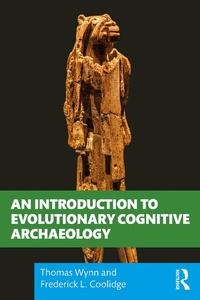
An Introduction to Evolutionary Cognitive Archaeology
1st Edition
Published on 19. April 2022
136 pages
978-1-000-57114-1 (ISBN)
Description

An Introduction to Evolutionary Cognitive Archaeology is the first concise introduction that lays out the epistemological foundations of evolutionary cognitive archaeology in a way that is accessible to students.
The volume is divided into three sections. The first section situates cognitive archaeology in the pantheon of archaeological approaches and distinguishes between ideational cognitive archaeology and evolutionary cognitive archaeology. This is followed by a close look at the nature of cognitive archaeological inferences and concludes with brief summaries of the major methods of evolutionary cognitive archaeology. The second section of the book introduces the reader to a variety of cognitive phenomena that are accessible using the methods of cognitive archaeology: memory, technical cognition, spatial cognition, social cognition, art and aesthetics, and symbolism and language. The third section presents a brief outline of hominin cognitive evolution from the perspective of evolutionary cognitive archaeology. The authors divide the archaeological record into three major phases: The Bipedal Apes-3.3 million-1.7 million years ago; The Axe Age-1.7 million-300,000 years ago; and The Emergence of Modern Thinking-300,000-12,000 years ago.
An Introduction to Evolutionary Cognitive Archaeology is an essential text for undergraduate students, graduate students, and scholars across the behavioral and social sciences interested in learning about cognitive archaeology, including psychologists, philosophers, anthropologists, and archaeologists.
The volume is divided into three sections. The first section situates cognitive archaeology in the pantheon of archaeological approaches and distinguishes between ideational cognitive archaeology and evolutionary cognitive archaeology. This is followed by a close look at the nature of cognitive archaeological inferences and concludes with brief summaries of the major methods of evolutionary cognitive archaeology. The second section of the book introduces the reader to a variety of cognitive phenomena that are accessible using the methods of cognitive archaeology: memory, technical cognition, spatial cognition, social cognition, art and aesthetics, and symbolism and language. The third section presents a brief outline of hominin cognitive evolution from the perspective of evolutionary cognitive archaeology. The authors divide the archaeological record into three major phases: The Bipedal Apes-3.3 million-1.7 million years ago; The Axe Age-1.7 million-300,000 years ago; and The Emergence of Modern Thinking-300,000-12,000 years ago.
An Introduction to Evolutionary Cognitive Archaeology is an essential text for undergraduate students, graduate students, and scholars across the behavioral and social sciences interested in learning about cognitive archaeology, including psychologists, philosophers, anthropologists, and archaeologists.
More details
Edition
1. Auflage
Language
English
Place of publication
London
United Kingdom
Publishing group
Taylor & Francis Ltd
Target group
College/higher education
Illustrations
20 Halftones, black and white; 20 Illustrations, black and white
ISBN-13
978-1-000-57114-1 (9781000571141)
Copyright in bibliographic data and cover images is held by Nielsen Book Services Limited or by the publishers or by their respective licensors: all rights reserved.
Schweitzer Classification
Other editions
Additional editions

Thomas Wynn | Frederick L. Coolidge
An Introduction to Evolutionary Cognitive Archaeology
Book
04/2022
1st Edition
Routledge
€205.70
Shipment within 15-20 days
Thomas Wynn | Frederick L. Coolidge
An Introduction to Evolutionary Cognitive Archaeology
Book
04/2022
1st Edition
Routledge
€73.70
Shipment within 15-20 days
Persons
Thomas Wynn is a distinguished professor of anthropology at the University of Colorado, Colorado Springs. Since the 1970s, his research has centered on the explicit use of psychological theory to interpret archaeological remains. He has published extensively on hominin cognitive evolution.
Frederick L. Coolidge is a professor of psychology at the University of Colorado, Colorado Springs (UCCS). He is the co-director of the UCCS Center of Cognitive Archaeology. He is the author or co-author of several books spanning the disciplines of cognitive archaeology, statistics, and psychology.
Frederick L. Coolidge is a professor of psychology at the University of Colorado, Colorado Springs (UCCS). He is the co-director of the UCCS Center of Cognitive Archaeology. He is the author or co-author of several books spanning the disciplines of cognitive archaeology, statistics, and psychology.
Content
SECTION I: METHOD AND THEORY 1. Introduction 2. Evolutionary Cognitive Archaeology 3. Two Cognitive Archaeologies 4. Reasoning About Prehistoric Minds 5. Methods of Evolutionary Cognitive Archaeology; SECTION II: CORE ISSUES IN EVOLUTIONARY COGNITIVE ARCHAEOLOGY 6. Memory 7. Technical Cognition 8. Spatial Cognition 9. Social Cognition 10. Art and Aesthetics 11. Symbolism and Language; SECTION III: BRIEF OUTLINE OF HOMININ COGNITIVE EVOLUTION 12. Phase 1: The Bipedal Apes 3.3 - 1.7 Million 13. Phase 2: The Axe Age 1.7 Million - 300,000 14. Phase 3: The Emergence of Modern Thinking - 300,000 - 12,000 Conclusion
