

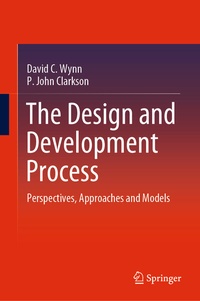
The Design and Development Process
Description

This book explores a process perspective on design and development, grounded in research in design studies, engineering design and systems design.
The design and development process is important---it creates all artificial products and systems and determines how well they address human needs. The process perspective set out in this book has value for design and development practice and education, and is in its own right a fascinating topic of investigation.
This book expands on the foundations of a process perspective and discusses its realisation in many process models, theories and approaches that have been developed over the years. The chapters provide connected overviews of key concepts and introduce new conceptual frameworks to clarify relationships between the contributions discussed. Practical considerations and competencies required to realise the tangible benefits of a process perspective are also discussed.
A unique aspect of this book is that itbrings together many perspectives on the design and development process: those that focus on individual design activity through to those that focus on large-scale development projects; those of research interest and those of practical interest; and those of relevance to design contexts ranging from human-centered design to engineering design and systems design. The chapter bibliographies collect carefully-selected recommendations for further reading on each topic discussed. The book additionally contains many figures presented in colour, visually reflecting each topic's relationship to the new organising frameworks that are introduced.
More details
Other editions
Additional editions
Persons
David Wynn has been researching the design and development process since 2002. After completing a PhD in the area, he worked as a researcher at Cambridge University Engineering Design Centre and then as an engineering professional at Bombardier Aerospace in Montréal . David is currently a senior lecturer in mechanical engineering at the University of Auckland, where he contributes to teaching in every year of the mechanical engineering programme on the topics of design, manufacture and product development. David has also held adjunct appointments at the Department of Mechanical Engineering at McGill University and the Faculty of Sustainable Design Engineering at the University of Prince Edward Island. He was a fellow of Homerton College, Cambridge for a number of years. He is currently a member of the editorial boards of Research in Engineering Design, Journal of Engineering Design and IEEE Transactions on Engineering Management. David now lives on Waiheke Island in New Zealand with Khadidja and their children Adam, Marie-Anne and Alexander.
John Clarkson returned to the Department of Engineering at the University of Cambridge in 1995 following a seven-year spell with PA Consulting Group's Technology Division. He was appointed director of the Engineering Design Centre in 1997 and a University Professor in 2004. He has been directly involved in the teaching of design at all levels of the undergraduate course. At PA John was Manager of the Advanced Process Group where he gained wide experience of product development with a particular focus on the design of medical equipment and high-integrity systems. John's research interests are in the general area of engineering design, particularly the development of design methodologies to address specific design issues, for example, process management, change management, healthcare design, inclusive design and automotive design. As well as publishing over 900 papers, he has written and edited a number of books on medical equipment design, inclusive design and process management. He is also Professor of Healthcare Systems in the Faculty of Industrial Design Engineering at TU Delft.
