

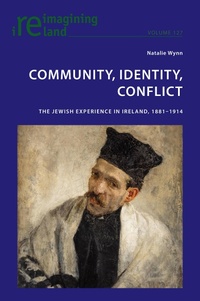
Community, Identity, Conflict
Description

«Natalie Wynn has written a definitive account of Irish Jewish history in the period of mass migration at the turn of the twentieth century. She unravels the myths-such as accidental arrival from eastern Europe, or untroubled social mobility as a model minority-which have hitherto characterized Irish Jews. Community, Identity, Conflict moves from detailed studies of local communities (Belfast, Dublin, Cork, Limerick) to the metropolitan and colonial contexts of minority formation. As Dr Wynn adeptly shows, the everyday ambivalence towards minorities in Irish culture is a centuries-old history which is still present today. Her meticulous and compelling study will be of value to Irish studies, Jewish studies, and anyone interested in the life experience of refugees.»
(Bryan Cheyette, Emeritus Professor, University of Reading, and author of The Ghetto: A Very Short Introduction (2020))
«Natalie Wynn has produced an outstanding contribution to the relevant literature. It dismantles established myths and opens up the field of Irish Jewish studies with a fresh, innovative interpretation, which sets new standards in scholarship.»
(Eugenio Biagini, Professor of Modern and Contemporary History, University of Cambridge)
As a small community located on the peripheries of Europe and of the Jewish world, Ireland's Jewish community is something of an outlier and is often portrayed as having a unique history or being quaint or quirky in character. This book challenges this narrative by contextualizing Irish Jewry as a community that has been defined by the experience and mythology of Jewish mass migration. This book charts the history of Ireland's Jewish community at a time of rapid growth and cultural, political and social transition, from British rule to Irish independence, exploring the relationship between Jews, Irish society and Irish Jewish communal tradition. Key themes include arrival and settlement; the dynamics between «native» and immigrant Jews; acculturation and hybridity; intracommunal conflict; gender; and Jewish/non-Jewish relations.
More details
Other editions
Additional editions
Person
Natalie Wynn is a Research Associate of the Herzog Centre for Jewish and Near Eastern Religions and Culture, Trinity College Dublin. She has contributed to books and journals on various aspects of Irish Jewish history, historiography, identity and experience, and is co-editor of the essay collections Reimagining the Jews of Ireland: Historiography, Identity and Representation, with Zuleika Rodgers (2023); The Limerick Boycott in Context, with Seán William Gannon (forthcoming, 2024); and Migration in Jewish Imagination and Experience, with Mara W. Cohen Ioannides (forthcoming, 2024).
Content
Contents: Constructing Communal Identity: Irish Jewish Myths of Origin - Constructing Community: 'Natives', 'Foreigners' and the Resurrection of Irish Jewry - 'An Excess of Zeal': Conflict and Community - Infrastructure and Identity: Charity, Self- help and Intracommunal Relations - An 'Acharacteristic and Atypical Episode'? Towards a Critical Jewish Historiography of the Limerick Boycott - Becoming Irish? Jewish/ non- Jewish Relations in the Irish Setting*.
