

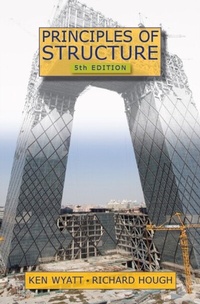
Principles of Structure
5th Edition
Published on 21. March 2013
230 pages
978-0-203-81716-2 (ISBN)
Description

Since its first publication in 1974, Principles of Structure has established itself at the forefront of introductory texts for students of architecture, building and project management seeking a basic understanding of the behavior and design of building structures. It provides a simple quantitative introduction to structural engineering, while also drawing connections to real buildings that are more complex. Retaining the style and format of earlier editions, this Fifth Edition brings the text and examples into alignment with international practice. It also features six new buildings from around the world, illustrating the principles described in the text.
The book begins with a chapter explaining forces and their effects. Other chapters cover ties and struts, loadings, graphical statics, bracings, shears and moments, stresses, deflections, and beam design. There is also an appendix with a fuller explanation of fundamentals for readers unfamiliar with the basic concepts of geometry and statics.
The book offers a unique format with right-hand pages containing text and left-hand pages containing complementary commentary including explanations and expansions of points made in the text and worked examples. This cross-referencing gives readers a range of perspectives and a deeper understanding of each topic. The simple mathematical approach and logical progression-along with the hints and suggestions, worked examples and problem sheets-give beginners straightforward access to elementary structural engineering.
The book begins with a chapter explaining forces and their effects. Other chapters cover ties and struts, loadings, graphical statics, bracings, shears and moments, stresses, deflections, and beam design. There is also an appendix with a fuller explanation of fundamentals for readers unfamiliar with the basic concepts of geometry and statics.
The book offers a unique format with right-hand pages containing text and left-hand pages containing complementary commentary including explanations and expansions of points made in the text and worked examples. This cross-referencing gives readers a range of perspectives and a deeper understanding of each topic. The simple mathematical approach and logical progression-along with the hints and suggestions, worked examples and problem sheets-give beginners straightforward access to elementary structural engineering.
More details
Edition
5th New edition
Language
English
Place of publication
Baton Rouge
United States
Publishing group
Taylor & Francis Inc
Target group
College/higher education
Edition type
New edition
Illustrations
224 s/w Abbildungen, 8 s/w Tabellen
Over 100; 8 Tables, black and white; 224 Illustrations, black and white
ISBN-13
978-0-203-81716-2 (9780203817162)
Copyright in bibliographic data and cover images is held by Nielsen Book Services Limited or by the publishers or by their respective licensors: all rights reserved.
Schweitzer Classification
Other editions
Additional editions

Ken Wyatt | Richard Hough
Principles of Structure
Book
06/2019
5th Edition
CRC Press
€142.62
The article will not be published
Ken Wyatt | Richard Hough
Principles of Structure
Book
02/2013
5th Edition
CRC Press
€88.00
Shipment within 15-20 days
Persons
Ken Wyatt was the mainstay of structural engineering teaching in the Faculty of the Built Environment at the University of New South Wales, Australia, for many decades. There he developed the original text of Principles of Structure. He is also a structural engineer, researcher, materials scientist, and heritage consultant.
Richard Hough has worked as a structural engineer with the design firm Arup in London, Los Angeles, and Sydney on many well-known buildings and with some of the world's best-known architects. He is presently a principal in the firm's Sydney office, and a conjoint professor at the University of Newcastle, Australia.
Richard Hough has worked as a structural engineer with the design firm Arup in London, Los Angeles, and Sydney on many well-known buildings and with some of the world's best-known architects. He is presently a principal in the firm's Sydney office, and a conjoint professor at the University of Newcastle, Australia.
Content
Forces, Moments and Equilibrium
Forces on Structures
Measurement of Force
External Forces
Resultants and Components
Moments
Couples
Equilibrium
Co-Planar Forces
Concurrent Force Systems
Forces at Supports
Stability and Determinacy
Parallel Force Systems
Internal Forces
Application: Concurrent Forces, Hong Kong and Shanghai Bank
Ties and Struts
Pressure
Stress
Types of Stress
Strain and Elasticity
Design of Tension Elements (Ties)
Ties and Struts
Application: Ties and Struts, Il Grande Bigo
Application: Struts and Ties: Kurilpa Bridge
Loadings on Buildings
Loads
Dead Loads
Live Loads
Wind Loads
Other Loads
Calculation of Loads
Application: Loading, Live Loads
Graphical Statics
Vectors
The Triangle of Forces: Resultants and Equilibrants
Bow's Notation
The Triangle of Forces: Two Unknown Forces
Concurrency of Forces
Application: Graphical Statics, Patscentre
Pin-Jointed Structures
Pin-Ended Members
Graphical Method
Method of Joints
Method of Sections
Summary
Application: Roof Trusses, Menil Collection Museum
Application: Pin-jointed Trusses: Raleigh-Durham Airport
Bracing of Buildings
Vertical and Lateral Loads
Basic Systems
Bracing Options
Asymmetry
Combined Effects
Application: Bracing, Osaka International Conference Centre
Application: Bracing: China Central Television
Shear Force and Bending Moment
Terms
Shear Force
Bending Moment
Bending Moment Diagrams
Load, Shear Force and Bending Moment
Contraflexure
Application: SFD, BMD, Red Centre
Properties of Area
Centre of Gravity
The Centroid
Second Moment of Area
Theorem of Parallel Axes
Common Centroid Theorem
Section Modulus
Application: Properties of Cross Sections, Sydney Opera House
Application: Properties of Cross-Sections: National Stadium, Beijing
Bending Stresses
Internal Effects
The Stress Formula
Deductions
Stress Variation
Maximum Stress
'Ultimate' Conditions
Application: Beams in Bending, Phoenix Central Library
Shear Stresses
Horizontal and Vertical Shear Stress
Shear Stress Formula
Maximum Shear Stress
Deductions
'Ultimate' Conditions
Application: Design for Shear, Cummins Engine Factory
Application: Design for Shear: Serpentine Pavilion 2005
Deflections
General Rules
Deflection Formula
Spans and Materials
Deflection Sensitivity
Dynamics
Application: Controlling Deflections, Commerzbank Headquarters
Design of Beams
Analysis and Design
Design of a Simple Beam
Design Steps
Ultimate Strength Design
Application: Timber Beams, Nottingham University Jubilee Campus
Application: Timber Beams: Druk White Lotus School, Ladakh
Answers to Worksheets
Appendix: A First Encounter with Statics
Index
Forces on Structures
Measurement of Force
External Forces
Resultants and Components
Moments
Couples
Equilibrium
Co-Planar Forces
Concurrent Force Systems
Forces at Supports
Stability and Determinacy
Parallel Force Systems
Internal Forces
Application: Concurrent Forces, Hong Kong and Shanghai Bank
Ties and Struts
Pressure
Stress
Types of Stress
Strain and Elasticity
Design of Tension Elements (Ties)
Ties and Struts
Application: Ties and Struts, Il Grande Bigo
Application: Struts and Ties: Kurilpa Bridge
Loadings on Buildings
Loads
Dead Loads
Live Loads
Wind Loads
Other Loads
Calculation of Loads
Application: Loading, Live Loads
Graphical Statics
Vectors
The Triangle of Forces: Resultants and Equilibrants
Bow's Notation
The Triangle of Forces: Two Unknown Forces
Concurrency of Forces
Application: Graphical Statics, Patscentre
Pin-Jointed Structures
Pin-Ended Members
Graphical Method
Method of Joints
Method of Sections
Summary
Application: Roof Trusses, Menil Collection Museum
Application: Pin-jointed Trusses: Raleigh-Durham Airport
Bracing of Buildings
Vertical and Lateral Loads
Basic Systems
Bracing Options
Asymmetry
Combined Effects
Application: Bracing, Osaka International Conference Centre
Application: Bracing: China Central Television
Shear Force and Bending Moment
Terms
Shear Force
Bending Moment
Bending Moment Diagrams
Load, Shear Force and Bending Moment
Contraflexure
Application: SFD, BMD, Red Centre
Properties of Area
Centre of Gravity
The Centroid
Second Moment of Area
Theorem of Parallel Axes
Common Centroid Theorem
Section Modulus
Application: Properties of Cross Sections, Sydney Opera House
Application: Properties of Cross-Sections: National Stadium, Beijing
Bending Stresses
Internal Effects
The Stress Formula
Deductions
Stress Variation
Maximum Stress
'Ultimate' Conditions
Application: Beams in Bending, Phoenix Central Library
Shear Stresses
Horizontal and Vertical Shear Stress
Shear Stress Formula
Maximum Shear Stress
Deductions
'Ultimate' Conditions
Application: Design for Shear, Cummins Engine Factory
Application: Design for Shear: Serpentine Pavilion 2005
Deflections
General Rules
Deflection Formula
Spans and Materials
Deflection Sensitivity
Dynamics
Application: Controlling Deflections, Commerzbank Headquarters
Design of Beams
Analysis and Design
Design of a Simple Beam
Design Steps
Ultimate Strength Design
Application: Timber Beams, Nottingham University Jubilee Campus
Application: Timber Beams: Druk White Lotus School, Ladakh
Answers to Worksheets
Appendix: A First Encounter with Statics
Index
