

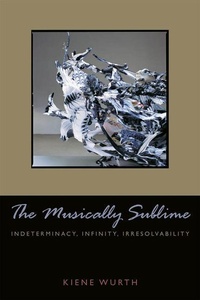
Musically Sublime
Indeterminacy, Infinity, Irresolvability
1st Edition
Published on 25. August 2009
234 pages
978-0-8232-3798-2 (ISBN)
Description

Musically Sublime rewrites musically the history and philosophy of the sublime. Music enables us to reconsider the traditional course of sublime feeling on a track from pain to pleasure. Resisting the notion that there is a single format for sublime feeling, Wurth shows how, from the mid eighteenth century onward, sublime feeling is, instead, constantly rearticulated in a complex interaction with musicality.
Wurth takes as her point of departure Immanuel Kant's Critique of Judgment and Jean-Francois Lyotard's aesthetic writings of the 1980s and 1990s. Kant framed the sublime narratively as an epic of self-transcendence. By contrast, Lyotard sought to substitute open immanence for Kantian transcendence, yet he failed to deconstruct the Kantian epic. The book performs this deconstruction by juxtaposing eighteenth- and nineteenth-century conceptions of the infinite, Sehnsucht, the divided self, and unconscious drives with contemporary readings of instrumental music.
Critically assessing Edmund Burke, James Usher, E.T.A. Hoffmann, Novalis, Friedrich Hoelderlin, Arthur Schopenhauer, Richard Wagner, and Friedrich Nietzsche, this book re-presents the sublime as a feeling that defers resolution and hangs suspended between pain and pleasure. Musically Sublime rewrites the mathematical sublime as differance, while it redresses the dynamical sublime as trauma: unending, undetermined, unresolved.
Whereas most musicological studies in this area have focused on traces of the Kantian sublime in Handel, Haydn, and Beethoven, this book calls on the nineteenth-century theorist Arthur Seidl to analyze the sublime of, rather than in, music. It does so by invoking Seidl's concept of formwidrigkeit ("form-contrariness") in juxtaposition with Romantic piano music, (post)modernist musical minimalisms, and Lyotard's postmodern sublime. It presents a sublime of matter, rather than form-performative rather than representational. In doing so, Musically Sublime shows that the binary distinction Lyotard posits between the postmodern and romantic sublime is finally untenable.
Wurth takes as her point of departure Immanuel Kant's Critique of Judgment and Jean-Francois Lyotard's aesthetic writings of the 1980s and 1990s. Kant framed the sublime narratively as an epic of self-transcendence. By contrast, Lyotard sought to substitute open immanence for Kantian transcendence, yet he failed to deconstruct the Kantian epic. The book performs this deconstruction by juxtaposing eighteenth- and nineteenth-century conceptions of the infinite, Sehnsucht, the divided self, and unconscious drives with contemporary readings of instrumental music.
Critically assessing Edmund Burke, James Usher, E.T.A. Hoffmann, Novalis, Friedrich Hoelderlin, Arthur Schopenhauer, Richard Wagner, and Friedrich Nietzsche, this book re-presents the sublime as a feeling that defers resolution and hangs suspended between pain and pleasure. Musically Sublime rewrites the mathematical sublime as differance, while it redresses the dynamical sublime as trauma: unending, undetermined, unresolved.
Whereas most musicological studies in this area have focused on traces of the Kantian sublime in Handel, Haydn, and Beethoven, this book calls on the nineteenth-century theorist Arthur Seidl to analyze the sublime of, rather than in, music. It does so by invoking Seidl's concept of formwidrigkeit ("form-contrariness") in juxtaposition with Romantic piano music, (post)modernist musical minimalisms, and Lyotard's postmodern sublime. It presents a sublime of matter, rather than form-performative rather than representational. In doing so, Musically Sublime shows that the binary distinction Lyotard posits between the postmodern and romantic sublime is finally untenable.
More details
Language
English
Place of publication
NY
United States
Target group
Professional and scholarly
File size
1,12 MB
ISBN-13
978-0-8232-3798-2 (9780823237982)
Copyright in bibliographic data and cover images is held by Nielsen Book Services Limited or by the publishers or by their respective licensors: all rights reserved.
Schweitzer Classification
Other editions
Additional editions
Book
03/2012
Fordham University Press
€41.60
Shipment within 10-20 days
Book
03/2009
Fordham University Press
€89.00
Article not available at the moment
Person
Kiene Brillenburg Wurth is Professor of Contemporary Literature and Media at Utrecht University and project leader of the VIDI project "Back to the Book" (2011-16), funded by the Dutch Research Council. She is the author of Musically Sublime: Infinity, Indeterminacy, Irresolvability and the editor of Between Page and Screen: Remaking Literature through Cinema and Cyberspace (both with Fordham University Press). She has published widely in peer-reviewed journals and volumes and is currently preparing a new monograph.
Content
- Intro
- Contents
- Acknowledgments
- List of Abbreviations
- Introduction
- CHAPTER 1 Empty Signs and the Burkean Sublime
- CHAPTER 2 Sehnsucht, Music, and the Sublime
- CHAPTER 3 Ruins and (Un)forgetfulness: A Genealogy of the Musically Sublime
- CHAPTER 4 Sounds Like Now: Form-Contrariness, Romanticism, and the Postmodern Sublime
- CHAPTER 5 Anxiety: The Sublime as Trauma and Repetition
- CODA: The Sublime, Intermedially Speaking
- Notes
- Bibliography
