

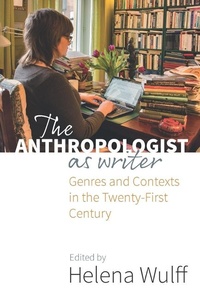
The Anthropologist as Writer
Genres and Contexts in the Twenty-First Century
Published on 1. March 2016
288 pages
978-1-78533-019-3 (ISBN)
Description

Writing is crucial to anthropology, but which genres are anthropologists expected to master in the 21st century? This book explores how anthropological writing shapes the intellectual content of the discipline and academic careers. First, chapters identify the different writing genres and contexts anthropologists actually engage with. Second, this book argues for the usefulness and necessity of taking seriously the idea of writing as a craft and of writing across and within genres in new ways. Although academic writing is an anthropologist's primary genre, they also write in many others, from drafting administrative texts and filing reports to composing ethnographically inspired journalism and fiction.
Reviews / Votes
"Overall, the collection should be a mandatory reference for all working ethnographers in the social sciences and required reading in all graduate courses on ethnographic methods." * Journal of the Royal Anthropological Institute (JRAI)"Due to the volume's overall approach to the writing process as part of the profession, the chapters offer insightful observations for scholars in both early and later stages of their careers... The strength of the edited volume is that each chapter takes a very concrete situation as departure point, from perspectives such as journalism, administration, publishing, activism or funding. These are the basis for wider observations about challenges and opportunities for the writer - the anthropologist - to take into account. As such, it is an extremely valuable resource for anthropologists and ethnographers working in academia." * Anthropological Journal of European Cultures (AJEC)
"This well-written collection of essays is not merely a programmatic statement about the need for anthropologists to experiment with genres, but indicates how it can be done. It succeeds in showing just as much as telling, with examples ranging from the thought-provoking to the entertaining." * Thomas Hylland Eriksen, University of Oslo
More details
Language
English
Place of publication
Oxford
United Kingdom
Target group
Professional and scholarly
Illustrations
Bibliography; Index; 4 Tables, unspecified
ISBN-13
978-1-78533-019-3 (9781785330193)
DOI
10.3167/9781785330186
Copyright in bibliographic data and cover images is held by Nielsen Book Services Limited or by the publishers or by their respective licensors: all rights reserved.
Schweitzer Classification
Other editions
Additional editions
Book
09/2017
1st Edition
Berghahn Books
€41.90
Shipment within 3-4 weeks
Book
03/2016
1st Edition
Berghahn Books
€148.30
Shipment within 3-4 weeks
Person
Helena Wulff is Professor of Social Anthropology at Stockholm University. Among her publications are the monographs Ballet across Borders (1998, Bloomsbury), Dancing at the Crossroads (2007, Berghahn), and Rhythms of Writing (2017, Bloomsbury).
Content
List of Tables
Acknowledgements
Introducing the Anthropologist as Writer: Across and Within Genres
Helena Wulff
PART I: THE ROLE OF WRITING IN ANTHROPOLOGICAL CAREERS
Chapter 1. The Necessity of Being a Writer in Anthropology Today
Dominic Boyer
Chapter 2. Reading, Writing, and Recognition in the Emerging Academy
Don Brenneis
Chapter 3. O Anthropology, Where Art Thou? An Auto-Ethnography of Proposals
Sverker Finnstroem
Chapter 4. The Craft of Editing: Anthropology's Prose and Qualms
Brian Moeran
Chapter 5. The Anglicization of Anthropology: Opportunities and Challenges
Mairead Nic Craith
PART II: ETHNOGRAPHIC WRITING
Chapter 6. The Anthropologist as Storyteller
Alma Gottlieb
Chapter 7. Writing for the Future
Paul Stoller
Chapter 8. Life-writing: Anthropological Knowledge, Boundary-Making, and the Experiential
Narmala Halstead
Chapter 9. Chekhov as Ethnographic Muse
Kirin Narayan
PART III: REACHING OUT: POPULAR WRITING AND JOURNALISM
Chapter 10. On Some Nice Benefits and One Big Challenge of The Second File
Anette Nyqvist
Chapter 11. The Writer as Anthropologist
Oscar Hemer
Chapter 12. Writing Together: Tensions and Joy between Scholars and Activists
Eva-Maria Hardtmann, Vincent Manoharan, Urmila Devi, Jussi Eskola and Swarna Sabrina Francis
PART IV: WRITING ACROSS GENRES
Chapter 13. Fiction and Anthropological Understanding: A Cosmopolitan Vision
Nigel Rapport
Chapter 14. On Timely Appearances: Anthropology, Art, Literature
Mattias Viktorin
Chapter 15. Digital Narratives in Anthropology
Paula Uimonen
Chapter 16. Writing Otherwise
Ulf Hannerz
Index
Acknowledgements
Introducing the Anthropologist as Writer: Across and Within Genres
Helena Wulff
PART I: THE ROLE OF WRITING IN ANTHROPOLOGICAL CAREERS
Chapter 1. The Necessity of Being a Writer in Anthropology Today
Dominic Boyer
Chapter 2. Reading, Writing, and Recognition in the Emerging Academy
Don Brenneis
Chapter 3. O Anthropology, Where Art Thou? An Auto-Ethnography of Proposals
Sverker Finnstroem
Chapter 4. The Craft of Editing: Anthropology's Prose and Qualms
Brian Moeran
Chapter 5. The Anglicization of Anthropology: Opportunities and Challenges
Mairead Nic Craith
PART II: ETHNOGRAPHIC WRITING
Chapter 6. The Anthropologist as Storyteller
Alma Gottlieb
Chapter 7. Writing for the Future
Paul Stoller
Chapter 8. Life-writing: Anthropological Knowledge, Boundary-Making, and the Experiential
Narmala Halstead
Chapter 9. Chekhov as Ethnographic Muse
Kirin Narayan
PART III: REACHING OUT: POPULAR WRITING AND JOURNALISM
Chapter 10. On Some Nice Benefits and One Big Challenge of The Second File
Anette Nyqvist
Chapter 11. The Writer as Anthropologist
Oscar Hemer
Chapter 12. Writing Together: Tensions and Joy between Scholars and Activists
Eva-Maria Hardtmann, Vincent Manoharan, Urmila Devi, Jussi Eskola and Swarna Sabrina Francis
PART IV: WRITING ACROSS GENRES
Chapter 13. Fiction and Anthropological Understanding: A Cosmopolitan Vision
Nigel Rapport
Chapter 14. On Timely Appearances: Anthropology, Art, Literature
Mattias Viktorin
Chapter 15. Digital Narratives in Anthropology
Paula Uimonen
Chapter 16. Writing Otherwise
Ulf Hannerz
Index
