

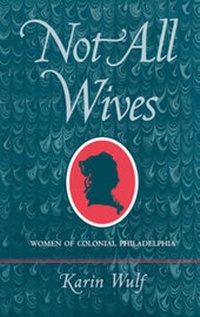
Not All Wives
Women of Colonial Philadelphia
1st Edition
Published on 15. May 2019
240 pages
978-1-5017-4535-5 (ISBN)
Description

Marital status was a fundamental legal and cultural feature of women's identity in the eighteenth century. Free women who were not married could own property and make wills, contracts, and court appearances, rights that the law of coverture prevented their married sisters from enjoying. Karin Wulf explores the significance of marital status in this account of unmarried women in Philadelphia, the largest city in the British colonies.
In a major act of historical reconstruction, Wulf draws upon sources ranging from tax lists, censuses, poor relief records, and wills to almanacs, newspapers, correspondence, and poetry to recreate the daily experiences of women who were never-married, widowed, divorced, or separated. With its substantial population of unmarried women, eighteenth-century Philadelphia was much like other early modern cities, but it became a distinctive proving ground for cultural debate and social experimentation involving those women. Arguing that unmarried women shaped the city as much as it shaped them, Wulf examines popular literary representations of marriage, the economic hardships faced by women, and the decisive impact of a newly masculine public culture in the late colonial period. -- Cornell University Press
In a major act of historical reconstruction, Wulf draws upon sources ranging from tax lists, censuses, poor relief records, and wills to almanacs, newspapers, correspondence, and poetry to recreate the daily experiences of women who were never-married, widowed, divorced, or separated. With its substantial population of unmarried women, eighteenth-century Philadelphia was much like other early modern cities, but it became a distinctive proving ground for cultural debate and social experimentation involving those women. Arguing that unmarried women shaped the city as much as it shaped them, Wulf examines popular literary representations of marriage, the economic hardships faced by women, and the decisive impact of a newly masculine public culture in the late colonial period. -- Cornell University Press
More details
Language
English
Place of publication
Ithaca
United States
Target group
US School Grade: College Graduate Student and over
Edition type
Digital original
Illustrations
2 maps, 5 halftones, 7 tables
2 maps, 5 halftones, 7 tables
ISBN-13
978-1-5017-4535-5 (9781501745355)
Copyright in bibliographic data and cover images is held by Nielsen Book Services Limited or by the publishers or by their respective licensors: all rights reserved.
Schweitzer Classification
Other editions
Additional editions
Book
01/2000
Cornell University Press
€47.06
No shipping information available
Person
Karin Wulf is Assistant Professor of History at American University. She is coeditor of both Milcah Martha Moore's Book: A Commonplace Book from Revolutionary America and the forthcoming Diary of Hannah Callendar, 1758'1788. -- Cornell University Press
Content
- Cover
- Not All Wives
- Title
- Copyright
- Dedication
- Contents
- Illustrations
- Tables
- Preface
- Abbreviations
- INTRODUCTION "Not All Wives": The Problem of Marriage in Early America
- Women, Marriage, and the Historical Literature
- Aunt Bek's Oddity: Situating Unmarried Women in Urban and Regional Cultures
- On Sources and Methods
- CHAPTER ONE Martha Cooper's Choice: Literature and Mentality
- Representations of Marriage: Tyrants and Virgins
- Counter-Claims: Liberated Spinsters
- Reading, Writing, and Learning Singleness
- Conclusion
- CHAPTER TWO Elizabeth Norris's Reign: Religion and Self
- Quaker Culture and a Female Self
- Marriage, Religion, and Female Individualism
- Singleness and Radical Religious Community in Pennsylvania
- Conclusion
- CHAPTER THREE Mary Sandwith's Spouse: Family and Household
- Gender and Household Hierarchy
- Unmarried Women in Rural and Urban Households
- Widows Keeping House
- Servants and Slaves
- Sisters, Aunts, and Cousins
- Household Partnerships
- Conclusion
- CHAPTER FOUR Rachel Draper's Neighborhood: Work and Community
- Neighborhood Community
- Women's Work and the Urban Economy
- Marriage, Work, and Community
- Conclusion
- CHAPTER FIVE Ann Dunlap's "Great Want": Poverty and Public Policy
- Poor Women and Poor Relief
- Gender, Dependence, and Poor-Relief Policy
- Conclusion
- CHAPTER SIX Lydia Hyde's Petition: Property and Political Culture
- Property and Political Authority
- From Property to Masculinity
- Women, Marriage, and the Transformation of Political Culture
- Conclusion
- Index
