

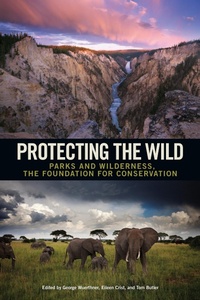
Protecting the Wild
Description

Protected natural areas have historically been the primary tool of conservationists to conserve land and wildlife. These parks and reserves are set apart to forever remain in contrast to those places where human activities, technologies, and developments prevail. But even as the biodiversity crisis accelerates, a growing number of voices are suggesting that protected areas are passé. Conservation, they argue, should instead focus on lands managed for human use-working landscapes-and abandon the goal of preventing human-caused extinctions in favor of maintaining ecosystem services to support people. If such arguments take hold, we risk losing support for the unique qualities and values of wild, undeveloped nature. Protecting the Wild offers a spirited argument for the robust protection of the natural world. In it, experts from five continents reaffirm that parks, wilderness areas, and other reserves are an indispensable-albeit insufficient-means to sustain species, subspecies, key habitats, ecological processes, and evolutionary potential. Using case studies from around the globe, they present evidence that terrestrial and marine protected areas are crucial for biodiversity and human well-being alike, vital to countering anthropogenic extinctions and climate change. A companion volume to Keeping the Wild: Against the Domestication of Earth, Protecting the Wild provides a necessary addition to the conversation about the future of conservation in the so-called Anthropocene, one that will be useful for academics, policymakers, and conservation practitioners at all levels, from local land trusts to international NGOs.
More details
Other editions
Additional editions
Persons
George Wuerthner is the Ecological Projects Director for the Foundation for Deep Ecology, where he does research and writes about environmental issues. For many years he was a full-time freelance photographer and writer and has published thirty-five books on natural history, conservation history, ecology, and environmental issues.
Content
FOREWORD John Terborgh INTRODUCTION Protected Areas and the Long Arc Toward Justice Tom Butler PART ONE: BOLD THINKING ABOUT PROTECTING THE WILD Nature Needs (at least) Half: A Necessary New Agenda for Protected Areas Harvey Locke Bolder Thinking for Conservation Reed F. Noss,Andrew P. Dobson, Robert Baldwin, Paul Beier,Cory R. Davis, Dominick A. DellaSala, John Francis Harvey Locke, Katarzyna Nowak, Roel Lopez, Conrad Reining, Stephen C. Trombulak, and Gary Tabor Caring for People and Valuing Forests in Africa Jane Goodall What Is the Future of Conservation? Daniel F. Doak, Victoria J. Bakker, Bruce Evan Goldstein, and Benjamin Hale Fool's Gold in the Catskill Mountains: Thinking Critically about the Ecosystem Services Paradigm Douglas J. McCauley Parks, People, and Perspectives: Historicizing Conservation in Latin America Emily Wakild The Fight for Wilderness Preservation in the Pacific Northwest Brock Evans Of Tigers and Humans: The Question of Democratic Deliberation and Biodiversity Conservation Helen Kopnina
Protected Areas Are Necessary for Conservation Anthony R. E. Sinclair. PART TWO: REWILDING EARTH, REWILDING OURSELVES I Walk in the World to Love It Eileen Crist Rewilding Europe Christof Schenck The British Thermopylae and the Return of the Lynx George Monbiot Letting It Be on a Continental Scale: Some Thoughts on Rewilding John Davis Yellowstone to Yukon: Global Conservation Innovations Through the Years Harvey Locke and Karsten Heuer Yellowstone as Model for the World George Wuerthner Rewilding Our Hearts: Making a Personal Commitment to Animals and Their Homes Marc Bekoff The Humbling Power of Wilderness Spencer R. Phillips. PART THREE:PROTECTED AREAS: THE FOUNDATION FOR CONSERVATION Conservation in the African Anthropocene Tim Caro The Silent Killer: Habitat Loss and the Role of African Protected Areas to Conserve Biodiversity Kathleen H. Fitzgerald Another Inconvenient Truth: The Failure of Enforcement Systems to Save Charismatic Species Elizabeth L. Bennett America Needs More National Parks Michael J. Kellett A New Era of Protected Areas for the Great Plains Curtis H. Freese Human Impact on Protected Areas of the Peruvian Amazon Marc J. Dourojeanni Protected Areas in Chilean Patagonia Carlos Cuevas Rewilding the Carpathians: A Present-Day Opportunity Barbara and Christoph Promberger Protecting the Wild Nature and Biodiversity of the Altai-Sayan Ecoregion Mikhail Paltsyn The Crucial Importance of Protected Areas to Conserving Mongolia's Natural Heritage Richard P. Reading, Ganchimeg Wingard, Tuvdendorj Selenge, and Sukh Amgalanbaatar Parks: The Best Option for Wildlife Protection in Australia Martin Taylor
