

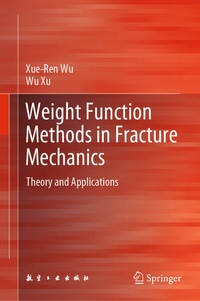
Weight Function Methods in Fracture Mechanics
Description

The book presents the theoretical background of the weight function methods, together with a wealth of analytical weight functions and stress intensity factors for two- and three-dimensional crack geometries; many of these have been incorporated into national, international standards and industrial codes of practice. The accuracy of the results is rigorously verified, and various sample applications are provided. Accordingly, the book offers an ideal reference source for graduate students, researchers, and engineers whose work involves fracture and fatigue of materials and structures, who need not only stress intensity factors themselves but also efficient and reliable tools for obtaining them.
More details
Other editions
Additional editions
Persons
Dr. X. R. Wu (Xue-Ren Wu) obtained his Ph.D. in 1983 from the Royal Institute of Technology (KTH), Stockholm, Sweden. He is Professor at Beijing Institute of Aeronautical materials, where he was technical director for 14 years and senior advisor for 10 years. He was Co-chief Scientist of the Sino-American first aerospace cooperative research program (fatigue and fracture mechanics) between Chinese Aeronautical Establishment (CAE) and National Aeronautics and Space Administration (NASA, USA) from 1987 to 1994. He has promoted China's involvement in international research activities on fatigue life prediction methods for small cracks. He was Chairman of the 7th International Fatigue Congress (FATIGUE'99) in Beijing. Professor Wu has received many awards, including China's National Natural Science Award (1993), Kwang-Hua Science and Technology Foundation Award (1994), the IUMRS first Somiya Award for International Cooperation (2000) jointly with Dr. J C Newman (NASA Langley Research Center), and a number of Technology Progress Awards at the national and ministerial level in China. He published (by Pergamon Press, Oxford England, 1991) the world first weight function book "Weight Functions and Stress Intensity Factor Solutions" co-authored with Professor A J Carlsson. The book has been well received and extensively used by the international fracture mechanics community. He has authored/co-authored over 200 papers and edited several books in the technical literature.
Dr. W. Xu is an associate professor at Shanghai Jiao Tong University. He got his Ph.D. in 2012 from Shanghai Jiao Tong University, Shanghai, China. From 2012 to 2015, he was a postdoctoral research fellow at the Aerospace Engineering Department in the University of Michigan, Ann Arbor, USA. His research interests are mainly focused on fracture mechanics and composite material mechanics. His research was fund by NSFC, AVIC, and the Shanghai Sailing Program for outstanding young talent in science and technology by the Shanghai Municipality. He is the author of more than 50 journal papers.
