

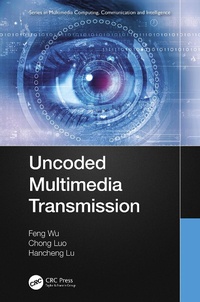
Uncoded Multimedia Transmission
1st Edition
Published on 18. July 2021
348 pages
978-1-000-40871-3 (ISBN)
Description

An uncoded multimedia transmission (UMT) system is one that skips quantization and entropy coding in compression and all subsequent binary operations, including channel coding and bit-to-symbol mapping of modulation. By directly transmitting non-binary symbols with amplitude modulation, the uncoded system avoids the annoying cliff effect observed in the coded transmission system. This advantage makes uncoded transmission more suited to both unicast in varying channel conditions and multicast to heterogeneous users.
Particularly, in the first part of Uncoded Multimedia Transmission, we consider how to improve the efficiency of uncoded transmission and make it on par with coded transmission. We then address issues and challenges regarding how to better utilize temporal and spatial correlation of images and video in the uncoded transmission, to achieve the optimal transmission performance. Next, we investigate the resource allocation problem for uncoded transmission, including subchannel, bandwidth and power allocation. By properly allocating these resources, uncoded transmission can achieve higher efficiency and more robust performance. Subsequently, we consider the image and video delivery in MIMO broadcasting networks with diverse channel quality and varying numbers of antennas across receivers. Finally, we investigate the cases where uncoded transmission can be used in conjunction with digital transmission for a balanced efficiency and adaptation capability.
This book is the very first monograph in the general area of uncoded multimedia transmission written in a self-contained format. It addresses both the fundamentals and the applications of uncoded transmission. It gives a systematic introduction to the fundamental theory and concepts in this field, and at the same time, also presents specific applications that reveal the great potential and impacts for the technologies generated from the research in this field. By concentrating several important studies and developments currently taking place in the field of uncoded transmission in a single source, this book can reduce the time and cost required to learn and improve skills and knowledge in the field.
The authors have been actively working in this field for years, and this book is the final essence of their years of long research in this field. The book may be used as a collection of research notes for researchers in this field, a reference book for practitioners or engineers, as well as a textbook for a graduate advanced seminar in this field or any related fields. The references collected in this book may be used as further reading lists or references for the readers.
Particularly, in the first part of Uncoded Multimedia Transmission, we consider how to improve the efficiency of uncoded transmission and make it on par with coded transmission. We then address issues and challenges regarding how to better utilize temporal and spatial correlation of images and video in the uncoded transmission, to achieve the optimal transmission performance. Next, we investigate the resource allocation problem for uncoded transmission, including subchannel, bandwidth and power allocation. By properly allocating these resources, uncoded transmission can achieve higher efficiency and more robust performance. Subsequently, we consider the image and video delivery in MIMO broadcasting networks with diverse channel quality and varying numbers of antennas across receivers. Finally, we investigate the cases where uncoded transmission can be used in conjunction with digital transmission for a balanced efficiency and adaptation capability.
This book is the very first monograph in the general area of uncoded multimedia transmission written in a self-contained format. It addresses both the fundamentals and the applications of uncoded transmission. It gives a systematic introduction to the fundamental theory and concepts in this field, and at the same time, also presents specific applications that reveal the great potential and impacts for the technologies generated from the research in this field. By concentrating several important studies and developments currently taking place in the field of uncoded transmission in a single source, this book can reduce the time and cost required to learn and improve skills and knowledge in the field.
The authors have been actively working in this field for years, and this book is the final essence of their years of long research in this field. The book may be used as a collection of research notes for researchers in this field, a reference book for practitioners or engineers, as well as a textbook for a graduate advanced seminar in this field or any related fields. The references collected in this book may be used as further reading lists or references for the readers.
More details
Series
Edition
1. Auflage
Language
English
Place of publication
London
United Kingdom
Publishing group
Taylor & Francis Ltd
Target group
College/higher education
Professional and scholarly
Product notice
Reflowable
Illustrations
9 Tables, black and white; 96 Line drawings, black and white; 32 Halftones, black and white; 128 Illustrations, black and white
ISBN-13
978-1-000-40871-3 (9781000408713)
Copyright in bibliographic data and cover images is held by Nielsen Book Services Limited or by the publishers or by their respective licensors: all rights reserved.
Schweitzer Classification
Other editions
Additional editions
Feng Wu | Chong Luo | Hancheng Lu
Uncoded Multimedia Transmission
Book
07/2023
1st Edition
CRC Press
€73.10
Shipment within 15-20 days
Feng Wu | Chong Luo | Hancheng Lu
Uncoded Multimedia Transmission
Book
07/2021
1st Edition
CRC Press
€136.18
Shipment within 15-20 days
Persons
Feng Wu received his B.S. degree in Electrical Engineering from XIDIAN University in 1992. He received his M.S. and Ph.D. degrees in Computer Science from Harbin Institute of Technology in 1996 and 1999, respectively. Now he is a full professor, the assistant to the president of University of Science and Technology of China (USTC) and the director of National Engineering Laboratory of Brain-Inspired Intelligence Technology and Application (NEL-BITA). Before that, he was a principle researcher and a research manager in Microsoft Research Asia. His research interests include image and video compression, media communication, and media analysis and synthesis. He has authored or co-authored over 300 high quality papers (including about 100 Journal papers) and top conference papers on MOBICOM, SIGIR, CVPR and ACM MM. He has 80 granted US patents. His 15 techniques have been adopted into international video coding standards. His work in Google Scholar has been cited 18000+ (H-index as 54) to date. As a co-author, he got the best paper award in IEEE T-CSVT 2009, IEEE VCIP 2016, PCM 2008 and SPIE VCIP 2007. Wu has been a Fellow of IEEE. He serves or served as, EIC of TCSVT, DEiC of TCSVT, Associate Editors in IEEE TIP, IEEE TCSVT, IEEE TMM, and several other International journals. He also serves/served as General Chair in ICME 2019, TPC Chair in MMSP 2011, VCIP 2010 and PCM 2009.
Dr. Chong Luo joined Microsoft Research Asia (MSRA) in 2003, where she is currently a Principal Researcher with the Intelligent Multimedia Group. She is also an Adjunct Professor and Ph.D. advisor with the University of Science and Technology of China (USTC). Dr. Luo received her Ph.D. degree in Electrical Engineering from Shanghai Jiao Tong University in 2012, M.Sc. degree in Computer Science from National University of Singapore (NUS), Singapore in 2002 and B.Sc. degree in Computer Science from Fudan University, China in 2000. She has been an IEEE senior member since 2014. Dr. Luo has been working on various video-related topics, including peer-to-peer video conferencing, wireless video communications, and multimedia cloud computing. Her current research focus is on building intelligent multimedia systems based on advanced AI technologies.
Hancheng Lu received his Ph.D. degree from University of Science and Technology of China (USTC) in July 2005, in Communication and Information Systems. He has been a faculty member of USTC since July 2005 and worked as an associate professor at USTC since Jan. 2008. His research interests include multimedia communication and networking, resource optimization in wireless heterogeneous networks. Lu is active in academic volunteer work. He has served as a reviewer for IEEE JSAC, IEEE TWC, IEEE TMM, IEEE T-CSVT, and Technical Program Committee (TPC) member at IEEE ICC, IEEE GLOBECOM, IEEE WCNC.
Dr. Chong Luo joined Microsoft Research Asia (MSRA) in 2003, where she is currently a Principal Researcher with the Intelligent Multimedia Group. She is also an Adjunct Professor and Ph.D. advisor with the University of Science and Technology of China (USTC). Dr. Luo received her Ph.D. degree in Electrical Engineering from Shanghai Jiao Tong University in 2012, M.Sc. degree in Computer Science from National University of Singapore (NUS), Singapore in 2002 and B.Sc. degree in Computer Science from Fudan University, China in 2000. She has been an IEEE senior member since 2014. Dr. Luo has been working on various video-related topics, including peer-to-peer video conferencing, wireless video communications, and multimedia cloud computing. Her current research focus is on building intelligent multimedia systems based on advanced AI technologies.
Hancheng Lu received his Ph.D. degree from University of Science and Technology of China (USTC) in July 2005, in Communication and Information Systems. He has been a faculty member of USTC since July 2005 and worked as an associate professor at USTC since Jan. 2008. His research interests include multimedia communication and networking, resource optimization in wireless heterogeneous networks. Lu is active in academic volunteer work. He has served as a reviewer for IEEE JSAC, IEEE TWC, IEEE TMM, IEEE T-CSVT, and Technical Program Committee (TPC) member at IEEE ICC, IEEE GLOBECOM, IEEE WCNC.
Content
Part I Video Transmission - Coded or Uncoded
1 Uncoded Video Transmission
2 Advances in Uncoded and Hybrid Multimedia Transmission
Part II Correlation Processing
3 Keeping Redundancy in Transmission
4 Distributed Uncoded Video Transmission
5 Line-based Uncoded Image Transmission
Part III Resource Allocation
6 Joint Bandwidth and Power Allocation
7 Progressive Transmission
8 Superposed Transmission with NOMA
9 Joint Subcarrier Matching and Power Allocation
Part IV MIMO Support
10 Channel Allocation
11 Compressive Sampling Code
12 Multiple Similar Description Code
Part V Hybrid Digital and Analog Transmission
13 A Practical HDA Design
14 Structure-Preserving Hybrid Digital-Analog Transmission
15 Superimposed Modulation for Soft Video Delivery with Hidden
Resources
16 Adaptive HDA Video Transmission in Wireless Fading Channel
Index
References
1 Uncoded Video Transmission
2 Advances in Uncoded and Hybrid Multimedia Transmission
Part II Correlation Processing
3 Keeping Redundancy in Transmission
4 Distributed Uncoded Video Transmission
5 Line-based Uncoded Image Transmission
Part III Resource Allocation
6 Joint Bandwidth and Power Allocation
7 Progressive Transmission
8 Superposed Transmission with NOMA
9 Joint Subcarrier Matching and Power Allocation
Part IV MIMO Support
10 Channel Allocation
11 Compressive Sampling Code
12 Multiple Similar Description Code
Part V Hybrid Digital and Analog Transmission
13 A Practical HDA Design
14 Structure-Preserving Hybrid Digital-Analog Transmission
15 Superimposed Modulation for Soft Video Delivery with Hidden
Resources
16 Adaptive HDA Video Transmission in Wireless Fading Channel
Index
References
