

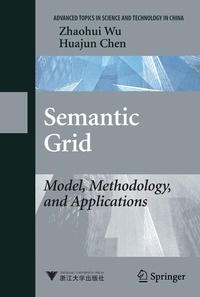
Semantic Grid: Model, Methodology, and Applications
Description

Semantic Grid: Model, Methodology, and Applications introduces to the science, core technologies, and killer applications. First, scientific issues of semantic grid systems are covered, followed by two basic technical issues, data-level semantic mapping, and service-level semantic interoperating. Two killer applications are then introduced to show how to build a semantic grid for specific application domains. Although this book is organized in a step by step manner, each chapter is independent. Detailed application scenarios are also presented. In 1990, Prof. Wu invented the first KB-system tool, ZIPE, based on C on a SUN platform. He proposed the first coupling knowledge representing model, Couplingua, which embodies Rule, Frame, Semantic Network and Nerve Cell Network, and supports symbol computing and data processing computing. His current focus is on semantic web, grid & ubiquitous computing, and their applications in the life sciences.
Reviews / Votes
From the reviews:
"This book is organized proposal of the various components of a system able to integrate grid computing and the semantic Web . . The references are listed at the end of each chapter. A short analytical index is included. . A notable point of this book is the organized presentation of many topics that occur in such a large area as semantic grids. . This book is a definite asset for developers and students." (G. Gini, ACM Computing Reviews, January, 2009)
More details
Other editions
Additional editions
Persons
Prof. Wu's major research areas include distributed artificial intelligence, knowledge-based system, grid computing, semantic web, and ubiquitous computing. He invented the first KB-system tool, ZIPE, based on the C programming language on a SUN platform in China, 1990. He proposed the first coupling knowledge representing model, Couplingua, which embodies Rule, Frame, Semantic Network and Nerve Cell Network and supports symbol computing and traditional data processing computing. During the past few years, his work is mainly focused on semantic web, grid computing, ubiquitous computing and their applications in the life sciences (especially for Traditional Chinese Medicine) and ITS (Intelligent Transportation System). He is the leader of the project DartGrid, a semantic grid toolkit for data integration, which has been used to help build the largest TCM data grid in the world. In year 2005, he was awarded as one of the Outstanding Young Scientists by China National Science Foundation.
