

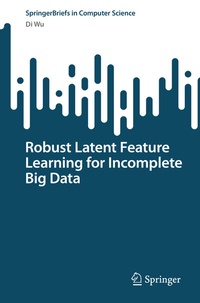
Robust Latent Feature Learning for Incomplete Big Data
Description

Incomplete big data are frequently encountered in many industrial applications, such as recommender systems, the Internet of Things, intelligent transportation, cloud computing, and so on. It is of great significance to analyze them for mining rich and valuable knowledge and patterns. Latent feature analysis (LFA) is one of the most popular representation learning methods tailored for incomplete big data due to its high accuracy, computational efficiency, and ease of scalability. The crux of analyzing incomplete big data lies in addressing the uncertainty problem caused by their incomplete characteristics. However, existing LFA methods do not fully consider such uncertainty.
In this book, the author introduces several robust latent feature learning methods to address such uncertainty for effectively and efficiently analyzing incomplete big data, including robust latent feature learning based on smooth L 1 -norm, improving robustness of latent feature learningusing L 1 -norm, improving robustness of latent feature learning using double-space, data-characteristic-aware latent feature learning, posterior-neighborhood-regularized latent feature learning, and generalized deep latent feature learning. Readers can obtain an overview of the challenges of analyzing incomplete big data and how to employ latent feature learning to build a robust model to analyze incomplete big data. In addition, this book provides several algorithms and real application cases, which can help students, researchers, and professionals easily build their models to analyze incomplete big data.
More details
Other editions
Additional editions
Person
Dr. Di Wu received a Ph.D. degree in Computer Science from Chongqing Institute of Green and Intelligent Technology, Chinese Academy of Sciences, Chongqing, China, in 2019. He was a visiting scholar from April 2018 to April 2019 at the University of Louisiana, Lafayette, USA. Currently, he is a Professor at the College of Computer and Information Science, Southwest University. His current research interests include data mining, artificial intelligence, and big data. He has published over 50 papers, including 12 IEEE TRANSACTIONS papers, three highly cited paper of ESI, and several top-tier conferences such as AAAI, ICDM, WWW, and IJCAI, etc. His Google Scholar citations are more than 1800, and his H-Index is 23. He is an Associate Editor for Frontiers in Neurorobotics (SCI, IF 3.493). He received the Nomination Award for Excellent Doctoral Dissertation of the Chinese Association for Artificial Intelligence (CAAI).
