

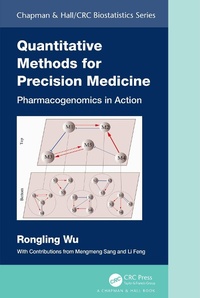
Quantitative Methods for Precision Medicine
Pharmacogenomics in Action
1st Edition
Published on 26. December 2022
306 pages
978-1-4822-1946-3 (ISBN)
Description

Modern medicine is undergoing a paradigm shift from a "one-size-fits-all" strategy to a more precise patient-customized therapy and medication plan. While the success of precision medicine relies on the level of pharmacogenomic knowledge, dissecting the genetic mechanisms of drug response in a sufficient detail requires powerful computational tools. Quantitative Methods for Precision Medicine: Pharmacogenomics in Action presents the advanced statistical methods for mapping pharmacogenetic control by integrating pharmacokinetic and pharmacodynamic principles of drug-body interactions. Beyond traditional reductionist-based statistical genetic approaches, statistical formulization in this book synthesizes elements of multiple disciplines to infer, visualize, and track how pharmacogenes interact together as an intricate but well-coordinated system to mediate patient-specific drug response.
Features:
Functional and systems mapping models to characterize the genetic architecture of multiple medication processes
Statistical methods for analyzing informative missing data in pharmacogenetic association studies
Functional graph theory of inferring genetic interaction networks from association data
Leveraging the concept of epistasis to capture its bidirectional, signed and weighted properties
Modeling gene-induced cell-cell crosstalk and its impact on drug response
A graph model of drug-drug interactions in combination therapies
Critical methodological issues to improve pharmacogenomic research as the cornerstone of precision medicine
This book is suitable for graduate students and researchers in the fields of biology, medicine, bioinformatics and drug design and delivery who are interested in statistical and computational modelling of biological processes and systems. It may also serve as a major reference for applied mathematicians, computer scientists, and statisticians who attempt to develop algorithmic tools for genetic mapping, systems pharmacogenomics and systems biology. It can be used as both a textbook and research reference. Professionals in pharmaceutical sectors who design drugs and clinical doctors who deliver drugs will also find it useful.
Features:
Functional and systems mapping models to characterize the genetic architecture of multiple medication processes
Statistical methods for analyzing informative missing data in pharmacogenetic association studies
Functional graph theory of inferring genetic interaction networks from association data
Leveraging the concept of epistasis to capture its bidirectional, signed and weighted properties
Modeling gene-induced cell-cell crosstalk and its impact on drug response
A graph model of drug-drug interactions in combination therapies
Critical methodological issues to improve pharmacogenomic research as the cornerstone of precision medicine
This book is suitable for graduate students and researchers in the fields of biology, medicine, bioinformatics and drug design and delivery who are interested in statistical and computational modelling of biological processes and systems. It may also serve as a major reference for applied mathematicians, computer scientists, and statisticians who attempt to develop algorithmic tools for genetic mapping, systems pharmacogenomics and systems biology. It can be used as both a textbook and research reference. Professionals in pharmaceutical sectors who design drugs and clinical doctors who deliver drugs will also find it useful.
Reviews / Votes
"This book, a valuable addition to the Chapman & Hall/CRC Biostatistics Series, caters to researchers and graduate students with an interest in advanced statistical genetics models and methods. The author, distinguished Professor Rongling Wu, leverages his extensive experience in the field to build upon the pioneering research presented in his previous works, Statistical Genetics of Quantitative Traits and Statistical and Computational Pharmacogenomics. This book offers a comprehensive array of statistical models and methods tailored specifically for pharmacogenomic research, equipping practitioners with innovative genetic research tools that contribute significantly to the evolution of precision medicine. . . . offers an in-depth exploration of quantitative methods in precision medicine, with a particular emphasis on pharmacogenomics. The book addresses a wide array of theoretical and practical issues within precision medicine, targeted toward readers with a strong statistical background working in diverse fields such as biology, medicine, bioinformatics, and drug design. Serving as an indispensable resource for those interested in statistical and computational modeling of biological systems, its selfcontained chapters make it ideal for individual study, as a source of graduate-level project topics, or as a reference for professionals seeking to apply statistical and computational modeling to foster innovation."~Arthur Berg, Journal of the American Statistical Association
More details
Series
Edition
1. Auflage
Language
English
Place of publication
Philadelphia, PA
United States
Publishing group
Taylor & Francis Inc
Target group
Professional and scholarly
College/higher education
Illustrations
17 Tables, black and white; 65 Line drawings, color; 65 Illustrations, color
ISBN-13
978-1-4822-1946-3 (9781482219463)
Copyright in bibliographic data and cover images is held by Nielsen Book Services Limited or by the publishers or by their respective licensors: all rights reserved.
Schweitzer Classification
Other editions
Additional editions
Book
12/2022
1st Edition
Chapman & Hall/CRC
€128.50
Article not available for order
Person
Rongling Wu develops a transdisciplinary approach for building up multilayer, multiscale and multifunctional bridges that link genotype to phenotype. Dr. Wu asks, answers, and disseminates biologically meaningful questions in the boundaries of statistics, genetics, ecology, and evolution. He invented a statistical method called functional mapping to reveal the genetic architecture of developmental trajectories and incorporated this approach into the context of eco-evo-devo research aimed to unveil the genetic and ecological mechanisms underpinning evolutionary novelties. More recently, Dr. Wu has integrated evolutionary game theory and predator-prey theory through naturally omnipresent allometric scaling law into graph theory to create a new theory - functional game-graph theory. This new theory can unravel the internal workings of complex systems at an unprecedented level of detail by charting and tracing the causal, signed, and weighted roadmap of relationships among high- or even ultrahigh-dimensional variables from any data domains. The second part of this book represents the application of this theory to pharmacogenomic research. Dr. Wu received his PhD in forest genetics at the University of Washington in 1995. He was appointed as Assistant Professor of Statistics at the University of Florida in 2000 and awarded the University Foundation Professorship in 2007. Since 2008, Dr. Wu has been Professor of Public Health Sciences and Statistics, promoted to Distinguished Professor in 2015, and served as Director of the Center of Statistical Genetics at The Pennsylvania State University. Dr. Wu is a Fellow of the American Statistical Association and a Fellow of American Association for the Advancement of Science.
Dr. Sang and Ms. Feng are collaborators of this book writing project under the leadership of Dr. Wu. Dr. Sang got his PhD degree at Beijing Forestry University in 2019 and is currently working as Lecturer of Medical Informatics at Nantong University Medical School, China. Ms. Feng is a PhD candidate in computational biology at Beijing Forestry University and going to graduate in 2023. The research interest of both Dr. Sang and Ms. Feng lies in the statistical modeling of computational biology and its applications to a broader area of agriculture, forestry, medicine, and beyond.
Dr. Sang and Ms. Feng are collaborators of this book writing project under the leadership of Dr. Wu. Dr. Sang got his PhD degree at Beijing Forestry University in 2019 and is currently working as Lecturer of Medical Informatics at Nantong University Medical School, China. Ms. Feng is a PhD candidate in computational biology at Beijing Forestry University and going to graduate in 2023. The research interest of both Dr. Sang and Ms. Feng lies in the statistical modeling of computational biology and its applications to a broader area of agriculture, forestry, medicine, and beyond.
Content
1. Methodological Foundation of Precision Medicine. 1.1. Interpersonal variability in drug response. 1.2. Mechanistic modelling of drug response. 1.3 Statistical models for mapping drug response. 1.4 Network mapping of drug response. 1.5 Conclusions and Outlook. Part I: Pharmacokinetic-Pharmacodynamic Pharmacogenetics. 2. Pharmacogenetic Dissection by Functional Mapping. 2.1. Introduction. 2.2. Quantitative Genetics. 2.3. A General Framework for Functional Mapping. 2.4 Pharmacogenetic Application of Functional Mapping. 2.5. High-dimensional Functional Mapping. 2.6. Concluding Remarks. 3. A Multiscale Model of Pharmacokinetic-Pharmacodynamic Mapping. 3.3. Heterochronopharmacodynamic Mapping. 3.4. Mapping Multifaceted Drug Reactions. 3.5. Concluding Remarks. 4. Pharmacogenetic Mapping of Missing Longitudinal Data. 4.1 Introduction. 4.2. Strategies for Modeling Non-Ignorable Dropout Data. 4.3. Haplotyping Drug Response Using the Pattern-Mixture Model. 4.4. Haplotyping Drug Response Using the Selection Model. 4.5. Concluding Remarks. 5. Systems Mapping of Drug Response. 5.1. Introduction. 5.2. ODE Modeling of PK/PD Machineries. 5.3. Systems Mapping: Model and Algorithm. 5.4. Stochastic Systems Mapping. 5.5. Concluding Remarks. Part II. Network Pharmacogenetics. 6. Network Mapping of Drug Response. 6.1. Introduction. 6.2. Functional Graph Theory. 6.3. Functional Pharmacogenetic Interaction Networks: An Example. 6.4. Fine-Grained Dissection of Pharmacogenetic Networks. 6.5. Modularity Theory and Dunbar's law. 6.6. Concluding Remarks. 7. Learning Individualized Pharmacogenetic Networks. 7.1. Introduction. 7.2. A Framework for Network Inference. 7.3. Coalescing Individualized Networks into Stratification-Specific Networks. 7.4. Computer Simulation. 7.5. Reconstructing Multilayer Genetic Networks. 7.6. Concluding Remarks. 8. A Game-Theoretic Model of Cell Crosstalk in Drug Response. 8.1. Introduction. 8.2. GameTalker: A crosstalk model of tumor-microenvironment interactions. 8.3. Modeling Personalized Cell-Cell Interaction Networks. 8.4. Reconstructing multilayer gene regulatory networks of tumor-TME interactions. 8.5. Predictive network model for cancer growth. 8.6 Concluding Remarks. 9. A Graph Model of Personalized Drug-Drug Interactions. 9.1. Introduction. 9.2. Inferring DDI networks. 9.3. Inferring dynamic DDI networks from static data. 9.4. Coalescing high-order DDIs into hypernetworks. 9.5. Learning Large-scale DDI Networks. 9.6. Concluding remarks. 10. Pharmacogenomics as a Cornerstone of Precision Medicine: Methodological Leveraging. 10.1. Introduction. 10.2. How Drug Works. 10.3. Correcting for Relatedness in Pharmacogenomics GWAS. 10.4 Family-based Designs for PGx Studies. 10.5. Intertwined Epistatic and Epistatic Networks. 10.6. Pharmacosystems Biology: from Pharmacogenomics to Pharmaco-Omics. 10.7. Concluding Remarks.
