

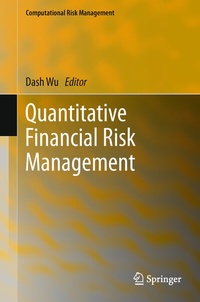
Quantitative Financial Risk Management
1st Edition
Published on 25. June 2011
X, 338 pages
978-3-642-19339-2 (ISBN)
Description

The bulk of this volume deals with the four main aspects of risk management: market risk, credit risk, risk management - in macro-economy as well as within companies. It presents a number of approaches and case studies directed at applying risk management to diverse business environments. Included are traditional market and credit risk management models such as the Black-Scholes Option Pricing Model, the Vasicek Model, Factor models, CAPM models, GARCH models, KMV models and credit scoring models.
More details
Other editions
Additional editions
Desheng Dash Wu
Quantitative Financial Risk Management
Book
06/2011
Springer
€160.49
Shipment within 7-9 days
Content
- Intro
- Preface
- References
- Contents
- Part I: Market Risk Management
- Empirical Analysis of Risk Measurement of Chinese Mutual Funds
- 1 Introduction
- 2 Literature Review
- 3 Empirical Analysis
- 4 Conclusion
- References
- Assess the Impact of Asset Price Shocks on the Banking System
- 1 Introduction
- 2 Liquidity Risk Macro Stress-Testing Framework
- 2.1 Monte Carlo Simulations of Market Risk Shocks
- 2.2 Market-Risk Equations, Default-Risk Equations and Liquidity Risk Equations
- 2.2.1 Market-Risk Equations
- 2.2.2 Default-Risk Equations
- 2.2.3 Liquidity Risk Equations
- 3 Data Sample and Sources
- 4 Specification of Stress Scenarios
- 5 Simulation Results
- 6 Conclusion
- Appendix
- Econometric Estimation of the Relationship Between the Probability of Default and the Monthly Retail Deposit Outflow Rate
- References
- Comparative Study on Minimizing the Risk of Options for Hedge Ratio Model of Futures
- 1 Introduction
- 2 Traditional Minimize Option Hedge Ratio of
- 2.1 Traditional Simple Regression Models
- 2.2 Dual Variable Vector Autoregressive Model
- 2.3 Error Correction Hedging Model
- 2.4 General Auto-regressive Conditional Heteroscedastic Model
- 3 CVaR Options Optimal Hedging Ratio Model
- 3.1 CVaR Model Derived
- 3.2 Model´s Establishment
- 3.3 Model Comparison Vertical Analysis
- 4 Summary
- References
- The Application of Option Pricing Theory in Participating Life Insurance Pricing Based On Vasicek Model
- 1 Introduction
- 2 Fair Premium Pricing
- 3 Conclusion
- References
- The Study of Applying Black-Scholes Option Pricing Model to the Term Life Insurance
- 1 Introduction
- 2 B-S Option Pricing Model
- 2.1 The Derivation of Black-Scholes Option Pricing Model
- 2.2 European Put Option Formula
- 3 Option Features of Insurance
- 4 The Application of B-S Option Pricing Model
- 5 The Conclusion
- References
- Evolutionary Variation of Service Trade Barriers in Banking: A Case of ASEAN+3
- 1 Introduction
- 2 Measurements of Trade Barriers in Banking
- 2.1 Identification of Non-prudential and Prudential Components and Scores
- 2.2 Estimation of Weights
- 2.3 Evaluation Results of TRI in ASEAN+3
- 3 Data Description
- 4 Conclusions and Future Research
- Appendix
- References
- Corporate Board Governance and Risk Taking
- 1 Introduction
- 2 Literature Review
- 2.1 Corporate Risk Taking
- 2.2 Board Governance
- 3 Research Design
- 3.1 Sample Selection and Data Source
- 3.2 Research Variables
- 3.3 Research Models
- 4 Empirical Results
- 4.1 Descriptive Statistics
- 4.2 Regression Results
- 5 Conclusion
- References
- The Risk Factors Analysis of the Term Structure of Interest Rate in the Interbank Bond Market
- 1 Introduction
- 2 Literature Review
- 3 Methodology
- 4 Empirical Analysis
- 4.1 Principal Component Analysis
- 4.2 Relative Importance of the Factors
- 5 Conclusion
- References
- Pricing of Convertible Bond Based on GARCH Model
- 1 Introduction
- 2 Hypothesis
- 3 Convertible Bond Pricing Model
- 3.1 Volatility Model
- 3.2 Parameter Estimation
- 4 Empirical Studies
- 4.1 Historical Volatility Model
- 4.2 GARCH Volatility Model
- 4.3 Threshold Structure GARCH Model
- 4.4 Empirical Results
- 5 Conclusion
- References
- Sentiment Capital Asset Cognitive Price and Empirical Evidence from China's Stock Market
- 1 Introduction
- 2 Description, Assumption, Construction and Solution of Model
- 2.1 Model Description and Assumption
- 2.2 Model Construction and Solution
- 3 Empirical Evidence
- 3.1 Construction of Investor Sentiment
- 3.2 Calculation of Cognitive and Transition Probability Matrixes
- 3.3 Calculation of the Cognitive Price of the Asset
- 4 Conclusions
- References
- Carbon Emission Markets
- 1 Introduction
- 2 Carbon Markets
- 2.1 European Union Emissions Trading Scheme
- 2.2 Other Emissions Trading Markets
- 3 Modeling and Pricing in Emission Markets
- 3.1 Equilibrium Models
- 3.2 Stochastic Modeling
- 4 Conclusion
- References
- Part II: Credit Risk Management
- Dynamic Asset Allocation with Credit Risk
- 1 Introduction
- 2 Financial Market Model
- 2.1 Information Structure
- 2.2 Dynamics of Financial Assets Prices under Q
- 2.3 Dynamics of Financial Assets Prices under P
- 3 Optimal Asset Allocation Solution
- 4 Numerical Analysis
- 5 Conclusion
- References
- Analysis of the Factors Influencing Credit Risk of Commercial Banks
- 1 Introduction
- 2 Related Studies
- 3 Relevant Concepts and Models
- 3.1 The Definition of Non-performing Loans
- 3.2 Mixed Effects Model
- 4 Empirical Analysis
- 5 Conclusion
- References
- The Credit Risk Measurement of China´s Listed Companies Based on the KMV Model
- 1 Introduction
- 2 Literature Review
- 2.1 The Credit Risk and KMV Model Study in the Western Countries
- 2.2 The Credit Risk Measurement and KMV Model Study in China
- 3 Samples and Parameters
- 3.1 The Calculation Process of the KMV Model
- 3.1.1 The Calculation of Default Distance
- 3.1.2 The Calculation of EDF
- 3.2 The Sample Choosing of the Listed Company
- 3.3 Model Parameters
- 3.3.1 The Determination of no Risk Rate
- 3.3.2 The Determination of Default Point
- 3.3.3 Listed Companies
- 3.3.4 The Company Assets Value and the Volatility
- 4 The Measurement of Credit Risk Based on the KMV Model
- 4.1 The Calculation of Default Distance of Samples Companies
- 4.2 The Differentiation Analysis of ST Stock and Non-ST Stock
- 4.3 The Correlation Analysis Between Default Distance Value and Solvency
- 4.3.1 The Correlation Analysis to the Assets Liabilities Ratio
- 4.3.2 The Correlation to the Current Ratio and Interest Earned Ratio
- 4.4 The Relationship Between DD and the Real Loan Cost of Companies
- 5 The Influence of Macro Level Fluctuation to the KMV and DD
- 5.1 The Calculation of the Sample Enterprises´ Default Distance in Different Years
- 5.2 The Relationship Between Default Distance and the Prosperity Degree Data of the Related Industries
- 5.3 The Indicator Relationship Between Default Distance of the Five Sample Enterprises and GDP Growth Rate
- 5.4 The Summary of the Default Distance of Credit Risk Measurement
- 6 Conclusion
- References
- Consumer Credit Risk Research Based on Our Macroeconomic Environment
- 1 Introduction
- 2 The Current Situation of Consumer Finance Market in Our Country
- 2.1 High-Speed Growth in the Credit Scale
- 2.2 The Type of Financial Institutions Engaged in Consumer Finance Services Is Single
- 2.3 Lake of Consumer Finance Products
- 3 The Influence Effects on the Consumer Credit Risk Based on Our Country´s Macroeconomic Environment
- 3.1 The Change of Residents´ Capacity to Repay the Loans Influences the Credit Risk Exposures
- 3.1.1 The Influence of the Growth Rate of GDP and Fiscal Taxation on Residents´ Disposable Income
- 3.1.2 The Influence on the Income Source from Daily Consumption Expenditure
- 3.2 The Change of Assets-Liabilities Structure Cause the Liquidity Risk
- 3.3 The Rise of Interest Rate Intensifies the Interest Rate Risk
- 4 The Proposals on the Consumer Credit Risk Management
- 4.1 Optimize the Finance-Taxation Policy and Improve the Reimbursement Ability
- 4.2 Perfect the Credit Product Portfolio and Improve the Term Structure
- 4.3 Pay Attention to the Term Mismatch of Assets and Liabilities and Beware of the Liquidity Risk
- 5 Conclusion
- References
- Wealth Effects of the Creditor in Mergers: Evidence from Chinese Listed Companies
- 1 Introduction
- 2 Methodology and Valuation model
- 2.1 Basic Logic of Valuation Model
- 2.2 Valuation of Debt, Equity and the Firm
- 2.3 Definition of Wealth Effects of the Creditor
- 3 Empirical Study Design and Sample Selection
- 3.1 Empirical Study Design
- 3.2 Data Sources and Sample Selection
- 4 Empirical Analysis
- 4.1 Descriptive Statistics of Samples
- 4.2 Regression Results and Explanation
- 4.3 Discussions on Wealth Effects of Creditors and Merger Risks for the Healthy
- 5 Conclusions
- References
- Part III: Risk Management in Enterprises
- Research on the Economy Fluctuations with Energy Consumption of China Based on H-PFiltration
- 1 Introduction
- 2 Co-integration Analyses Based on H-P Filtration
- 2.1 Co-integration and Unit Root Test
- 2.2 The Basic Principles of H-P Filtration
- 3 Discussion
- 4 Empirical Study Based on H-P Filtration
- 4.1 The Analysis of Trend Fluctuations
- 4.2 The Analysis of Cycle Fluctuations
- 5 Conclusions
- References
- Enterprise Risk Assessment and Forecast: Based on Chinese Listed Companies in 2009-2010
- 1 Introduction
- 2 Risk Factors Identification
- 2.1 Current Operation Analysis
- 2.2 Risk Factors Identification
- 3 Risk Assessment and Analysis
- 3.1 Static Bayesian Network Model on Risk Measurement
- 3.2 Dynamic Bayesian Network Model on Risk Measurement
- 3.3 Sample and Index Selection
- 3.4 Risk Assessment and Analysis
- 4 Risk Forecast and Analysis
- 5 Conclusion
- References
- The Prevention and Control of Environmental Liability Based on Environmental Risk Management and Assessment in Enterprise
- 1 Introduction
- 2 Environmental Risk: Main Driving Force of Environmental Liabilities
- 3 Environmental Risk Assessment and Management Technology and Its Application in Environmental Liabilities
- 4 The Prevention and Control of Environmental Liability
- 5 Conclusion
- References
- Supply Chain Risk Management Review and a New Framework for Petroleum Supply Chains
- 1 Introduction
- 2 A Hierarchical SCRM Framework
- 3 Strategic Supply Chain Risk Management
- 3.1 Customer Management
- 3.2 Supplier Management
- 3.3 Product Management
- 3.4 Operations Management
- 3.5 Financial Management
- 4 Tactical Supply Chain Risk Management
- 4.1 Customer Management
- 4.2 Supplier Management
- 4.3 Product Management
- 4.4 Operations Management
- 4.5 Financial Management
- 5 Operational Supply Chain Risk Management
- 5.1 Customer Management
- 5.2 Supplier Management
- 5.3 Operations Management
- 5.4 Information Management
- 5.5 Financial Management
- 6 Integrated SCRM and Industry Streams
- 7 A Shift to the PSC Paradigm
- 7.1 The Petroleum Supply Chain
- 7.2 PSC: Risk Management Challenges
- 7.3 References from the Process Industry
- 8 A Risk Management Framework Methodology
- 9 Opportunities for PSC-RM Modeling
- 10 Conclusions
- References
- Towards a Supply Risk Management Capability Process Model: An Analysis of What Constitutes Excellence in Supply Risk Management Across Different Industry Sectors
- 1 Introduction
- 2 A Review of Supply Risk Management Literature
- 3 Development of the Supply Risk Management Capability Maturity Model
- 3.1 Strategic Process
- 3.1.1 Supply Risk Strategy
- 3.2 Core Processes
- 3.2.1 Supply Risk Identification
- 3.2.2 Supply Risk Assessment
- 3.2.3 Supply Risk Response/Treatment
- 3.2.4 Supply Risk Monitoring
- 3.3 Enabling Processes
- 3.3.1 Risk Management Guidelines and Procedures
- 3.3.2 IT Integration of Supply Risk Management
- 3.3.3 Training for Supply Risk Management
- 3.4 SRM Process Proficiency Levels
- 4 Research Method
- 5 Discussion of Firm Cases Based on Their Assessment in the SRM-CMM
- 5.1 Strategic Process
- 5.1.1 Supply Risk Strategy
- 5.2 Core Processes
- 5.2.1 Supply Risk Identification
- 5.2.2 Supply Risk Assessment
- 5.2.3 Supply Risk Response/Treatment
- 5.2.4 Supply Risk Monitoring
- 5.3 Enabling Processes
- 5.3.1 Risk Management Guidelines and Procedures
- 5.3.2 IT Integration of Supply Risk Management
- 5.3.3 Training for Supply Risk Management
- 6 Conclusion and Implications for Management Practice
- Reference
- Enterprise Risk Management from Theory to Practice: The Role of Dynamic Capabilities Approach - the ``Spring´´ Model
- 1 Introduction
- 2 Organizational Complexity and Risk Evolution
- 2.1 Organizational Complexity
- 2.2 Risk Evolution
- 3 Development of the ``Spring´´ Model
- 4 Implementation of the ``Spring´´ Model in an Engineering and Contracting Company
- 4.1 The Company
- 4.2 The ``Spring´´ Model in Action
- 5 Discussion
- 6 Conclusions
- References
- Part IV: Risk Management in Macro-economy
- Risk Index of China´s Macroeconomic Operation: Method and Application
- 1 Introduction
- 2 Literature Review
- 3 Establish of Risk Index
- 3.1 Index Selection
- 3.2 Index Weights
- 3.3 Model and Risk Interval
- 4 Risk Forecast
- 5 Conclusion
- References
- Appendix
- Matrix of the Importance of Indicators
- Systemic Risk
- 1 Introduction
- 2 Distressed Markets
- 2.1 Value at Risk
- 2.2 Turbulent Markets
- 2.3 Downturn Markets
- 3 Measuring Systemic Risk
- 4 Results
- 5 Conclusion
- Appendix A: Results VaR Approach
- Appendix B: Results Heuristic Approach
- References
