

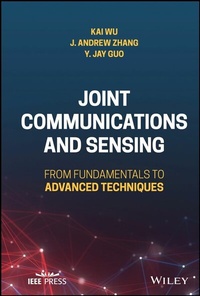
Joint Communications and Sensing
Description

Authoritative resource systematically introducing JCAS technologies and providing valuable information and knowledge to researchers and engineers
Based on over six years of dedicated research on joint communications and sensing (JCAS) by the authors, their collaborators, and students, Joint Communications and Sensing is the first book to comprehensively cover the subject of JCAS, which is expected to deliver huge cost and energy savings, and therefore has become a hallmark of future 6G and next generation radar technologies.
The book has three parts. Part I presents the basic JCAS concepts and applications and the basic signal processing algorithms to support JCAS. Part II covers communications-centric JCAS designs that describe how sensing can be integrated into communications networks such as 5G and 6G. Part III presents ways to integrate communications in various radar sensing technologies and platforms.
Specific sample topics covered in Joint Communications and Sensing include:
* Three categories of JCAS systems, potential sensing applications of JCAS, signal processing fundamentals, and channel models for communications and radar
* Frameworks for perceptive mobile networks (PMNs), system modifications to enable PMN sensing, and PMN system issues
* Orthogonal time-frequency space waveform-based JCAS for IoT, including signal models, echo pre-processing, and target parameter estimation
Joint Communications and Sensing provides valuable information and knowledge to researchers and engineers in the communications and radar sensing communities and industries, enabling them to upskill and prepare for JCAS technology research and development. The text is of particular interest to engineers in the wireless communications industry who are pursuing new capabilities in 6G.
More details
Other editions
Additional editions
Persons
Kai Wu, PhD, is a Research Fellow at the Global Big Data Technologies Centre, University of Technology Sydney (UTS), Australia.
J. Andrew Zhang, PhD, is an Associate Professor at the School of Electrical and Data Engineering, University of Technology Sydney, Australia.
Y. Jay Guo, PhD, is the Director of Global Big Data Technologies Centre and Distinguished Professor at University of Technology Sydney, Australia. He co-edited the Wiley-IEEE Press title Antenna and Array Technologies for Future Wireless Ecosystems (2022) and co-authored the Wiley-IEEE Press title Advanced Antenna Array Engineering for 6G and Beyond Wireless Communications (2021).
Content
Acknowledgments xiii
Preface xv
Acronyms xvii
Part I Fundamentals of Joint Communications and
Sensing (JCAS) 1
1 Introduction to Joint Communications and Sensing
(JCAS) 3
1.1 Background 3
1.2 Three Categories of JCAS Systems 5
1.2.1 Major Differences Between Communications and Sensing 7
1.2.2 Communications-Centric Design 12
1.2.3 Radar-Centric Design 15
1.2.4 Joint Design without an Underlying System 17
1.2.5 Summary of Key Research Problems 18
1.3 Potential Sensing Applications of JCAS 18
1.4 Book Organization 22
References 24
2 Signal Processing Fundamentals for JCAS 31
2.1 Channel Model for Communications and Radar 31
2.2 Basic Communication Signals and Systems 33
2.2.1 Single-Carrier MIMO 33
2.2.2 MIMO-OFDM 34
2.2.3 Transmitter and Receiver Signal Processing in Communications 34
2.3 MIMO Radar Signals and Systems 36
2.3.1 Single-Carrier MIMO Radar 36
2.3.2 MIMO-OFDM Radar 37
2.3.3 FH-MIMO Radar 38
2.4 Basic Signal Processing for Radar Sensing 40
2.4.1 Matched Filtering 40
2.4.2 Moving Target Detection (MTD) 41
2.4.3 Spatial-Domain Processing 42
2.4.4 Target Detection 43
2.4.5 Spatial Refinement 44
2.5 Signal Processing Basics for Communication-Centric JCAS 44
2.5.1 802.11ad JCAS Systems 44
2.5.2 Mobile Network with JCAS Capabilities 46
2.5.3 Sensing Parameter Estimation 46
2.5.3.1 Direct and Indirect Sensing 47
2.5.3.2 Sensing Algorithms 49
2.6 Signal Processing Basics for DFRC 50
2.6.1 Embedding Information in RadarWaveform 50
2.6.2 Signal Reception and Processing for Communications 52
2.6.2.1 Demodulation 53
2.6.2.2 Channel Estimation 54
2.6.3 Codebook Design 54
2.7 Conclusions 55
References 55
3 Efficient Parameter Estimation 59
3.1 Q-Shifted Estimator (QSE) 60
3.2 Refined QSE (QSEr) 62
3.2.1 Impact ofq 62
3.2.2 Refined Optimalq 66
3.2.3 Numerical Illustration of QSEr 67
3.3 Padé approximation-Enabled Estimator 70
3.3.1 Core Updating Function 71
3.3.2 Initialization and Overall Estimation Procedure 74
3.3.3 Numerical Illustrations 76
3.4 Conclusions 80
References 80
Part II Communication-Centric JCAS 83
4 Perceptive Mobile Network (PMN) 85
4.1 Framework for PMN 85
4.1.1 System Platform and Infrastructure 86
Trim Size: 6in x 9in Single Column Wu982913 ftoc.tex V1 - 09/06/2022 5:13pm Page vii
[1]
[1] [1]
[1]
Contents vii
4.1.1.1 CRAN 87
4.1.1.2 Standalone BS 87
4.1.2 Three Types of Sensing Operations 88
4.1.2.1 Downlink Active Sensing 88
4.1.2.2 Downlink Passive Sensing 88
4.1.2.3 Uplink Sensing 89
4.1.2.4 Comparison 89
4.1.3 Signals Usable from 5G NR for Radio Sensing 90
4.1.3.1 Reference Signals Used for Channel Estimation 90
4.1.3.2 Nonchannel Estimation Signals 92
4.1.3.3 Data Payload Signals 92
4.2 System Modifications to Enable Sensing 92
4.2.1 Dedicated Transmitter for Uplink Sensing 93
4.2.2 Dedicated Receiver for Downlink (and Uplink) Sensing 94
4.2.3 Full-Duplex Radios for Downlink Sensing 94
4.2.4 Base Stations with Widely Separated Transmitting and Receiving
Antennas 96
4.3 System Issues 98
4.3.1 Performance Bounds 98
4.3.2 Waveform Optimization 100
4.3.2.1 Spatial Optimization 102
4.3.2.2 Optimization in Time and Frequency Domains 105
4.3.2.3 Optimization with Next-Generation Signaling Formats 106
4.3.3 Antenna Array Design 106
4.3.3.1 Virtual MIMO and Antenna Grouping 107
4.3.3.2 Sparse Array Design 108
4.3.3.3 Spatial Modulation 109
4.3.3.4 Reconfigurable Intelligent Surface-Assisted JCAS 109
4.3.4 Clutter Suppression Techniques 110
4.3.4.1 Recursive Moving Averaging (RMA) 112
4.3.4.2 Gaussian Mixture Model (GMM) 113
4.3.5 Sensing Parameter Estimation 114
4.3.5.1 Periodogram such as 2D DFT 115
4.3.5.2 Subspace-Based Spectrum Analysis Techniques 115
4.3.5.3 On-Grid Compressive Sensing Algorithms 117
4.3.6 Resolution of Sensing Ambiguity 119
4.3.7 Pattern Analysis 122
4.3.8 Networked Sensing under Cellular Topology 123
4.3.8.1 Fundamental Theories and Performance Bounds for "Cellular Sensing
Networks" 123
4.3.8.2 Distributed Sensing with Node Grouping and Cooperation 124
4.3.9 Sensing-Assisted Communications 124
4.3.9.1 Sensing-Assisted Beamforming 124
4.3.9.2 Sensing-Assisted Secure Communications 128
4.4 Conclusions 128
References 128
5 Integrating Low-Complexity and Flexible Sensing into
Communication Systems: A Unified Sensing
Framework 139
5.1 Problem Statement and Signal Model 139
5.1.1 Signal Model 140
5.1.2 Classical OFDM Sensing (COS) 142
5.1.3 Problem Statement 143
5.1.3.1 CP-limited Sensing Distance 143
5.1.3.2 Communication-limited Velocity measurement 143
5.1.3.3 COS adapted for DFT-S-OFDM 144
5.2 A Low-Complexity Sensing Framework 144
5.3 Performance Analysis 150
5.3.1 Preliminary Results 150
5.3.2 Analyzing Signal Components in Two RDMs 151
5.3.3 Comparison and Insights 154
5.3.4 Criteria for Setting Key Sensing Parameters 157
5.4 Simulation Results 158
5.4.1 Illustrating SINRs in RDMs 159
5.4.2 Illustration of Target Detection 162
5.5 Conclusions 166
References 167
6 Sensing Framework Optimization 169
6.1 Echo Preprocessing 169
6.1.1 Reshaping 170
6.1.2 Virtual Cyclic Prefix (VCP) 171
6.1.3 Removing Communication Information 174
6.2 Target Parameter Estimation 177
6.2.1 Parameter Estimation Method 177
6.2.2 Computational Complexity 181
6.3 Optimizing Parameters of Sensing Methods 182
6.3.1 Preliminary Results 183
6.3.2 Maximizing SINR for Parameter Estimation 184
6.4 Simulation Results 186
6.4.1 Comparison with Benchmark Method 186
Trim Size: 6in x 9in Single Column Wu982913 ftoc.tex V1 - 09/06/2022 5:13pm Page ix
[1]
[1] [1]
[1]
Contents ix
6.4.2 Wide Applicability 189
6.5 Conclusions 192
References 193
Part III Radar-Centric Joint Communications and
Sensing 195
7 FH-MIMO Dual-Function Radar-Based Communications:
Single-Antenna Receiver 197
7.1 Problem Statement 198
7.2 Waveform Design for FH-MIMO DFRC 199
7.2.1 FH-MIMO RadarWaveform 200
7.2.2 Overall Channel Estimation Scheme 202
7.2.2.1 Estimate Timing Offset 203
7.2.2.2 Estimate Channel Parameters 203
7.3 Estimating Timing Offset 203
7.3.1 Two Estimation Methods 204
7.3.2 Performance Analysis and Comparison of the Estimators 205
7.3.3 Design of a Suboptimal Hopping Frequency Sequence 208
7.4 Estimating Channel Response 209
7.4.1 Estimation Method 209
7.4.2 Complexity Analysis 210
7.5 Using Estimations in Data Communications 211
7.6 Extensions to Multipath Cases 212
7.7 Simulation Results 214
7.8 Conclusions 219
References 219
8 Frequency-Hopping MIMO Radar-Based Communications
with Multiantenna Receiver 221
8.1 Signal Model 221
8.2 The DFRC Signal Mode 223
8.3 A Multiantenna Receiving Scheme 226
8.3.1 Estimating Channel Response 226
8.3.2 Estimating Timing Offset 227
8.3.2.1 Estimating L¿¿¿¿ 228
8.3.2.2 Removing Estimation Ambiguity 229
8.3.3 Information Demodulation 230
8.3.3.1 Estimating khm 230
8.3.3.2 FHCS Demodulation 232
8.3.3.3 PSK Demodulation 232
8.4 Performance Analysis 232
8.4.1 Performance of Channel Coefficient Estimation 232
8.4.2 Performance of Timing Offset Estimation 233
8.4.3 Communication Performance 234
8.4.3.1 Achievable Rate 234
8.4.3.2 SER of PSK-Based FH-MIMO DFRC 234
8.5 Simulations 235
8.6 Conclusions 240
References 240
9 Integrating Secure Communications into Frequency Hopping
MIMO Radar with Improved Data Rates 243
9.1 Signal Models and Overall Design 243
9.1.1 Signal Model of Bob 244
9.1.2 Signal Model of Eve 245
9.1.3 Overall Description 246
9.1.4 Maximum Achievable Rate (MAR) 247
9.2 Elementwise Phase Compensation 249
9.2.1 AoD-Dependence Issue of Hopping Frequency Permutation Selection
(HFPS) Demodulation 249
9.2.2 Elementwise phase compensation and HFPS Demodulation at
Bob 250
9.2.3 Enhancing Physical-Layer Security by Elementwise Phase
Compensation 252
9.3 Random Sign Reversal 253
9.3.1 Random Sign Reversal and Maximum Likelihood (ML)
Decoding 253
9.3.2 Detecting Random Sign Reversal at Bob 254
9.3.3 Random Sign Reversal Impact Analysis 255
9.3.4 Impact of Presented Design on Radar Performance 258
9.3.4.1 Impact of HFCS on R(¿¿¿¿) 258
9.3.4.2 Impact of HFPS on R(¿¿¿¿) 259
9.3.4.3 Impact of Elementwise Phase Compensation and Random Sign
Reversal on R(¿¿¿¿) 259
9.3.4.4 Limitations of Presented Design for Radar Applications 260
9.3.5 Extension to Multipath and Multiuser Scenarios 260
9.3.5.1 Multipath Scenario 260
9.3.5.2 Multiuser Scenario 261
9.4 Simulation Results 261
9.5 Conclusions 267
References 267
Trim Size: 6in x 9in Single Column Wu982913 ftoc.tex V1 - 09/06/2022 5:13pm Page xi
[1]
[1] [1]
[1]
Contents xi
A Proofs, Analyses, and Derivations 271
A.1 Proof of Lemma 5.1 271
A.2 Proof of Lemma 5.2 271
A.3 Proof of Lemma 5.3 272
A.4 Proof of Proposition 5.1 273
A.5 Proof of Proposition 5.2 274
A.6 Proof of Proposition 6.1 275
A.7 Deriving the Powers of the Four Terms of X~ n[l] Given in (6.33) 277
A.8 Proof of Proposition 6.2 280
A.9 Proof of Proposition 6.3 281
A.10 Deriving (9.31) 282
References 283
Index 285
1
Introduction to Joint Communications and Sensing (JCAS)
1.1 Background
Wireless communications and radar sensing have been advancing in parallel for decades. Numerous new system architectures and algorithms have been developed in the names of new generation wireless communications systems and modern radar, respectively. However, despite the fact that they share many commonalities in terms of signal processing algorithms, devices and, to certain extent, system architecture, there have been very limited intersections between the designs and the deployment of the two systems. Chiefly motivated by spectrum and cost sharing and energy saving, we are witnessing a rapidly growing interest in the coexistence, cooperation, and, most importantly, joint design of the two systems recently [1-5].
The coexistence of communication and radar systems is not new, and the issue has been extensively studied in the past decade. The focus was on developing efficient interference management techniques in order for the two individually deployed systems to operate simultaneously without interfering with each other [6]. In this setup, radar and communication systems may be colocated and or spatially separated, and they may transmit two different signals overlapped in time and/or frequency domains. They can operate simultaneously by sharing the same resources cooperatively, with a goal of minimizing interference to each other. Great efforts have been devoted to mutual interference cancelation in this case, using, for example, beamforming design, cooperative spectrum sharing, opportunistic primary-secondary spectrum sharing, and dynamic coexistence. However, effective interference cancelation typically has stringent requirements on the mobility of nodes and information exchange between them. The spectral efficiency improvement is hence limited in such schemes.
Since the interference in coexisting systems is caused by transmitting two separate signals, it is natural to ask whether it is possible to use one single transmitted signal for both communications and radar sensing. Radar systems typically use specially designed waveforms such as short pulses and chirps, which enable high-power radiation and simple receiver processing. However, these waveforms are not necessarily required for radar sensing. Passive radar or passive sensing is a good example of exploring diverse radio signals for sensing [7, 8]. In principle, the objects to be sensed or detected can be illuminated by any radio signals of sufficient power, such as TV signals, Wi-Fi signals, and mobile (cellular) signals. This is because the propagation of radio signals is always affected by the static and dynamic environments such as transceiver movement, surrounding objects' movement and profile variation, and even weather changes. Hence, the environmental information is embedded in the received radio signals and can be extracted by using passive radar techniques. However, there are two major limitations with passive sensing. First, the clock phases between transmitter and receiver are not synchronized in passive sensing, and there are always unknown and possibly time-varying timing, frequency, and phase offsets between the transmitted and received signals. This leads to timing and therefore ranging ambiguity in the sensing results, as well as causing difficulties in aggregating multiple measurements for joint processing. Second, the sensing receiver may not know the signal structure. As a result, passive sensing lacks the capability of interference suppression, and it cannot separate multiuser signals from different transmitters. Admittedly, the radio signals are usually not optimized for sensing in any way.
The most recent trend is that radar systems are evolving toward more general radio sensing. We prefer the term "radio sensing" to radar due to its generality and comprehensiveness. Radio sensing here refers to retrieving information from received radio signals; this is in contrast to extracting information from the communication data modulated to the signal at the transmitter. It can be achieved through the measurement of sensing parameters related to location and movement, such as time delay, angle-of-arrival (AoA), angle-of-departure (AoD), Doppler frequency, and magnitude of multipath signals, and physical feature parameters such as inherent "radio signature" of devices/objects/activities. The two corresponding processing activities are called sensing parameter estimation and pattern recognition in this book. In this sense, radio sensing refers more to general sensing techniques and applications using radio signals, just like video sensing using video signals. Radio sensing has a diverse range of applications such as object, activity, and event recognition in Internet of Things (IoT), Wi-Fi, and 5G networks. These radio signals are transmitted by an existing infrastructure and are not specifically designed for sensing purpose. The paper [9] presents numerous Wi-Fi sensing applications where, for instance, Wi-Fi signals have been used for people and behavior recognition in indoor environments. In [10], it is shown that other radio signals, such as radio-frequency identification (RFID) and ZigBee, can also be used for activity recognition. These publications demonstrate the strong potential of using low-bandwidth communication signals for radio-sensing applications.
Joint communications and radar/radio sensing (JCAS) [11, 12] is emerging as an attractive solution to integrating communications and sensing into one system. It has also been known under different terms, such as radar-communications (RadCom) [1], joint radar (and) communications (JRC) [3, 13, 14], joint communications (and) radar (JCR) [15], dual-function(al) radar communications (DFRC) [16, 17], and more recently, integrated sensing and communications (ISAC). In a JCAS system, a single transmitted signal for both communications and sensing is jointly designed and employed. The objective for JCAS is that the majority of transmitter modules can be shared by communications and sensing. In such a system, most of the receiver hardware can also be shared, but some receiver baseband signal processing would be different for communications and sensing. By virtue of joint design, JCAS can also potentially overcome the many limitations in passive sensing. These properties make JCAS significantly different from existing spectrum sharing concepts such as cognitive radio, the aforementioned coexisting communication-radar systems, and "integrated" systems using separated waveforms [18] where communications and sensing signals are separated in such resources as time, frequency, and code, despite the two functions may physically be combined in one system. In Table 1.1, we briefly compare the signal formats and key features, advantages, and disadvantages of five types of systems: communications and sensing with separated waveforms, coexisting communications and sensing, passive sensing, cognitive radio, and JCAS.
1.2 Three Categories of JCAS Systems
The initial concept of integrated communications and sensing may be traced back to the 1960s [3] and had been primarily investigated for developing multimode or multifunction military radars. In early days, most of such systems belonged to the type in which communications and sensing use separated waveforms, as detailed in Table 1.1. There has been very limited research on JCAS for civil systems before 2010. In the past 10 years, JCAS has been receiving rapidly growing interest and is being considered as a candidate for next generations of communications, radar, and sensing systems.
Based on the design priority and the underlying signal formats, the current JCAS systems may be classified into the following three categories:
- Communication-centric design: In this class, radio sensing is an add-on to a communication system, where the design priority is on communications. The aim of such a design is to exploit communication waveform to extract sensing information through target echoes. Enhancements to hardware and algorithms are required to support radio sensing. Possible enhancements to communication standards may be introduced to enable better reuse of the communication waveform for radio sensing. In this design, the communication performance can be largely unaffected; however, the sensing performance may be scenario-dependent and difficult-to-optimize.
Table 1.1 Comparison of communications and sensing (C&S) with separated waveforms, coexisting communications and sensing, passive sensing, cognitive radio, and JCAS.
Systems Signal formats and key features Advantages Disadvantages C&S with separated waveforms (e.g. [18])- - C&S signals are separated in time, frequency, code and/or polarization
- - C&S hardware and software are partially shared
- - Low mutual interference
- - Almost independent design of C&S waveforms
- - Low-spectrum efficiency
- - Low order of...
