

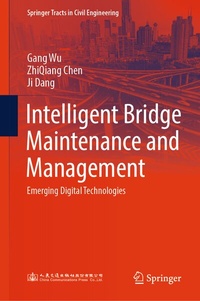
Intelligent Bridge Maintenance and Management
Description

This book provides a timely introduction to the methodology of Intelligent Bridge Maintenance and Management (IBM&M) and a comprehensive synthesis of emerging digital technologies for realizing IBM&M. The authors, who carry research, teaching, and consulting experience in the USA, Japan, and China, present the background, principles, methods, and application examples of essential IBM&M solutions in eight dedicated chapters. The digital technologies covered in this book include:
Artificial intelligence, big data, machine learning, computer vision.
Data fusion, 3D building information, digital twin modeling, virtual and augmented reality.
Internet of things sensors, robotics including unmanned vehicles.
The book targets the audience in the broader Bridge Engineering community, including academic researchers, students, bridge owners, and technology providers.
More details
Other editions
Additional editions
Persons
Gang Wu is a professor, doctoral tutor, Southeast University vice president. He is a recipient of National Outstanding Youth Scientific Fund, a chair professor of Chang Jiang Scholars Program,the president of the Chinese Association of Young Technologists & Scientists, and the director of National and Local Joint Engineering Research Center for Intelligent Construction and Maintenance. He has long been engaged in research on structural engineering and intelligent construction and maintenance of infrastructures. Prof. Wu has been awarded two Second Prizes for Progress in Science & Technology of the State, China Youth Science and Technology Award, the Xplorer Prize 2021, Jiangsu Youth Science and Technology Outstanding Contribution Award, and many other awards.
ZhiQiang Chen is a Professor of Civil and Computer Engineering at the University of Missouri-Kansas City. He received his Bachelor of Science from Southeast University (1997), Nanjing, China, and his Ph.D. from the University of California, San Diego (2008). Since joining at UMKC in 2010, he directs the interdisciplinary Disaster, Infrastructure, and Geointelligence Technology (DIGIT) Lab. His research group currently focuses on theoretical and technical developments of artificial intelligence, robotic vision, remote sensing, human-machine interaction, and digital twinning technologies for their applications in natural and built-environment monitoring and inspection, civil infrastructure systems and natural hazards modeling, risk communication, and community resilience.
Ji Dang is an associate professor in the Department of Civil and Environmental Engineering, Saitama University, Japan. He received his Bachelor's degree (2002) and Master's Degree (2006) from Southeast University and his Doctor (Engineering) Degree (2010) from Aichi Institute of Technology. He has held the current position since 2020. In recent years, his main research interests are structural dynamics, IoT bridge sensing, bridge inspection based on UAV, and damage recognition based on AI and computer vision. He developed a free smartphone software 'AccMeasure' for vibration observation, proposed a performance-based UAV bridge inspection and evaluation method, which participated in Japan Strategic Innovation Program (SIP), and developed damage recognition technology based on AI computer vision. He has published 41 papers and won the Excellent Presentation Award of Japan Civil Engineering Society (2016), AI and Digital Science Data Award (2021), and other awards.
Content
Introduction.- Intelligent Bridge Maintenance and Management System.- IoT Sensing Technology.- Bridge Inspection Automation.- Big Data Enabled Computating.
