

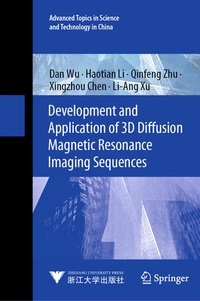
Development and Application of 3D Diffusion Magnetic Resonance Imaging Sequences
Description

This book focuses on diffusion magnetic resonance imaging(MRI). It first introduces the principles and methods of diffusion MRI. Subsequently, a series of sequence modules are constructed for a 3D diffusion MRI sequence. These modules include global saturation, diffusion preparation, fat saturation, gradient and spin echo readout, and navigator readout modules. Based on simulation and experimental results, the book presents the application of these imaging sequences for measuring diffusion time dependence in the adult brain and highlights their advantages in fiber tractography imaging compared to conventional diffusion sequences. From a novel perspective, this book extends 3D sequence imaging techniques to the field of diffusion MRI, integrating theory, models, and experimental findings. It serves as a valuable reference for scientists, engineers, and graduate students involved in research on diffusion MRI sequences.
More details
Other editions
Additional editions
Persons
Dan Wu, is a tenured professor at the College of Biomedical Engineering and Instrument Science, Zhejiang University, Hangzhou, China. She is also the director of the Department of Biomedical Engineering. She is a leader in the National "Ten Thousand Talents Program", a recipient of the National Outstanding Youth Science Foundation, an overseas high-level talent, and a recipient of the China Youth May Fourth Medal. She obtained her Ph.D. from Johns Hopkins University in the United States and previously served as an assistant professor at Johns Hopkins University. Her main research interests include the analysis methods of magnetic resonance imaging sequences and medical images. She has made lots of original contributions in the development of fast high-resolution imaging sequences, diffusion magnetic resonance-based microstructural imaging, and fetal and infant brain imaging. She has published over 90 papers in high-level journals such as PNAS and Radiology, and has been granted nearly 20 domestic and international patents, including the Geneva International Invention Exhibition Special License Gold Award.
Haotian Li is a post-doctoral researcher at the College of Biomedical Engineering and Instrument Science, at Zhejiang University. His research focuses on the development of diffusion magnetic resonance sequences and data analysis. He has published over 10 papers in high-level journals in the field of magnetic resonance imaging, such as "Magnetic Resonance in Medicine," "NeuroImage," and "Medical Image Analysis." In addition, he has presented eight abstracts at the International Society for Magnetic Resonance in Medicine (ISMRM). He has received the Magna Cum Laude Award from the ISMRM, the Outstanding Award from the Youth Doctoral Forum of the Zhejiang Provincial Neuroscience Society, and the Excellence Award from the West Lake Academic Forum and Medical Imaging Technology Summit of Zhejiang University.
Qinfeng Zhu is a Ph.D. student at the College of Biomedical Engineering and Instrument Science, at Zhejiang University. His research focuses on the development of diffusion magnetic resonance sequences and the processing of fetal brain MRI data.
Xingzhou Chen is a Ph.D. student at the College of Biomedical Engineering and Instrument Science, Zhejiang University. His research focuses on the development and optimization of diffusion magnetic resonance imaging (dMRI) sequences on high performance gradient MRI scanner.
Liang Xu is a Ph.D. student at the College of Biomedical Engineering and Instrument Science, at Zhejiang University. His research focuses on the development of diffusion magnetic resonance spectroscopy sequences and the simulating & modeling of brain microstructure.
Content
Introduction.- Diffusion Magnetic Resonance Imaging Sequence Design.- 3D Diffusion Gradient Spin-echo Sequence.- Navigator Based 3D Diffusion Gradient Spin-echo Sequence.- High-resolution Accelerated 3D Diffusion Gradient Spin-echo Sequence.- Oscillating Gradient-prepared 3D Diffusion Gradient Spin-echo Sequence and Applications.- Summary and Outlook.
