

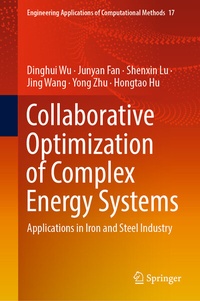
Collaborative Optimization of Complex Energy Systems
Description

This book mainly focuses on the multi-media energy prediction technology and optimization methods of iron and steel enterprises. The technical methods adopted include swarm intelligence algorithm, neural network, reinforcement learning, and so on. Energy saving and consumption reduction in iron and steel enterprises have always been a research hotspot in the field of process control. This book considers the multi-media energy balance problem from the perspective of system, studies the energy flow and material flow in iron and steel enterprises, and provides energy optimization methods that can be used for planning, prediction, and scheduling under different production scenes. The main audience of this book is scholars and graduate students in the fields of control theory, applied mathematics, energy optimization, etc.
More details
Other editions
Additional editions
Persons
Dr. Dinghui Wu received the Ph.D. degree in Control Science and Engineering with Jiangnan University and now is a visiting fellow with the School of Computer and Electronic Engineering, University of Denver, the USA. His current research interests include energy optimization control technology, fault diagnosis of power systems, and edge calculation. Since Nov. 2019, Dr. Wu has been in School of Internet of Things, Jiangnan University, as a professor.
Mr. Junyan Fan received master's degree in Mechatronics Engineering with Jiangsu Ocean University, China, in 2021. He began his doctoral program with Jiangnan University, China, in 2021. His current research interests include energy prediction and energy optimization.
Mr. Shenxin Lu received bachelor's degree in Electrical Engineering with Luoyang Institute of Science and Technology, China, in 2020. He took a successive postgraduate and doctoral programs of study at Jiangnan University, China, in 2022. His current research interests include energy scheduling and deep learning.
Ms. Jing Wang obtained a master's degree in power system and automation from Wuhan University, China, in 2002. Her main research directions include metallurgical industry energy management informatization, low-carbon energy-saving technology, energy process control automation, multi-media energy scheduling optimization, process industry smart manufacturing, etc.
Mr. Yong Zhu received his bachelor's degree in engineering from Huaqiao University, China, in 2019. He began his master program with Jiangnan University, China, in 2020. His current research interests are energy prediction.
Mr. Hongtao Hu received his bachelor's degree in engineering from Huainan Normal University, China, in 2019.He began his master 's degree at Jiangnan University, China, in 2020. His current research interests are energy optimal scheduling of iron and steel enterprises under multiple working conditions.
