

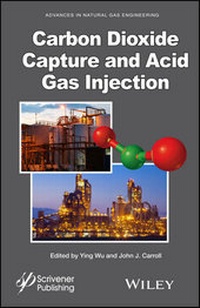
Carbon Dioxide Capture and Acid Gas Injection
Description

More details
Other editions
Additional editions
Persons
John J. Carroll, PhD, PEng is the Director, Geostorage Process Engineering for Gas Liquids Engineering, Ltd. in Calgary, Canada. Dr. Carroll holds bachelor and doctoral degrees in chemical engineering from the University of Alberta, Edmonton, Canada, and is a registered professional engineer in the provinces of Alberta and New Brunswick in Canada.?His fist book, Natural Gas Hydrates: A Guide for Engineers, is now in its second edition, and he is the author or co-author of 50 technical publications and about 40 technical presentations.
Content
Preface xiii
1 Enthalpies of Carbon Dioxide-Methane and Carbon Dioxide-Nitrogen Mixtures: Comparison with Thermodynamic Models 1
Erin L. Roberts and John J. Carroll
1.1 Introduction 1
1.2 Enthalpy 2
1.3 Literature Review 2
1.3.1 Carbon Dioxide-Methane 4
1.3.2 Carbon Dioxide-Nitrogen 4
1.4 Calculations 5
1.4.1 Benedict-Webb-Rubin 6
1.4.2 Lee-Kesler 12
1.4.3 Soave-Redlich-Kwong 17
1.4.4 Peng-Robinson 23
1.4.5 AQUAlibrium 28
1.5 Discussion 33
1.6 Conclusion 36
References 37
2 Enthalpies of Hydrogen Sulfide-Methane Mixture: Comparison with Thermodynamic Models 39
Erin L. Roberts and John J. Carroll
2.1 Introduction 39
2.2 Enthalpy 40
2.3 Literature Review 40
2.4 Calculations 41
2.4.1 Lee-Kesler 41
2.4.2 Benedict-Webb-Rubin 43
2.4.3 Soave-Redlich-Kwong 43
2.4.4 Redlich-Kwong 47
2.4.5 Peng-Robinson 47
2.4.6 AQUAlibrium 50
2.5 Discussion 50
2.6 Conclusion 52
References 54
3 Phase Behavior and Reaction Thermodynamics Involving Dense-Phase CO2 Impurities 55
J.A. Commodore, C.E. Deering and R.A. Marriott
3.1 Introduction 55
3.2 Experimental 57
3.3 Results and Discussion 58
3.3.1 Phase Behavior Studies of SO2 Dissolved in Dense CO2 Fluid 58
3.3.2 The Densimetric Properties of CS2 and CO2 Mixtures 60
References 61
4 Sulfur Recovery in High Density CO2 Fluid 63
S. Lee and R.A. Marriott
4.1 Introduction 64
4.2 Literature Review 64
4.3 Methodology 65
4.4 Results and Discussion 66
4.5 Conclusion and Future Directions 67
References 68
5 Carbon Capture Performance of Seven Novel Immidazolium and Pyridinium Based Ionic Liquids 71
Mohamed Zoubeik, Mohanned Mohamedali and Amr Henni
5.1 Introduction 71
5.2 Experimental Work 73
5.2.1 Materials 73
5.2.2 Density Measurement 73
5.2.3 Solubility Measurement 73
5.3 Modeling 76
5.3.1 Calculation of Henry's Law Constants 76
5.3.2 Critical Properties Calculations 76
5.3.3 Peng Robinson EoS 76
5.4 Results and Discussion 77
5.4.1 Density 77
5.4.2 Critical Properties 77
5.4.3 CO2 Solubility 78
5.4.4 The Effect of Changing the Cation 81
5.4.5 The Effect of Changing the Anion 84
5.4.6 Henry's Law Constant, Enthalpy and Entropy Calculations 85
5.4.7 Thermodynamic Modeling of CO2 Solubility 86
5.5 Conclusion 87
Acknowledgements 88
References 88
6 Vitrisol a 100% Selective Process for H2S Removal in the Presence of CO2 91
W.N. Wermink, N. Ramachandran, and G.F. Versteeg
6.1 Introduction 92
6.2 Case Definition 94
6.3 "Amine-Treated" Cases by PPS 95
6.3.1 Introduction to PPS 95
6.3.2 Process Description 96
6.3.3 PFD 97
6.3.4 Results 97
6.3.4.1 Case 1 97
6.3.4.2 Case 2 97
6.4 VitrisolfòfnProcess Extended with Regeneration of Active Component 99
6.4.1 Technology Description 99
6.4.2 Parameters Determining the Process Boundary Conditions 99
6.4.3 Absorption Section 101
6.4.4 Regeneration Section 102
6.4.5 Sulphur Recovery Section 104
6.4.6 CO2-Absorber 105
6.4.7 PFD 105
6.5 Results 105
6.6 Discussion 110
6.6.1 Comparison of Amine Treating Solutions to Vitrisolfòfn110
6.6.2 Enhanced H2S Removal of Barnett Shale Gas (case 2) 112viii Contents
6.7 Conclusions 113
6.8 Notation 115
References 115
Appendix 6-A: H&M Balance of Case 1 (British Columbia shale) of the Amine Process 117
Appendix 6-B H&M Balance of Case 2a (Barnett shale) of the Amine Process with Stripper Promoter 119
Appendix 6-C H&M Balance of Case 3 (Barnett shale) of the Amine Process (MEA) 121
Appendix 6-D: H&M Balance of Case 1 (British Columbia shale) of the Vitrisolfnprocess 123
Appendix 6-E H&M Balance of Case 2 (Barnett shale) of the VitrisolfnProcess 125
7 New Amine Based Solvents for Acid Gas Removal 127
Yohann Coulier, Elise El Ahmar, Jean-Yves Coxam, Elise Provost, Didier Dalmazzone, Patrice Paricaud, Christophe Coquelet and Karine Ballerat-Busserolles
7.1 Introduction 128
7.2 Chemicals and Materials 131
7.3 Liquid-Liquid Equilibria 131
7.3.1 LLE in {methylpiperidines - H2O} and {methylpiperidines - H2O - CO2} 131
7.3.2 Liquid-Liquid Equilibria of Ternary Systems {Amine - H2O - Glycol} 135
7.3.3 Liquid-Liquid Equilibria of the Quaternary Systems {CO2 - NMPD - TEG - H2O} 136
7.4 Densities and Heat Capacities of Ternary Systems {NMPD - H2O - Glycol} 137
7.4.1 Densities 137
7.4.2 Specific Heat Capacities 137
7.5 Vapor-Liquid Equilibria of Ternary Systems {NMPD - TEG - H2O - CO2} 139
7.6 Enthalpies of Solution 140
7.7 Discussion and Conclusion 143
Acknowledgments 143
References 144Contents ix
8 Improved Solvents for CO2 Capture by Molecular Simulation Methodology 147
William R. Smith
8.1 Introduction 147
8.2 Physical and Chemical Models 149
8.3 Molecular-Level Models and Algorithms for Thermodynamic Property Predictions 150
8.4 Molecular-Level Models and Methodology for MEA-H2O-CO2 153
8.4.1 Extensions to Other Alkanolamine Solvents and Their Mixtures 155
Acknowledgements 157
References 157
9 Strategies for Minimizing Hydrocarbon Contamination in Amine Acid Gas for Reinjection 161
Mike Sheilan, Ben Spooner and David Engel
9.1 Introduction 162
9.2 Amine Sweetening Process 162
9.3 Hydrocarbons in Amine 164
9.4 Effect of Hydrocarbons on the Acid Gas Reinjection System 166
9.5 Effect of Hydrocarbons on the Amine Plant 167
9.6 Minimizing Hydrocarbon Content in Amine Acid Gas 171
9.6.1 Option 1. Optimization of the Amine Plant Operation 171
9.6.2 Option 2. Amine Flash Tanks 176
9.6.3 Option 3. Rich Amine Liquid Coalescers 178
9.6.4 Option 4. Use of Skimming Devices 180
9.6.5 Option 5. Technological Solutions 182
References 183
10 Modeling of Transient Pressure Response for CO2 Flooding Process by Incorporating Convection and Diffusion Driven Mass Transfer 185
Jianli Li and Gang Zhao
10.1 Introduction 186
10.2 Model Development 187
10.2.1 Pressure Diffusion 187
10.2.2 Mass Transfer 188
10.2.3 Solutions 190x Contents
10.3 Results and Discussion 191
10.3.1 Flow Regimes 191
10.3.2 Effect of Mass Transfer 192
10.3.3 Sensitivity Analysis 195
10.3.3.1 CO2 Bank 195
10.3.3.2 Reservoir Outer Boundary 196
10.4 Conclusions 196
Acknowledgments 197
References 197
11 Well Modeling Aspects of CO2 Sequestration 199
Liaqat Ali and Russell E. Bentley
11.1 Introduction 199
11.2 Delivery Conditions 200
11.3 Reservoir and Completion Data 201
11.4 Inflow Performance Relationship (IPR) and Injectivity Index 201
11.5 Equation of State (EOS) 202
11.6 Vertical Flow Performance (VFP) Curves 205
11.7 Impact of the Well Deviation on CO2 Injection 208
11.8 Implication of Bottom Hole Temperature (BHT) on Reservoir 209
11.9 Impact of CO2 Phase Change 213
11.10 Injection Rates, Facility Design Constraints and Number of Wells Required 214
11.11 Wellhead Temperature Effect on VFP Curves 214
11.12 Effect of Impurities in CO2 on VFP Curves 216
11.13 Concluding Remarks 217
Conversion Factors 218
References 218
12 Effects of Acid Gas Reinjection on Enhanced Natural Gas Recovery and Carbon Dioxide Geological Storage: Investigation of the Right Bank of the Amu Darya River 221
Qi Li, Xiaying Li, Zhiyong Niu, Dongqin Kuang, Jianli Ma, Xuehao Liu, Yankun Sun and Xiaochun Li
12.1 Introduction 222
12.2 The Amu Darya Right Bank Gas Reservoirs in Turkmenistan 223Contents xi
12.3 Model Development 223
12.3.1 State equation 224
12.3.1.1 Introduction of Traditional PR State Equation 224
12.3.1.2 Modifications for the Vapor-Aqueous System 224
12.3.2 Salinity 225
12.3.3 Diffusion 226
12.3.3.1 Diffusion Coefficients 226
12.3.3.2 The Cross-Phase Diffusion Coefficients 226
12.4 Simulation Model 227
12.4.1 Model Parameters 227
12.4.2 Grid-Sensitive Research of the Model 227
12.4.3 The Development and Exploitation Mode 230
12.5 Results and Discussion 230
12.5.1 Reservoir Pressure 230
12.5.2 Gas Sequestration 232
12.5.3 Production 235
12.5.4 Recovery Ratio and Recovery Percentage 238
12.6 Conclusions 239
12.7 Acknowledgments 240
References 241
Index 245
Chapter 1
Enthalpies of Carbon Dioxide-Methane and Carbon Dioxide-Nitrogen Mixtures: Comparison with Thermodynamic Models
Erin L. Roberts and John J. Carroll
Gas Liquids Engineering, Calgary, Alberta, Canada
Abstract
The physical properties of acid-gas injection streams are important for use in design considerations of the acid-gas scheme. One such property is the enthalpy of the stream. As carbon dioxide is rarely pure, with methane and nitrogen being common impurities in the stream, the effect of these impurities on the enthalpy is also important to consider.
This study compares experimentally determined excess enthalpies and enthalpy departures from literature to the enthalpy predictions of five different models, Benedict-Webb-Rubin, Lee-Kesler, Soave-Redlich-Kwong, and Peng-Robinson from VMGSim, as well as AQUAlibrium software. The mixtures studied are carbon dioxide-methane, as well as carbon dioxide- nitrogen mixtures at a wide range of compositions.
The Soave-Redlich-Kwong model gave the most accurate predictions for both the excess enthalpies and enthalpy departures, with Lee-Kesler frequently giving the least accurate predictions for the mixtures.
1.1 Introduction
An increase in demand of natural gas has led producers to pursue poorer quality reservoirs. These contain higher levels of carbon dioxide that then must be responsibly disposed. Regulations prevent the flaring of the acid-gas mixtures, therefore requiring an alternate means of disposal. One such method is the injection of acid gas into subsurface reservoirs.
An understanding of the physical properties of the stream is essential in the design of the acid-gas injection scheme. The enthalpy of the stream is required in the design of the compressor for injection. Common impurities in the carbon dioxide include methane and nitrogen; therefore the effect of these impurities on the enthalpy of carbon dioxide is required for design.
This paper investigates the accuracy of five different thermodynamic models for predicting such mixtures. Four different equations of state, Benedict-Webb-Rubin (BWR), Lee-Kesler (LK), Soave-Redlich-Kwong (SRK), Peng-Robinson (1978) were used with VMGSim software, as well as the AQUAlibrium model. BWR and LK are multi-constant equations, and SRK and PR78 are cubic equations of state. The AQUAlibrium model uses a variation of Peng-Robinson.
1.2 Enthalpy
The enthalpy of mixtures can be determined in a number of ways. One method is to use excess enthalpy (enthalpy of mixing). Excess enthalpy is defined as
(1.1)
where: HE - Excess enthalpy
Hm - Enthalpy of mixture
Hi - Enthalpy of component i
xi - mol fraction of component i
Alternatively, the enthalpy of the mixture can be represented as an enthalpy departure, a difference between the enthalpy at a given pressure, and the enthalpy at a reference pressure while keeping the temperature constant.
Enthalpies can be expressed in J/mol, or for greater relevance to acid-gas injection design, can be expressed in HP/MMSCFD. The conversion between units is 1 HP/MMSCFD to 53.86 J/mol.
1.3 Literature Review
A review of literature was performed to compile experimental data for the enthalpy of carbon dioxide-methane mixtures as well as carbon dioxide-nitrogen mixtures. Table 1.1 summarizes the relevant data used in this study.
Table 1.1 Summary of experimental data of enthalpy of carbon dioxide mixtures.
Temperature (°C) Pressure (MPa) Composition (mol% CO2) Impurity Comments Ref. 10-80 1-11 0.1-0.9 Methane- Excess enthalpies
- All vapour enthalpies
- 646 data points
- Excess enthalpies
- All vapour enthalpies
- 60 data points
- Enthalpy departure
- Liquid and vapour densities
- 42 data points
- Enthalpy departure
- Liquid and vapour densities
- 46 data points
- Excess enthalpies
- All vapour enthalpies
- 108 data points
- Excess enthalpies
- All vapour enthalpies
- 27 data points
1. Lee & Mather (1972)
2. Barry et al. (1982)
3. Ng & Mather (1976)
4. Peterson & Wilson (1974)
5. Lee & Mather (1970)
6. Hejmadi et al. (1971)
1.3.1 Carbon Dioxide-Methane
The most extensive study performed for enthalpies of carbon dioxide-methane mixtures was performed by Lee & Mather (1972). Their study consisted of mol fractions of 0.1-0.9, taken at intervals of 0.1, for a total of 9 different mol fractions. Measurements of excess enthalpy were reported at 8 different temperatures from 10-80 °C, with ranges of pressure of 1.0-4.4 MPa for 10 °C, 1.0- 5.07 for 20 °C, 1.0-11.1 for 40 °C, and 1.0-10.1 for 32 °C, 50 °C, 60 °C, 70 °C, and 80 °C. In total, 648 data points were reported. Two typographical errors were found in the data set; they are not included in the numerical error analysis but are represented in the figures.
Another smaller study was performed by Barry et al. (1982), for excess enthalpies of carbon dioxide-methane mixtures. Data was taken at three different temperatures, 20 °C, 32 °C, and 40 °C. Seven different pressures were used, ranging from 0.51 MPa to 4.6 MPa, with pressure of over 2 MPa only being measured for 40 °C. The mol fractions measured were not taken in increments, instead were taken at a wide variety of fractions ranging from 0.1 to 0.9.
Two other studies were done using enthalpy departures by Ng & Mather (1976) and Peterson & Wilson (1974). Ng & Mather (1976) used pressures of 3-13.7 MPa, and temperatures of 0-90 °C for mol fractions of 0.145 and 0.423. They used the ideal gas enthalpy as a reference point to measure the enthalpy departure. Peterson & Wilson (1974) only measured equimolar mixtures of carbon dioxide and methane with pressures from 0.7-13.8 MPa and temperatures of 255.4 K-422 K. The reference enthalpy used was measured at a pressure of 0.138 MPa. These two studies were the only ones that measured both liquid and vapor enthalpies, instead of just vapor.
1.3.2 Carbon Dioxide-Nitrogen
Lee & Mather (1970) and Hejmadi et al. (1971) studied the excess enthalpies of carbon dioxide-nitrogen mixtures. Lee & Mather (1970) looked at mole fractions from 0.1-0.9 at intervals of 0.1. Pressures from 1.01 MPa to 12.16 MPa were used, at only a single temperature of 40 °C.
Hejmadi et al. (1971) used only two different temperatures of 31 °C and 40 °C, and two different pressures of 3.5 MPa and 6.5 MPa. They used mole fraction of nitrogen from 0.2-0.7.
1.4 Calculations
The experimental enthalpies were compared to calculated enthalpies using BWR, LK, SRK, and PR78 thermodynamic models from VMGSim software, as well as using AQUAlibrium software.
The six different mixtures (four with methane, two with nitrogen) as summarized in Table 1.1 were evaluated. Four error functions for both the excess enthalpies and the enthalpy departures were used to analyze the accuracy of the prediction of each method.
For the excess enthalpies, the absolute average difference (AAD) was defined as;
(1.2)
where: NP - number of points
HEexp - experimental excess enthalpy
HEcalc - calculated excess enthalpy
and the average difference (AD) was defined as:
(1.3)
The absolute average error (AAE) in excess enthalpies was defined as:
(1.4)
and the average error (AE) was defined as:
(1.5)
For enthalpy departures, the absolute average difference
(1.6)
where H° - enthalpy of mixture at reference pressure
H - enthalpy of mixture at measured pressure
and the average difference was defined as:
(1.7)
The absolute average error for enthalpy departure was defined as:
(1.8)
and...
