

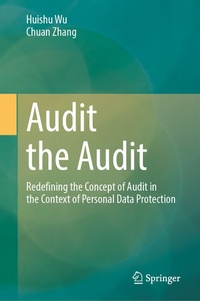
Audit the Audit
Description

This book deals with the tension between law and technology of data protection topic, to propose a novel approach for interpreting personal data protection audit. Audits have long been criticized as "a ritual of verification," originating from the financial sector. While this book proposed that audit is in fact a regulatory control system rather than a verification tool, especially dealing with audit of data. The prerequisite for reading this book is a basic understanding of data protection, audit system, information technology as well as administrative law.
More details
Other editions
Additional editions
Persons
Dr. Huishu Wu
is currently responsible for Data regulation and Data security risk management of Mercedes-Benz Group China. He is also the vice-director of Research Center for Government Procurement and Data Compliance of Sino-Germany Law School China University of Political Science and Law. He received the bachelor's degree in information management of computer science from Hebei Normal University of science and technology , Hebei, China, and the master's degree in management from the China University of Political Science and Law, Beijing, China. He received his master and doctoral degree of law in University of Montreal, Montreal, Canada. He was selected by Canadian Government for excellent scholarships for researchers. He was also selected for China CSC scholarship as researcher. His research interest includes data governance, data mining, data protection, audit and control theory, machine learning. He has published more than 10 papers, includes IEEE JSAC, IEEE TDSC, and other authoritative journals and conference in field of law and technology.
Dr. Chuan Zhang is currently an assistant professor at School of Cyberspace Science and Technology, Beijing Institute of Technology. He is also with Guangdong Provincial Key Laboratory of Novel Security Intelligence Technologies. He was selected for the 9th China Association for Science and Technology Young Toggle Talent Project and the top 2% of the world's top scientists in 2023. His research interests include secure data services in applied cryptography, cloud security, blockchain, and machine learning. He has published more than 50 papers, including IEEE JSAC, IEEE TDSC, IEEE TMC, IEEE TSC, IEEE TIFS, IEEE GLOBECOM/ICC and other authoritative journals and conferences in the field, and one book (i.e., Privacy-Preserving in Mobile Crowdsensing ). He was awarded the Outstanding Doctoral Dissertation of the Chinese Institute of Electronics, the Outstanding Doctoral Dissertation of Beijing Municipality, and one paper was selected as one of the 50 most popular papers of IEEE TDSC.
Content
Part I. Overview.- Chapter 1. Introduction.- Part II. The Function of Audit.- Chapter 2. Deconstructing the Audit.- Part III. Redefining Audit.- Chapter 3. Reconstructing the Definition of Audit.- Chapter 4. Summary.
