

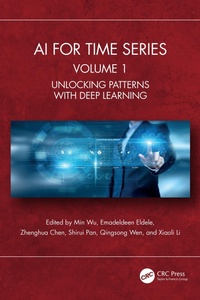
AI for Time Series
Volume 1: Unlocking Patterns with Deep Learning
Published on 22. May 2026
268 pages
978-1-040-68617-1 (ISBN)
Description

This book provides a thorough exploration of the latest innovations in AI for general time series analysis, distribution shift, and foundation models. It offers an in-depth look at cutting-edge techniques and methodologies, using advanced algorithms that are transforming time series analysis across industries. The authors highlight the use of AI models, particularly those based on deep learning, to study the sequence of data points collected at successive points in time.
In the study of the use of AI for general time series analysis, readers are introduced to a recent important model like TimesNet, which has set new benchmarks for general time series analysis. TimesNet is a cutting-edge model for time series analysis, which transforms one-dimensional time series data into two-dimensional space to better capture temporal variations. This approach allows TimesNet to excel in various tasks such as short- and long-term forecasting, imputation, classification, and anomaly detection. The authors also discuss distribution shift in time series, with an important coverage on the use of AdaTime. This is a benchmarking suite for domain adaptation which addresses distribution shifts in time series data through Unsupervised Domain Adaptation (UDA). In the last section, a significant focus is placed on the emergence of time series foundation models, particularly for forecasting. The book explores pioneering models like Time-LLM, which are designed to offer universal forecasting capabilities across diverse time series tasks.
The book can be used as supplementary reading for graduate students taking advanced topics/seminars on advanced deep learning and foundation models. It is also a useful reference for researchers and engineers working on time-series applications in finance, healthcare, energy, and climate.
In the study of the use of AI for general time series analysis, readers are introduced to a recent important model like TimesNet, which has set new benchmarks for general time series analysis. TimesNet is a cutting-edge model for time series analysis, which transforms one-dimensional time series data into two-dimensional space to better capture temporal variations. This approach allows TimesNet to excel in various tasks such as short- and long-term forecasting, imputation, classification, and anomaly detection. The authors also discuss distribution shift in time series, with an important coverage on the use of AdaTime. This is a benchmarking suite for domain adaptation which addresses distribution shifts in time series data through Unsupervised Domain Adaptation (UDA). In the last section, a significant focus is placed on the emergence of time series foundation models, particularly for forecasting. The book explores pioneering models like Time-LLM, which are designed to offer universal forecasting capabilities across diverse time series tasks.
The book can be used as supplementary reading for graduate students taking advanced topics/seminars on advanced deep learning and foundation models. It is also a useful reference for researchers and engineers working on time-series applications in finance, healthcare, energy, and climate.
More details
Language
English
Place of publication
London
United Kingdom
Publishing group
Taylor & Francis Ltd
Target group
Professional and scholarly
College/higher education
Product notice
Reflowable
Illustrations
86 Line drawings, black and white; 86 Illustrations, black and white
File size
11,66 MB
ISBN-13
978-1-040-68617-1 (9781040686171)
Copyright in bibliographic data and cover images is held by Nielsen Book Services Limited or by the publishers or by their respective licensors: all rights reserved.
Schweitzer Classification
Other editions
Additional editions

Min Wu | Emadeldeen Eldele | Zhenghua Chen
AI for Time Series
Volume 1: Unlocking Patterns with Deep Learning
Book
05/2026
1st Edition
CRC Press
€69.50
Shipment within 15-20 days
Min Wu | Emadeldeen Eldele | Zhenghua Chen
AI for Time Series
Volume 1: Unlocking Patterns with Deep Learning
Book
05/2026
1st Edition
CRC Press
€259.50
Shipment within 15-20 days
Persons
Min Wu is currently a Principal Scientist at Institute for Infocomm Research (I2R), Agency for Science, Technology and Research (A*STAR), Singapore.
Emadeldeen Eldele is an Assistant Professor at Khalifa University, UAE.
Zhenghua Chen is a Senior Lecture (Associate Professor) at University of Glasgow, UK.
Shirui Pan is a Professor and an ARC Future Fellow with the School of Information and Communication Technology, Griffith University, Australia.
Qingsong Wen is currently the Head of AI & Chief Scientist at Squirrel Ai Learning.
Xiaoli Li is currently Head of the Information Systems Technology and Design (ISTD) Pillar at Singapore University of Technology and Design (SUTD).
Emadeldeen Eldele is an Assistant Professor at Khalifa University, UAE.
Zhenghua Chen is a Senior Lecture (Associate Professor) at University of Glasgow, UK.
Shirui Pan is a Professor and an ARC Future Fellow with the School of Information and Communication Technology, Griffith University, Australia.
Qingsong Wen is currently the Head of AI & Chief Scientist at Squirrel Ai Learning.
Xiaoli Li is currently Head of the Information Systems Technology and Design (ISTD) Pillar at Singapore University of Technology and Design (SUTD).
Content
1 Introduction 2 Fedformer: Frequency Enhanced Decomposed Transformer for Long-term Series Forecasting 3 Fredf: Learning to Forecast in the Frequency Domain 4 PPGF: Probability Pattern-Guided Time Series Forecasting 5 Unlocking the Power of Lstm for Long Term Time Series Forecasting 6 Self-Supervised Contrastive Representation Learning for Semi-Supervised Time-Series Classification 7 Diffusion Language-Shapelets for Semi-Supervised Time-Series Classification 8 Graph-Aware Contrasting for Multivariate Time-Series Classification 9 Dcdetector: Dual Attention Contrastive Representation Learning for Time Series Anomaly Detection 10 Multivariate Anomaly Detection with Self-Learning Graph Convolutional Networks 11 Self-Attention-Driven Imputation for Multivariate Time Series
