

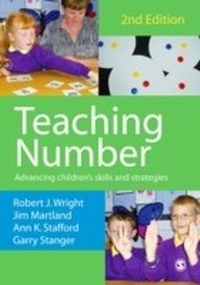
Teaching Number
Advancing Children's Skills and Strategies
2nd Edition
Published on 30. August 2006
264 pages
978-1-4462-3757-1 (ISBN)
Description

The book lets teachers identify where their students are in terms of number skills, and sets out a strategy for developing their knowledge. The authors show how to advance children's learning across five stages of early arithmetical learning - emergent, perceptual, figurative, initial number, and facile number. This provides for increasingly sophisticated number strategies across addition, subtraction, multiplication and division, as well as developing children's number word and numeral knowledge, and their ability to structure number and have grouping strategies. The approach used nine guiding principles for teaching.
Each chapter has clearly defined teaching procedures which show how to take the children onto the next more sophisticated stage. The teaching procedures are organized into key teaching topics, and each includes:
a clearly defined purpose
detailed instructions, activities, learning tasks and reinforcing games
lists of responses which children may make
application in whole class, small group and individualised settings
a link to the Learning Framework in Number (see Early Numeracy- second edition, 2005)
how the guiding principles for teaching can be used to allow teachers to evaluate and reflect upon their practice
Primary practitioners in Australia, the United States, the United Kingdom and Canada have tested the teaching procedures which can be used in conjunction with each country's numeracy strategy.
Primary teachers, especially of the early years, mathematics co-ordinators, heads of school, mathematics advisers, special educationalists, learning support personnel, teacher assistants, lecturers in initial teacher training and educational psychologists will all find this book invaluable.
Each chapter has clearly defined teaching procedures which show how to take the children onto the next more sophisticated stage. The teaching procedures are organized into key teaching topics, and each includes:
a clearly defined purpose
detailed instructions, activities, learning tasks and reinforcing games
lists of responses which children may make
application in whole class, small group and individualised settings
a link to the Learning Framework in Number (see Early Numeracy- second edition, 2005)
how the guiding principles for teaching can be used to allow teachers to evaluate and reflect upon their practice
Primary practitioners in Australia, the United States, the United Kingdom and Canada have tested the teaching procedures which can be used in conjunction with each country's numeracy strategy.
Primary teachers, especially of the early years, mathematics co-ordinators, heads of school, mathematics advisers, special educationalists, learning support personnel, teacher assistants, lecturers in initial teacher training and educational psychologists will all find this book invaluable.
All prices
More details
Series
Edition
Second Edition
Language
English
Place of publication
London
United Kingdom
Target group
Professional and scholarly
Product notice
Reflowable
ISBN-13
978-1-4462-3757-1 (9781446237571)
Copyright in bibliographic data and cover images is held by Nielsen Book Services Limited or by the publishers or by their respective licensors: all rights reserved.
Schweitzer Classification
Other editions
Additional editions
Robert J. Wright | Garry Stanger | Ann K. Stafford
Teaching Number
Advancing Children's Skills and Strategies
Book
09/2006
2nd Edition
SAGE Publications Inc
€74.90
Shipment within 10-20 days
Robert J. Wright | Garry Stanger | Ann K. Stafford
Teaching Number
Advancing Children's Skills and Strategies
Book
08/2006
2nd Edition
SAGE Publications Inc
€190.90
Shipment within 10-20 days
Persons
Dr Robert J. (Bob) Wright holds Bachelor's and Master's degrees in mathematics from the University of Queensland (Australia) and a doctoral degree in mathematics education from the University of Georgia. He is an adjunct professor in mathematics education at Southern Cross University in New South Wales. Bob is an inter-nationally recognized leader in assessment and instruction relating to children's early arithmetical knowledge and strategies, publishing six books, and many articles and papers in this field. His work over the last 25 years has included the development of the Mathematics Recovery Program, which focuses on providing specialist training for teachers to advance the numeracy levels of young children assessed as low-attainers. In Australia and New Zealand, Ireland, the UK, the USA, Canada, Mexico, South Africa and elsewhere, this programme has been implemented widely, and applied extensively to classroom teaching and to average and able learners as well as low-attainers. Bob has conducted several research projects funded by the Australian Research Council including the most recent project focusing on assessment and intervention in the early arithmetical learning of low-attaining 8- to 10-year-olds.
Garry Stanger has had a wide-ranging involvement in primary, secondary and tertiary education in Australia. He has held positions of Head Teacher, Deputy Principal and Principal, and has been a Mathematics Consultant with the New South Wales Department of Education. He has also taught in schools in the USA. He has worked with Robert Wright on the Mathematics Recovery project since its inception in 1992 and has been involved in the development of the Count Me In Too early numeracy project. His last project before finally retiring was working with Jenny Bednall, Head of Junior School, Trinity South and the thirty teachers at the Trinity College schools in South Australia.
Jim Martland is a member of the International Board of Mathematics Recovery and Founder of the Mathematics Recovery Council (UK and Ireland). He was a Senior Fellow in the Department of Education at the University of Liverpool. In his long career in education he has held headships in primary and middle schools and was Director of Primary Initial Teacher Training. In all the posts he continued to teach and pursue research in primary mathematics. His current work is with local education authorities in the UK and Canada, delivering professional development courses on assessing children's difficulties in numeracy and designing and evaluating teaching interventions.
Garry Stanger has had a wide-ranging involvement in primary, secondary and tertiary education in Australia. He has held positions of Head Teacher, Deputy Principal and Principal, and has been a Mathematics Consultant with the New South Wales Department of Education. He has also taught in schools in the USA. He has worked with Robert Wright on the Mathematics Recovery project since its inception in 1992 and has been involved in the development of the Count Me In Too early numeracy project. His last project before finally retiring was working with Jenny Bednall, Head of Junior School, Trinity South and the thirty teachers at the Trinity College schools in South Australia.
Jim Martland is a member of the International Board of Mathematics Recovery and Founder of the Mathematics Recovery Council (UK and Ireland). He was a Senior Fellow in the Department of Education at the University of Liverpool. In his long career in education he has held headships in primary and middle schools and was Director of Primary Initial Teacher Training. In all the posts he continued to teach and pursue research in primary mathematics. His current work is with local education authorities in the UK and Canada, delivering professional development courses on assessing children's difficulties in numeracy and designing and evaluating teaching interventions.
