

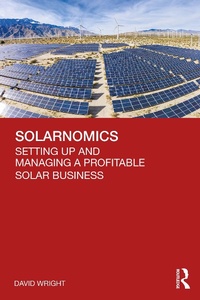
Solarnomics
Setting Up and Managing a Profitable Solar Business
1st Edition
Published on 4. April 2022
280 pages
978-1-000-55744-2 (ISBN)
Description

Solar power has come of age. Not only has it become one of the key alternatives to fossil fuels, it can now be deployed in a way that makes a viable business with a financial profit. This book shows industry professionals and students how to do just that.
Solarnomics describes the economics of building and operating a solar power plant today and provides a window into a future in which several technologies collaborate, and in which all participants in the electricity grid become smarter at scheduling both the supply and demand for electric power to give humanity a future that is sustainable, both environmentally and economically. The book shows how to estimate costs and revenues, how to tweak the design of a project to improve profitability, how to calculate return on investment, how to assess and deal with risk, how to raise capital, how to combine solar with batteries to make a hybrid microgrid, and how to be prepared for future developments in the evolving smart electricity grid.
Solarnomics will enable professionals in the solar industry to assess the potential profitability of a proposed solar project, and it will enable students to add an extra dimension to their understanding of sustainability.
Solarnomics describes the economics of building and operating a solar power plant today and provides a window into a future in which several technologies collaborate, and in which all participants in the electricity grid become smarter at scheduling both the supply and demand for electric power to give humanity a future that is sustainable, both environmentally and economically. The book shows how to estimate costs and revenues, how to tweak the design of a project to improve profitability, how to calculate return on investment, how to assess and deal with risk, how to raise capital, how to combine solar with batteries to make a hybrid microgrid, and how to be prepared for future developments in the evolving smart electricity grid.
Solarnomics will enable professionals in the solar industry to assess the potential profitability of a proposed solar project, and it will enable students to add an extra dimension to their understanding of sustainability.
Reviews / Votes
"Essential knowledge for the solar entrepreneur, Solarnomics is that rare book that discusses the technical and business aspects of solar power on equal footing. Wright succeeds in delivering the practical information needed to navigate today's solar market."Chris Giebink, Head of Applied Optoelectronics and Photonics Lab, Penn State University
"Solarnomics provides a thorough and well-rounded perspective on the ins and outs of running a profitable solar business. As solar power becomes increasingly important as we move towards a low carbon economy, this book can act as a toolkit for the solar leaders of tomorrow as they look to understand the risks and returns made possible through solar business."
Katherine Arblaster, Senior Manager, Monitor Deloitte
"Professor Wright shows how evolving solar and green technologies can benefit established economic sectors. Solar energy financing is key to project success. This book provides financial options available to the reader in an engaging manner."
David Arenburg, President, DAI Inc
"Down to basics, straight to the core of the issue, yet insightful - a reading I recommend for anyone interested in solar economics who doesn't want to go to the trouble of getting a PhD in photovoltaics."
Yves Poissant, Research Manager and Senior Specialist in Solar Photovoltaic Technologies, CanmetENERGY
More details
Edition
1. Auflage
Language
English
Place of publication
London
United Kingdom
Publishing group
Taylor & Francis Ltd
Target group
Professional and scholarly
Illustrations
17 Tables, black and white; 79 Line drawings, black and white; 79 Illustrations, black and white
File size
5,50 MB
ISBN-13
978-1-000-55744-2 (9781000557442)
Copyright in bibliographic data and cover images is held by Nielsen Book Services Limited or by the publishers or by their respective licensors: all rights reserved.
Schweitzer Classification
Other editions
Additional editions
Book
04/2022
1st Edition
Routledge
€196.50
Shipment within 10-20 days
Book
04/2022
1st Edition
Routledge
€60.50
Shipment within 10-20 days
Person
David Wright has a PhD from Cambridge University, UK and has experience in industry, academia and government in three continents. His university research in solar power has been conducted in collaboration with industrial partners in the Cleantech Sector and is published in top journals in renewable energy.
Content
Part I: Deploying Solar 1. Utility-Scale: Large Solar 2. Behind-the-Meter, Commercial and Industrial: Medium-Sized Solar 3. Behind-the-Meter, Small Business and Residential: Small Solar 4. Off Grid: Small to Large Solar Part II: Solar Profitability 5. Net Present Value (NPV) and Internal Rate of Return (IRR) 6. Levelized Cost of Electricity (LCOE) 7. Solar Finance 8. Managing Risk Part III: Getting the Biggest Bang for Your Solar Buck 9. Storage: Improving Solar Profitability 10. Profitability of Solar Microgrids and Hybrids 11. Extra Revenue from Grid-Balancing Services Part IV: Preparing for Future Solar Opportunities 12. Participative/Transactive Electricity Markets 13. Emerging Solar Technologies 14. Emerging Solar Applications 15. Profitability Analysis for Emerging Solar Technologies
