

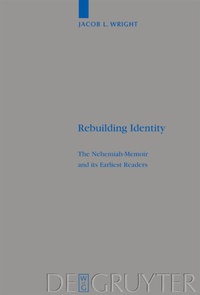
Rebuilding Identity
Description

This monograph presents a fresh and detailed treatment of the problems posed by the Nehemiah-Memoir. Starting from the pre-critical interpretations of Ezra-Neh, the study demonstrates that the use of the first-person does not suffice as a criterion for distinguishing between the verba Neemiae and the additions of later authors. The earliest edition of the Memoir is confined to a building report, which was expanded as early generations of readers developed the implications of Nehemiah's accomplishments for the consolidation and centralization of Judah. The expansions occasioned in turn the composition of the history of the "Restoration" in Ezra-Neh.
Reviews / Votes
"Die Arbeit besticht durch gute Beobachtungen, eine klare Argumentation und ein überzeugendes Gesamtbild, das zudem gewichtige Konsequenzen für die frühe >Second Temple Period< hat."Uwe Becker in: ZAW 1/2006 "Wright's Rebuilding Identity promises a great deal and delivers even more. [...] Its scholarly sophistication is coupled with elegant formulation as Wright illustrates how the story of Nehemiah has grown into the drama of the court-Jew who discovers his own identity in a foreign land and then moves to redirect the identity and destiny of his people." Tamara Cohn Eskenazi in JBL 124/4 (2005)More details
Other editions
Additional editions
Person
Content
- Intro
- Foreword
- 1. Introduction - Spinoza and the Attempt to Isolate Nehemiah's First-Person Account
- I. In Susa - 1:1-11 Introduction
- 2. Nehemiah's First Prayer - 1:5-1 la
- 2.1 Introduction
- 2.2 Diachronic Analysis
- 2.3 The Function of the Prayer
- 2.4 Conclusions
- 3. The Origins of Jerusalem's Ruins
- 3.1 Introduction
- 3.2 Examination of Neh 1:1-4
- 3.3 Neh 1-2 and the Artaxerxes-Correspondence
- 3.4 Conclusions
- 4. A Prologue to the Amplified Account - 1:1b-4
- 4.1 Introduction
- 4.2 The Tensions in Neh 1:1-2:11
- 4.3 The Reasons for the Composition of 1:1b-4
- 4.4 Conclusions
- II. From Susa to Jerusalem
- Introduction
- 5. Artaxerxes' Permission to Build - 2:1-11a
- 5.1 Introduction
- 5.2 The Composition of the Account
- 5.3 The Ramifications of the Analysis for an Historical Reconstruction
- 5.4 Conclusions
- 6. The Consolidation of the Builders - 2:11b-4:17
- 6.1 Introduction
- 6.2 Nehemiah's "Night Ride" - 2:11b-15
- 6.3 The Commencement and Completion of the Wall - 2:16b-3:38
- 6.4 Conclusions
- 7. The Intimidation of the Builder - 6:1-19
- 7.1 Introduction
- 7.2 The Unity of the Chapter
- 7.3 The Heading - V. 1
- 7.4 Nehemiah's Correspondence with Sanballat and Geshem
- 7.5 The Notice of Completion (VV. 15-16) in the Context of VV. 10-19
- 7.6 Conclusions
- 8. The Socioeconomic Reforms - 5:1-19
- 8.1 Introduction
- 8.2 Comparison of the Reform Accounts in Neh 5 and 13
- 8.3 Nehemiah as an Ideal Leader - 5:14-19
- 8.4 Nehemiah's Call for a Cancellation of Debts: VV. 1-13 and 19
- 8.5 Conclusions
- III. Additional Reforms during the Work on the Wall - 13:4-31
- Introduction
- 9. The Cultic Reforms - 13:4-14
- 9.1. Introduction
- 9.2 The Eliashib-Tobiah Affair - 13:4-9
- 9.3 The Reinstallation of the Levites and Singers - 13:10-14
- 9.4. Conclusions
- Excursus I: The Composition of Neh 10:1-40
- 10. The Sabbath-Reforms - 13:15-22
- 10.1. Introduction
- 10.2. Synchronic Analysis
- 10.3. Diachronic Analysis
- 10.4 Conclusions
- 11. The Marriage-Reforms - 13:23-31
- 11.1. Introduction
- 11.2 The Literary Development of 13:23-26 and Ezra 9-10
- 11.3. The Banishment of Eliashib's Descendant - 13:28f.
- 11.4 Conclusions
- IV. The Dedication of the Wall (12:27-13:3) and the Formation of a New Climax (7:1-12:26)
- Introduction
- 12. The Account of the Dedication Ceremonies (12:27ff.) and the Analogy of 7:1-3
- 12.1 Introduction
- 12.2 Analysis of the Composition of 12:27-43
- 12.3 The Third-Person Substratum in 7:1-3
- 12.4 Conclusions
- 13. The Account of the Dedication Ceremonies and the Growth of Chaps. 7-13
- 13.1. Introduction
- 13.2 The Priority of 12:27 vis-à-vis 11:3ff. and 13:10-13, 14b
- 13.3 The Literary Link between 7:1-3* + 11:1-2
- 13.4 The Analogy of the Temple Dedication in Ezra 6:16-22
- 13.5 Conclusions
- 14. The Final Form of the Book in Neh 12:44-13:3 and Neh 8-10
- 14.1 Introduction
- 14.2 The Youngest Additions to Ezra-Neh - Neh 12:44-13:3 and Neh 8-10
- 14.3 Concluding Survey
- The Primary Compositional Layers of Neh 1-13 (Table)
- Bibliographies
- Index of Biblical and Ancient Literature
- Index of Modern Authors
- Index of Subjects
