

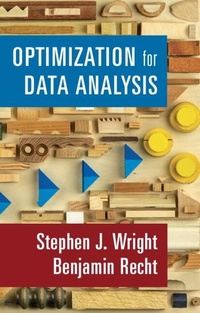
Optimization for Data Analysis
Published on 6. April 2022
978-1-009-02009-1 (ISBN)
Description

Optimization techniques are at the core of data science, including data analysis and machine learning. An understanding of basic optimization techniques and their fundamental properties provides important grounding for students, researchers, and practitioners in these areas. This text covers the fundamentals of optimization algorithms in a compact, self-contained way, focusing on the techniques most relevant to data science. An introductory chapter demonstrates that many standard problems in data science can be formulated as optimization problems. Next, many fundamental methods in optimization are described and analyzed, including: gradient and accelerated gradient methods for unconstrained optimization of smooth (especially convex) functions; the stochastic gradient method, a workhorse algorithm in machine learning; the coordinate descent approach; several key algorithms for constrained optimization problems; algorithms for minimizing nonsmooth functions arising in data science; foundations of the analysis of nonsmooth functions and optimization duality; and the back-propagation approach, relevant to neural networks.
Reviews / Votes
'This delightful compact tome gives the reader all the results they should have in their pocket to contribute to optimization and statistical learning. With the clean, elegant derivations of many of the foundational optimization methods underlying modern large-scale data analysis, everyone from students just getting started to researchers knowing this book inside and out will be well-positioned for both using the algorithms and developing new ones for machine learning, optimization, and statistics.' John C. Duchi, Stanford University 'Optimization algorithms play a vital role in the rapidly evolving field of machine learning, as well as in signal processing, statistics and control. Numerical optimization is a vast field, however, and a student wishing to learn the methods required in the world of data science could easily get lost in the literature. This book does a superb job of presenting the most important algorithms, providing both their mathematical foundations and lucid motivations for their development. Written by two of the foremost experts in the field, this book gently guides a reader without prior knowledge of optimization towards the methods and concepts that are central in modern data science applications.' Jorge Nocedal, Northwestern University 'This timely introductory book gives a rigorous view of continuous optimization techniques which are being used in machine learning. It is an excellent resource for those who are interested in understanding the mathematical concepts behind commonly used machine learning techniques.' Shai Shalev-Shwartz, Hebrew University of Jerusalem 'This textbook is a much-needed exposition of optimization techniques, presented with conciseness and precision, with emphasis on topics most relevant for data science and machine learning applications. I imagine that this book will be immensely popular in university courses across the globe, and become a standard reference used by researchers in the area.' Amitabh Basu, Johns Hopkins UniversityMore details
Language
English
Place of publication
Cambridge
United Kingdom
Target group
Professional and scholarly
College/higher education
Illustrations
Worked examples or Exercises
File size
2,75 MB
ISBN-13
978-1-009-02009-1 (9781009020091)
Copyright in bibliographic data and cover images is held by Nielsen Book Services Limited or by the publishers or by their respective licensors: all rights reserved.
Schweitzer Classification
Other editions
Additional editions
Stephen J. Wright | Benjamin Recht
Optimization for Data Analysis
Book
04/2022
Cambridge University Press
€56.30
Shipment within 15-20 days
Persons
Content
1. Introduction; 2. Foundations of smooth optimization; 3. Descent methods; 4. Gradient methods using momentum; 5. Stochastic gradient; 6. Coordinate descent; 7. First-order methods for constrained optimization; 8. Nonsmooth functions and subgradients; 9. Nonsmooth optimization methods; 10. Duality and algorithms; 11. Differentiation and adjoints.
