

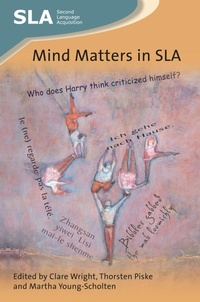
Mind Matters in SLA
Published on 21. September 2018
312 pages
978-1-78892-163-3 (ISBN)
Description

This book examines key issues in theories of what language is and what happens in the mind during second language acquisition (SLA), inspiring readers to think in new and exciting ways about language learning and teaching. Chapters, written by both established and rising star scholars, provide cutting-edge insights and new empirical findings on major topics of formal and cognitive linguistics, psycholinguistics and second language development, and offer a coherent, wide-ranging, reader-friendly examination of learner-internal factors in SLA. The first section of the book focuses on issues that are pertinent to our understanding of language acquisition, particularly in relation to syntax. The second section comprises empirical chapters on syntax, the lexicon, phonetics/phonology and language production in English and other languages. These chapters refer to theories and frameworks from within SLA to enable the reader to grasp the key questions and issues that are currently relevant. The final section focuses on research relating to how second language (L2) learners make transitions from one stage of development to the next; it covers state-of-the-art psycholinguistic research concerning how L2 acquisition occurs in real time, and includes discussion of models of L2 development both in and out of the classroom.
Reviews / Votes
This book provides an accessible background on linguistics, language acquisition and experimental methodologies. Each chapter presents new empirical data and the volume will appeal to second language specialists, as well as a general audience. Its fine writing and broad range of topics - from language evolution to psycholinguistics - make it a welcome contribution to the field. * Julia Herschensohn, University of Washington, USA * This book provides language teachers and applied linguists with a rich, comprehensive and carefully arranged smoergasbord of theoretical issues relevant for understanding the mismatch between what teachers teach and what learners learn. Even the more challenging aspects of some topics are worth the reader's careful attention and will pay rich dividends. * Michael Sharwood Smith, University of Edinburgh, UK * This is a highly recommended volume for three reasons: 1. It covers both property and transition theories and focuses on language representation and processing. 2. The chapters have been authored by the researchers involved in the reported research. 3. Chapters discuss teaching-related issues and make for invaluable reading for teachers and students alike. * Andreas Rohde, University of Cologne, Germany *More details
Series
Language
English
Place of publication
Bristol
United Kingdom
Target group
College/higher education
ISBN-13
978-1-78892-163-3 (9781788921633)
Copyright in bibliographic data and cover images is held by Nielsen Book Services Limited or by the publishers or by their respective licensors: all rights reserved.
Schweitzer Classification
Other editions
Additional editions
Clare Wright | Thorsten Piske | Martha Young-Scholten
Mind Matters in SLA
Book
09/2018
Multilingual Matters
€61.50
Shipment within 3-4 weeks
Persons
Clare Wright is Lecturer in Linguistics and Language Teaching at the University of Leeds, UK. Her research investigates the interfaces between linguistic, cognitive and pedagogic factors in second language acquisition, with particular focus on teaching and learning Chinese as a second language.
Thorsten Piske is Professor of Foreign Language Learning and Teaching at the Friedrich-Alexander-University of Erlangen-Nuernberg, Germany. His research focuses on first and second language acquisition and on bilingual education.
Martha Young-Scholten is Professor of Second Language Acquisition at Newcastle University, UK. Her research currently focuses on the reading development of migrant adults with little or no home language literacy.
Thorsten Piske is Professor of Foreign Language Learning and Teaching at the Friedrich-Alexander-University of Erlangen-Nuernberg, Germany. His research focuses on first and second language acquisition and on bilingual education.
Martha Young-Scholten is Professor of Second Language Acquisition at Newcastle University, UK. Her research currently focuses on the reading development of migrant adults with little or no home language literacy.
Content
Chapter 1. Clare Wright, Thorsten Piske and Martha Young-Scholten: Introduction
Section 1: Language and Mind
Chapter 2. Andrew Caink: What is Grammar? A Universal Grammar Approach
Chapter 3. William O'Grady: Syntax and Acquisition: The Emergentist Story
Chapter 4. Kook-Hee Gil, Heather Marsden and George Tsoulas: Poverty of the Stimulus and Language Acquisition: From Ancient Philosophy to Neuroscience
Chapter 5. Andrew Feeney: Language Evolution and the Nature of the Human Faculty for Language
Section 2: Properties of Interlanguage Grammars
Chapter 6. Walid Kahoul, Anne Vainikka and Martha Young-Scholten: The Mystery of the Missing Inflections
Chapter 7. Vivienne Rogers, David Playfoot and James Milton: The L2 Lexicon
Chapter 8. Joan Carles Mora and Elena Safronova: Foreign Accent in a Second Language: Individual Differences In Perception
Chapter 9. Esther De Leeuw, Aurela Tusha, Hui Zhao, Kyle Helke and Alice Greenfield: A Case Study of Extreme L1 Attrition
Section 3: Transitions in Acquisition
Chapter 10. Theo Marinis and Ian Cunnings: Using Psycholinguistic Techniques in a Second Language Teaching Setting
Chapter 11. Clare Wright: Research in Memory and Processing in SLA
Chapter 12. Joerg-U. Kessler, Anke Lenzing and Anja Plesser: Processability Theory: Architecture and Application
Section 1: Language and Mind
Chapter 2. Andrew Caink: What is Grammar? A Universal Grammar Approach
Chapter 3. William O'Grady: Syntax and Acquisition: The Emergentist Story
Chapter 4. Kook-Hee Gil, Heather Marsden and George Tsoulas: Poverty of the Stimulus and Language Acquisition: From Ancient Philosophy to Neuroscience
Chapter 5. Andrew Feeney: Language Evolution and the Nature of the Human Faculty for Language
Section 2: Properties of Interlanguage Grammars
Chapter 6. Walid Kahoul, Anne Vainikka and Martha Young-Scholten: The Mystery of the Missing Inflections
Chapter 7. Vivienne Rogers, David Playfoot and James Milton: The L2 Lexicon
Chapter 8. Joan Carles Mora and Elena Safronova: Foreign Accent in a Second Language: Individual Differences In Perception
Chapter 9. Esther De Leeuw, Aurela Tusha, Hui Zhao, Kyle Helke and Alice Greenfield: A Case Study of Extreme L1 Attrition
Section 3: Transitions in Acquisition
Chapter 10. Theo Marinis and Ian Cunnings: Using Psycholinguistic Techniques in a Second Language Teaching Setting
Chapter 11. Clare Wright: Research in Memory and Processing in SLA
Chapter 12. Joerg-U. Kessler, Anke Lenzing and Anja Plesser: Processability Theory: Architecture and Application
