

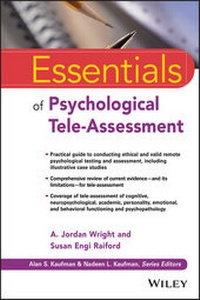
Essentials of Psychological Tele-Assessment
Description

Essentials of Psychological Tele-Assessment delivers a primer on the current state of professional knowledge related to psychological tele-assessment, ranging from the ethical and empirical considerations to the practical applications of tele-assessment procedures. The overarching framework encourages the balancing of the limitations of the current state of the research literature with the very real needs for assessment services to continue, even when in-person procedures are not feasible.
This book includes discussion on a broad range of tests and measures, with information related to both the state of the empirical support for tele-tests and measures, with information related to both the state of the empirical support for tele-assessment utilizing them and the practical 'how-to' for administering, scoring and interpreting data that emerge from them. Additionally, frameworks for integrating the data that emerge from tele-assessment procedures are discussed.
The book is applicable to those transitioning to tele-assessment practice and those training in a wide variety of training programs. Readers will also benefit from the inclusion of:
* Practical checklists and information about specific tests must be adapted to the realities of the tele-health environment.
* Information about how the results of tests should be interpreted differently to account for the tele-health environment.
* Case examples and studies to illustrate many of the challenges of working in tele-assessment
* Guidance on how to balance the limitations of the state of the empirical literature on the validity of tele-assessment with the real-world needs of clients.
Perfect for psychologists and trainees in a variety of health services, including clinical, counseling, school and forensic psychology, Essentials of Psychological Tele-Assessment will also earn a place in the libraries of anyone utilizing or training in cognitive, developmental, neuropsychological, psychoanalytic, psychodynamic, and interpersonal models of psychological assessment.
More details
Other editions
Additional editions
Persons
A. JORDAN WRIGHT is Director of the Center for Counseling and Community Wellbeing at New York University and oversees the graduate psychological assessment curriculum. He is a diplomate of the American Board of Assessment Psychology and chaired the APA task force that developed guidelines for education and training in psychological assessment.
SUSAN ENGI RAIFORD is Senior Research Director and Wechsler Team Lead at Pearson Clinical Assessment. She was formerly a psychologist in private practice. She has written multiple assessment books and has many years of clinical work experience providing assessment, psychotherapy, and consultation to patients in inpatient, outpatient, school and residential settings.
Content
Series Perface ix
One The Landscape of Psychological Tele-Assessment 1
Two Ethical Considerations in Psychological Tele-Assessment 21
Three Practical Considerations in Psychological Tele-Assessment 39
Four Norms, Equivalence, and Equating 61
Five Principles for Psychological Tele-Assessment Interpretation of Data 83
Six Cognitive and Neuropsychological Tele-Assessment with Katy Genseke 97
Seven Academic Achievement Tele-Assessment with Katy Genseke 195
Eight Personality, Emotional, and Behavioral Tele-Assessment 243
Nine Case Studies in Psychological Tele-Assessment 257
References 273
Case Study Contributors 295
Index 297
One
THE LANDSCAPE OF PSYCHOLOGICAL TELE-ASSESSMENT
The COVID-19 pandemic has changed the landscape of health and mental healthcare across the globe. And it seems that it has changed the landscape forever. While the psychotherapy functions of psychologists and other mental health professionals have relatively easily transitioned to an online modality, one which has had significant empirical inquiry and support (Batastini, King, Morgan, & McDaniel, 2016; Bolton & Dorstyn, 2015; Reese, Slone, Soares, & Sprang, 2015; Varker, Brand, Ward, Terhaag, & Phelps, 2019), the psychological assessment functions of psychologists have had to rapidly adapt within a context of significantly less empirical support. The requirements for some, especially performance-based, tests-using manipulatives and physical stimuli-have placed a disproportionate burden on psychological assessment to figure out ways to adapt to a remote, online environment.
Many clinicians chose to pause their assessment services, expecting the world to resume its in-person engagement capabilities relatively soon. However, it is becoming clearer that while a vaccine will likely emerge at some point, COVID-19 may permanently alter health and mental health practices. Thus, clinicians need to consider how they can adapt and continue to deliver essential assessment services to clients, whether in a tele-assessment or somehow physically distanced format.
While psychological tele-assessment has certainly garnered a great deal of attention lately, some researchers have been working toward an evidence base for it for many years. The impetus for such research agendas seems originally to be related more to equity and access, ensuring that those in remote or rural areas have access to needed assessments. This reasoning also accounts for why so much of the research to date evaluating tele-assessment has focused on older adults, neuropsychological assessment, and specifically assessment of cognition (e.g., dementia evaluations). While it seems somewhat counterintuitive that this population would naturally gravitate toward technology, these older adults are also more likely to be home-bound and have difficulty getting to appointments (Qiu et al., 2010). Because of these lines of research, we are lucky to at least have some empirical evidence base for remote, online tele-assessments (in contrast to assessments conducted with social distancing measures, such as masks, plexiglass partitions, greater distance between assessor and client, etc., which have no empirical inquiry). Our research evidence base is young and imperfect, but it allows for some confidence in some measures administered in this way.
STATE OF THE RESEARCH
The research landscape focused on psychological tele-assessment has amassed a modest, though compelling, body of evidence for the reliability, validity, and utility of tele-assessment procedures in collecting psychological data. First, as a primary measurement tool in psychological assessment, the evidence that clinical interviews conducted through tele-assessment procedures are generally equivalent to traditional, in-person procedures is quite strong (Garb, 2007; Hyler, Gangure, & Batchelder, 2005; Luxton, Pruitt, & Osenbach, 2014; Schopp, Johnstone, & Merrell, 2000; Singh, Arya, & Peters, 2007). The Society for Personality Assessment's (COVID-19 Task Force to Support Personality Assessment, 2020) guidance on tele-assessment of personality and psychopathology notes that this is likely related to the fact that clinical interview data accuracy is heavily related to the quality of the therapeutic alliance and relationship, which has been shown to be quite strong in telehealth in general (Bouchard et al., 2000; Germain, Marchand, Bouchard, Guay, & Drouin, 2010; Morgan, Patrick, & Magaletta, 2008; Simpson, 2001). The equal quality of data elicited through tele-assessment and in-person procedures seems especially true for more structured clinical interviews (Grady et al., 2011; Hyler et al., 2005; Ruskin et al., 1998; Shore, Savin, Orton, Beals, & Manson, 2007), and has even been supported in forensic evaluations (Lexcen, Hawk, Herrick, & Blank, 2006; Manguno-Mire et al., 2007). There is similarly relatively strong evidence that self-report questionnaire measures are generally equivalent (Garb, 2007; Luxton et al., 2014), especially if specific steps are taken to ensure the integrity of the self-report tests (Corey & Ben-Porath, 2020).
As stated previously, a great deal of the literature on equivalence between psychological tele-assessment and traditional, in-person psychological assessment administration of measures is found on neuropsychological tests. Research has evaluated the equivalency of specific, performance-based neuropsychological tasks and built a significant evidence base for tele-neuropsychological testing. Most of this work has included older adult populations and a variety of tasks. These tasks include broader, multitask and multi-construct measures like the Mini-Mental State Examination (MMSE; Folstein, Folstein, & McHugh, 1975) and the Repeatable Battery for the Assessment of Neuropsychological Status (RBANS; Randolph, 1998), both of which include verbal and nonverbal components. Also evaluated are select tests and subtests that evaluate single neuropsychological constructs, like the Boston Naming Test (Kaplan, Goodglass, & Weintraub, 1976), Digit Span, Matrix Reasoning, and Vocabulary subtests of the Wechsler Adult Intelligence Scale (WAIS; Wechsler, 2008), and drawing tasks like clock drawing and the Beery Visual-Motor Integration, Fourth Edition (VMI-I; Beery, 2004). The literature has shown that in general these performance-based, tele-neuropsychological assessment techniques are effective at evaluating older adults, both with and without cognitive impairment, and discriminating impaired from non-impaired individuals equally as well as in-person neuropsychological procedures (Cullum, Weiner, Gehrmann, & Hynan, 2006; Galusha-Glasscock, Horton, Weiner, & Cullum, 2016; Grosch, Weiner, Hynan, Shore, & Cullum, 2015; Harrell, Wilkins, Connor, & Chodosh, 2014; Loh, Donaldson, Flicker, Majer, & Goldswain, 2007; Luxton et al., 2014; Temple, Drummond, Valiquette, & Jozsvai, 2010; Tukstra, Quinn-Padron, Johnson, Workinger, & Antoniotti, 2012; Wadsworth et al., 2018).
In a systematic review and meta-analysis of neuropsychological tele-assessment test administration with adults, Brearly and colleagues (2017) identified several themes, including overall findings that videoconferencing administration did not yield any significant change in test scores when compared to in-person assessment, with a very small effect size noted for administration procedure. They noted an average of 1/33rd of a standard deviation lower scores elicited by tele-assessment procedures than by in-person ones. They did note in their analyses that while verbally mediated, synchronous tests (those that require in-the-moment interaction and scoring) were unaffected by the different administration modalities, those tests with both verbal and visual stimuli did have significantly lower scores in tele-assessment conditions. However, the effect size of these differences, even though significant, was small, and scores were about 1/10th of a standard deviation lower in the tele-assessment condition. It should be noted that most equivalence research on neuropsychological tests has taken a task-based (rather than full measure-based) approach.
Rapid References 1.1 and 1.2 summarize the major studies that have attempted to determine equivalence between traditional in-person methods and tele-assessment methods of test administration (to date). In addition to study details, a study rating column is provided to rate the strength of each study. The studies are rated on a three-point scale, with 1 indicating the strongest study qualities (and thus the most convincing evidence) and 3 indicating less strength. To receive a study rating of "1," a study must (a) be peer reviewed, (b) possess a convincing sample size, and (c) provide a strong research design (e.g., random assignment to groups) and statistical results (e.g., not merely a correlation or interrater reliability) that allow equivalence to be examined. If any one of these three criteria were not met, the study received a rating of 2. If two of these three criteria were not met, the study received a rating of 3 (studies that did not meet any of these criteria were not included). The Rating Reason column provides the area deemed problematic (i.e., a, b, or c in the aforementioned description) that resulted in the Study Rating being downgraded.
DON'T FORGET
Study Ratings in Tables 1.1 and 1.2 used the following criteria:
a = peer reviewed
b = convincing sample size
c = strong research design and statistical analyses to support equivalence
The ratings are as follows (and the reason for a downgraded rating is listed using these letter codes to represent problematic areas in the specific study, listed in the table under "Rating Reason"):
1 = All three criteria (a, b, and c) met
2 = Two of three criteria met
3 = One of three criteria met
Rapid Reference
Tele-Assessment Mode Equivalence Studies for Neuropsychological Tasks
Reference Population Study Rating Rating...