

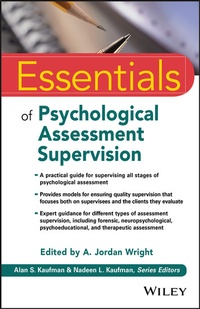
Essentials of Psychological Assessment Supervision
Description

In 2014, the American Psychological Association (APA) adopted a set of guidelines for clinical supervision for health service psychology. While technically covered by these guidelines, supervising clinical psychological assessment includes additional tasks (such as ensuring accurate administration, scoring, and interpretation of tests) and tensions. Supervisors must often instruct supervisees on the data-integration process--which can involve more direct teaching than standard clinical supervision--while encompassing the same interpersonal, therapeutic, and less structured guiding aspects as psychotherapy supervision. It is increasingly common to view clinical supervision in the assessment process and supervision of psychotherapy as two significantly different tasks. Surprisingly, there is very little training and guidance available on appropriate, effective, and beneficial methods of psychological assessment supervision.
Essentials of Psychological Assessment Supervision seeks to remedy the lack of literature in this area, offering guidance on supervising psychological testing and assessment. This much-needed guide provides supervisors with authoritative, up-to-date information on guidelines relevant to assessment supervision. Additionally, detailed coverage of supervision of cognitive, personality/emotional, psychoeducational, neuropsychological, forensic, and therapeutic assessments, among others, provide supervisors with guidance and structure in the supervision process. Focusing on practical application, this book offers guidance on topics such as assessment models appropriate in different areas of assessment; diversity issues; evaluation and feedback of supervisee performance; and ethical, legal, and regulatory considerations relevant in each assessment context. An invaluable resource for practitioners, this book:
* Offers practical advice on supervising a wide range of clinical psychological assessments
* Includes contributions from experts in their respective subfields
* Provides guidance on incorporating new American Psychological Association (APA) and Society for Personality Assessment (SPA) guidelines into the supervision process
* Fills an urgent need for an up-to-date reference on assessment supervision
Essentials of Psychological Assessment Supervision is a must-have reference for both psychology practitioners who supervise the assessment process and instructors of psychological testing and assessment.
More details
Other editions
Additional editions
Person
A. Jordan Wright, Ph.D., is the Director of the Center for Counseling and Community Wellbeing at New York University's Steinhardt School of Culture, Education, and Human Development, where he also coordinates the psychological assessment curriculum in the Counseling Psychology program. He is board certified by the American Board of Assessment Psychology and a fellow of the American Academy of Assessment Psychology and the Society for Personality Assessment.
Content
Series Preface
Introduction A. Jordan Wright
Chapter 1: The Use of Guidelines in Assessment Supervision A. Jordan Wright, Virginia M. Brabender, and Hadas Pade
Chapter 2: Supervising Cognitive Assessment Robert Walrath, John O. Willis, and Ron Dumont
Chapter 3: Supervising Personality Assessment Robert F. Bornstein
Chapter 4: Supervising Integration in Assessment Steven R. Smith and Ana Romero-Morales
Chapter 5: Supervising the Development of Treatment Recommendations in Psychological Assessment A. Jordan Wright
Chapter 6: Supervising Psychoeducational Assessment Michael R. Hass and Annmary S. Abdou
Chapter 7: Supervising Forensic Assessment Richart L. DeMier and Carol E. Holden
Chapter 8: Supervising Neuropsychological Assessment Catherine L. Leveroni
Chapter 9: Supervising Therapeutic Assessment Stephen E. Finn
Chapter 10: Supervising Psychological Assessment Report Writing A. Jordan Wright and Hadas Pade
One
THE USE OF GUIDELINES IN ASSESSMENT SUPERVISION
A. Jordan Wright
Virginia M. Brabender
Hadas Pade
Guidelines have been developed for all sorts of different aspects of work in the field of psychology. Psychological assessment training and supervision is often a component of these sets of guidelines, but using them as a resource or tool in actual supervision is not often accomplished. This chapter presents three sets of guidelines that can be useful in the work of the supervisor during psychological assessment supervision. One set of guidelines presented, the American Psychological Association's (APA, 2015) Guidelines for Clinical Supervision in Health Service Psychology, is more broadly about supervision and needs to be adapted. The second set, the National Council of Schools and Programs of Professional Psychology's (NCSPP, 2007) Competency Developmental Achievement Levels, has specific components that are relevant to assessment. The third set, the Society for Personality Assessment's (, 2015) framework, was developed specifically for the practice of psychological assessment. Supervisors are encouraged to read through each set of guidelines and determine how each of these can help them be more effective, more clear, and more deliberate in their work with supervisees.
APA'S SUPERVISION GUIDELINES
The American Psychological Association's (APA, 2015) Guidelines for Clinical Supervision in Health Service Psychology lay out broad areas that are relevant to supervisors across all domains of clinical work in psychology, including assessment, counseling, consulting, and more. Assessment supervisors should strive to know, understand, and meet all of the expectations spelled out in this document, without exception. However, some areas within these guidelines require even more specific knowledge and skill when supervisors are supervising assessment. Each guideline area is addressed below, focusing on what assessment supervisors need to pay attention to, even beyond what is explicitly stated in the guidelines.
Rapid Reference 1.1
APA's Supervision Guidelines Domain Areas (APA, 2015)
- Domain A: Supervision Competence
- Domain B: Diversity
- Domain C: Supervisory Relationship
- Domain D: Professionalism
- Domain E: Assessment/Evaluation/Feedback
- Domain F: Professional Competence Problems
- Domain G: Ethical, Legal, and Regulatory Considerations
Supervisor Competence
It should (hopefully) go without saying that those professionals who are supervising psychological assessment should be competent in both psychological assessment and the provision of supervision. The reality, though, is that often, because of logistical and availability constraints, assessment supervisors are either practitioners who do assessments and have limited specific training in supervision, or they are general clinical supervisors who may do some assessment but do not have specific expertise in it. Aligned with APA's guideline of supervisor competence, supervisors need to ensure that they are fully competent specifically in psychological assessment (including the types of assessment, referral questions, and populations that their supervisees will be working with) and seek out formal training in supervision practices. There are very few (if any) specific trainings on assessment supervision, but many professional development opportunities on supervision more generally can be usefully applied to assessment supervision. Because of constraints, supervisors should know their own limitations and what resources are available for consultation or additional information. Ideally, all assessment supervisors would be fully proficient (even beyond competent) in both psychological assessment and supervision practices, but supervisors should at least understand any limitations or lapses in their own competence.
Diversity
Obviously deeply ingrained within the profession of psychology is a respect for diversity (broadly defined). APA takes very seriously an understanding of and respect for diversity in every aspect of practicing psychologists' work, and assessment is no exception. As with all the guidelines, assessment supervisors should adhere to the diversity guideline as specified in APA's document. In addition to the broad "diversity competence" that is specified in the guidelines, which includes knowledge, attitudes, and skills related to diversity with regard to client relationships and the supervisory relationship, there are aspects of diversity that are specific to psychological assessment supervision.
Specifically, there are multiple "touch points" in the assessment process that need explicit consideration of diversity issues. In addition to the relationship between supervisee and client, which needs attention to interpersonal style and other cultural components, supervisees and supervisors should consider culture and diversity at multiple other stages in the process. First, when coming up with functional, dynamic, and diagnostic hypotheses about clients, assessors (and thus supervisees) must consider cultural context. Issues like minority stress, acculturative stress, and differences in the ways distress are communicated (among many, many others) should be considered when hypothesizing what may be going on with a client. Next, when deciding how best to test those hypotheses, supervisees must consider diversity issues in test selection, including whether certain tests are appropriate for clients from different backgrounds, including language, normative data availability, acculturation, and other issues. Once tests are determined to be appropriate and are administered and scored, culture and diversity need again to be considered in the interpretation of each individual test. Careful consideration should be given to the normative sample to which the client is being compared, the cultural assumptions for performance on the test, and alternative hypotheses for why test results emerged as they did.
Once tests have been interpreted, the tougher work of the psychological assessment process begins. When integrating all the data together into a case formulation/conceptualization, supervisors and supervisees must address culture and diversity issues (including individual differences, group differences, systems, cultural norms, and many other issues). That is, supervisors must ensure that supervisees conceptualize cases within the context of culture and diversity, a focus that must continue as diagnosis, recommendations, and feedback are discussed. Supervisors should be explicit about ensuring that culture and diversity have been addressed throughout each of these decision-making "touch points" in the assessment process. One way to ensure this diversity awareness is to encourage or require supervisees to articulate exactly how they have considered and addressed culture and diversity issues at each of these points in the assessment process.
REMEMBER
Some of the Most Important Diversity "Touch Points" in the Assessment Process
- The relationship between assessor and client, including ways of communicating
- Hypothesis development about client functioning and diagnosis
- Test selection
- Test interpretation
- Data integration and case formulation/conceptualization
- Diagnosis
- Recommendations
- Feedback
Supervisory Relationship
Again, psychological assessment supervisors should adhere to the guidelines presented by APA, but some aspects of assessment supervision have the potential to make maintaining a positive, supportive, collaborative relationship more difficult than in supervision of psychotherapy. This topic has been addressed in the Introduction of this book, so we will not belabor the point here. The overall idea is that the necessarily hybrid nature of psychological assessment supervision, always teetering between directive and non-directive, didactic and self-guided, can make the supervisor's role in the relationship less clear moment-to-moment. This is not at odds with APA's guidance to maintain a collaborative relationship with supervisees, but it can certainly make it seem less collaborative, especially in moments when the supervisor is teaching new tests or providing developmental, formative feedback about specific mistakes or missteps on the part of the supervisee, which can be much more salient than those in psychotherapy supervision.
Professionalism
Psychological assessment supervisors are again encouraged to adhere to the guidelines presented by APA in this domain, modeling professional attitudes and behavior throughout their work and providing specific feedback to supervisees about expectations for professional behavior and their developmental achievement against those expectations. There are no additional aspects of this that are specific to psychological assessment supervision.
Assessment/Evaluation/Feedback
Psychological assessment supervisors should be experts at evaluating supervisees and providing them feedback; ironically, this often is not the case. The below two resources, the National Council of Schools and Programs of Professional Psychology's (NCSPP) developmental achievement levels (DALs) and the SPA's framework, provide mechanisms for evaluating supervisees and providing feedback. It can be tempting for assessment supervisors to...
