

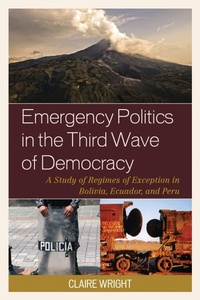
Emergency Politics in the Third Wave of Democracy
A Study of Regimes of Exception in Bolivia, Ecuador, and Peru
1st Edition
Published on 9. December 2015
212 pages
979-8-216-32203-0 (ISBN)
Description

Emergency Politics in the Third Wave of Democracy aims to make an important contribution to the study of emergency politics by offering an up-to-date study of how it works in practice. Specifically, it studies the uses given to the "regime of exception" mechanism in Bolivia, Ecuador, and Peru in the first decade of the 21st century and analyzes potential incompatibilities with the two pillars of democratic governability: efficiency and legitimacy.
This book offers a thorough review of existing literature on emergency politics, offering conceptual clarification, identifying three types or paradigms of emergency politics (repressive, administrative, and disaster) and pointing to regimes of exception as a useful route to their study. It also provides an overview of emergency politics in Latin America throughout history, pointing to the predominance of regimes of exception and the repressive paradigm. The book describes the continuity of the repressive paradigm in Peruvian emergency politics to deal with both social protest and the apparent threat of organized crime and terrorism, as well as how Bolivia has shifted from a repressive to a disaster paradigm in the face of pressure to deal with climate change. It also analyzes the predominance of an administrative paradigm in Ecuadorian emergency politics in the context of weak institutions and difficulties in implementing policy as well as a populist style of leadership. Ultimately, the book offers some "best practices" in relation to the design and use of regimes of exception in democratic contexts.
Other studies on emergency politics tend to focus on legal or formal issues in the context of the United States War on Terror. This study is decidedly political and empirical in focus, offering analysis and interpretation as a result of intensive fieldwork carried out by the author in Bolivia, Ecuador, and Peru. Consequently, this volume offers important contributions to our understanding of emergency politics in general (with evidence from the periphery) as well as to our understanding of democratization processes in the Third Wave.
This book offers a thorough review of existing literature on emergency politics, offering conceptual clarification, identifying three types or paradigms of emergency politics (repressive, administrative, and disaster) and pointing to regimes of exception as a useful route to their study. It also provides an overview of emergency politics in Latin America throughout history, pointing to the predominance of regimes of exception and the repressive paradigm. The book describes the continuity of the repressive paradigm in Peruvian emergency politics to deal with both social protest and the apparent threat of organized crime and terrorism, as well as how Bolivia has shifted from a repressive to a disaster paradigm in the face of pressure to deal with climate change. It also analyzes the predominance of an administrative paradigm in Ecuadorian emergency politics in the context of weak institutions and difficulties in implementing policy as well as a populist style of leadership. Ultimately, the book offers some "best practices" in relation to the design and use of regimes of exception in democratic contexts.
Other studies on emergency politics tend to focus on legal or formal issues in the context of the United States War on Terror. This study is decidedly political and empirical in focus, offering analysis and interpretation as a result of intensive fieldwork carried out by the author in Bolivia, Ecuador, and Peru. Consequently, this volume offers important contributions to our understanding of emergency politics in general (with evidence from the periphery) as well as to our understanding of democratization processes in the Third Wave.
More details
Edition
1. Auflage
Language
English
Place of publication
United States
Publishing group
Bloomsbury Publishing Plc
Target group
Professional and scholarly
Illustrations
6 Graphs, 5 Tables
ISBN-13
979-8-216-32203-0 (9798216322030)
Copyright in bibliographic data and cover images is held by Nielsen Book Services Limited or by the publishers or by their respective licensors: all rights reserved.
Schweitzer Classification
Other editions
Additional editions
Claire Wright
Emergency Politics in the Third Wave of Democracy
A Study of Regimes of Exception in Bolivia, Ecuador, and Peru
Book
12/2015
Lexington Books
€132.60
Shipment within 15-20 days
Person
Claire Wright isa lecturer at the Universidad Autónoma de Nuevo León.
Content
Chapter 1 The Emergency Politics Concept
Chapter 2 Regimes of Exception in Latin America
Chapter 3 Peru: The Repressive Paradigm
Chapter 4 Bolivia: The Disaster Paradigm
Chapter 5 Ecuador: The Administrative Paradigm
Chapter 6 Lessons Learned
Chapter 2 Regimes of Exception in Latin America
Chapter 3 Peru: The Repressive Paradigm
Chapter 4 Bolivia: The Disaster Paradigm
Chapter 5 Ecuador: The Administrative Paradigm
Chapter 6 Lessons Learned
