

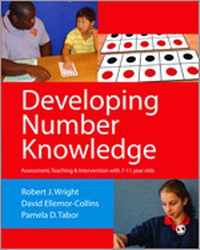
Developing Number Knowledge
Assessment,Teaching and Intervention with 7-11 year olds
1st Edition
Published on 4. November 2011
312 pages
978-1-4462-5368-7 (ISBN)
Description

Following the great success of the earlier books, this fourth book in the Mathematics Recovery series equips teachers with detailed pedagogical knowledge and resources for teaching number to 7 to 11-year olds.
Drawing on extensive programs of research, curriculum development, and teacher development, the book offers a coherent, up-to-date approach emphasising computational fluency and the progressive development of students' mathematical sophistication. The book is organized in key domains of number instruction, including structuring numbers 1 to 20, knowledge of number words and numerals, conceptual place value, mental computation, written computation methods, fractions, and early algebraic reasoning.
Features include:
fine-grained progressions of instruction within each domain;
detailed descriptions of students' strategies and difficulties;
assessment tasks with notes on students' responses;
classroom-ready instructional activities;
This book is designed for classroom and intervention teachers, special education teachers and classroom assistants. The book is an invaluable resource for mathematics advisors and coaches, learning support staff, numeracy consultants, curriculum developers, teacher educators and researchers.
Drawing on extensive programs of research, curriculum development, and teacher development, the book offers a coherent, up-to-date approach emphasising computational fluency and the progressive development of students' mathematical sophistication. The book is organized in key domains of number instruction, including structuring numbers 1 to 20, knowledge of number words and numerals, conceptual place value, mental computation, written computation methods, fractions, and early algebraic reasoning.
Features include:
fine-grained progressions of instruction within each domain;
detailed descriptions of students' strategies and difficulties;
assessment tasks with notes on students' responses;
classroom-ready instructional activities;
This book is designed for classroom and intervention teachers, special education teachers and classroom assistants. The book is an invaluable resource for mathematics advisors and coaches, learning support staff, numeracy consultants, curriculum developers, teacher educators and researchers.
Reviews / Votes
'This is the must-have resource our teachers have been waiting for! Developing Number Knowledge transforms an extensive body of research and field testing into a practical guide of assessments and instructional activities designed especially for older elementary students. As an instructional support teacher, I will use this guide when helping teachers plan developmentally appropriate lessons for their struggling students' -Jackie Amato, District Math Recovery Leader
'Essential reading for every teacher of mathematics in primary or early secondary education, 'Developing Number Knowledge' is a professional development tool with detailed assessment and instructional content for the classroom. It is for teachers working one-to-one, with small groups or whole classes who want their children to make sense of mathematics and become confident, successful mathematicians. With its foundations in research and extensive classroom practice, it will challenge the way you teach! Maths Recovery teachers will welcome this addition to their 'tool kit'' -
Julia Sheridan
Chair Maths Recovery Council UK and Ireland, Maths Recovery Consultant
All prices
More details
Series
Language
English
Place of publication
London
United Kingdom
Target group
Professional and scholarly
Classroom and intervention teachers, special education teachers and classroom assistants; also mathematics advisors and coaches, learning support staff, numeracy consultants, curriculum developers, teacher educators and researchers.
ISBN-13
978-1-4462-5368-7 (9781446253687)
Copyright in bibliographic data and cover images is held by Nielsen Book Services Limited or by the publishers or by their respective licensors: all rights reserved.
Schweitzer Classification
Other editions
Additional editions
Robert J. Wright | David Ellemor-Collins | Pamela D. Tabor
Developing Number Knowledge
Assessment,Teaching and Intervention with 7-11 year olds
Book
11/2011
1st Edition
SAGE Publications Ltd
€190.15
Shipment within 15-20 days
Robert J. Wright | David Ellemor-Collins | Pamela D. Tabor
Developing Number Knowledge
Assessment,Teaching and Intervention with 7-11 year olds
Book
11/2011
1st Edition
SAGE Publications Ltd
€45.00
Shipment within 15-20 days
Persons
Dr Robert J. (Bob) Wright holds Bachelor's and Master's degrees in mathematics from the University of Queensland (Australia) and a doctoral degree in mathematics education from the University of Georgia. He is an adjunct professor in mathematics education at Southern Cross University in New South Wales. Bob is an inter-nationally recognized leader in assessment and instruction relating to children's early arithmetical knowledge and strategies, publishing six books, and many articles and papers in this field. His work over the last 25 years has included the development of the Mathematics Recovery Program, which focuses on providing specialist training for teachers to advance the numeracy levels of young children assessed as low-attainers. In Australia and New Zealand, Ireland, the UK, the USA, Canada, Mexico, South Africa and elsewhere, this programme has been implemented widely, and applied extensively to classroom teaching and to average and able learners as well as low-attainers. Bob has conducted several research projects funded by the Australian Research Council including the most recent project focusing on assessment and intervention in the early arithmetical learning of low-attaining 8- to 10-year-olds.
Dr. Pamela D. Tabor holds a Bachelor of Science degree in elementary education and Bible from Kentucky Christian University, a Master of Arts degree in elementary education from East Tennessee State University, and a Doctor of Philosophy in mathematics education from Southern Cross University. Her supervisor was Robert J. Wright, the developer of Mathematics Recovery. She has recently worked as Research and Evaluation Specialist for the US Math Recovery Council in which she has had the pleasure of working with instructional leaders from districts around the US and internationally to think deeply about the impact of Math Recovery in their school contexts. Previously, she spent nearly two decades as a school-based math specialist, interventionist and instructional coach. In that capacity she worked with administrators, teachers of mathematics, teachers of special education, students, and parents to improve the quality of mathematics instruction in a public elementary school in Maryland. She is also a coauthor of the Math Recovery series book Developing Number Knowledge, a contributor of Teaching Number in the Classroom with 4-8 year Olds, one of the original developers of USMRC's Add+VantageMR Professional Development Courses, and one of the developers of USMRC's Student Numeracy Assessment Progressions (SNAP).
Dr. Pamela D. Tabor holds a Bachelor of Science degree in elementary education and Bible from Kentucky Christian University, a Master of Arts degree in elementary education from East Tennessee State University, and a Doctor of Philosophy in mathematics education from Southern Cross University. Her supervisor was Robert J. Wright, the developer of Mathematics Recovery. She has recently worked as Research and Evaluation Specialist for the US Math Recovery Council in which she has had the pleasure of working with instructional leaders from districts around the US and internationally to think deeply about the impact of Math Recovery in their school contexts. Previously, she spent nearly two decades as a school-based math specialist, interventionist and instructional coach. In that capacity she worked with administrators, teachers of mathematics, teachers of special education, students, and parents to improve the quality of mathematics instruction in a public elementary school in Maryland. She is also a coauthor of the Math Recovery series book Developing Number Knowledge, a contributor of Teaching Number in the Classroom with 4-8 year Olds, one of the original developers of USMRC's Add+VantageMR Professional Development Courses, and one of the developers of USMRC's Student Numeracy Assessment Progressions (SNAP).
Content
- Cover Page
- Title Page
- Copyright Page
- Brief Contents
- Contents
- List of Boxes
- List of Tables
- List of Figures
- List of Photographs
- Contents of Resource CD
- Acknowledgements
- About the Authors and Contributor
- Series Preface
- Introduction
- The Purpose of the Book
- The Background to the Book
- The Structure of the Book
- Notes to the Reader
- PART I
- 1 Professional Learning for Quality Instruction
- Using the Book for Professional Learning and Development
- Using the Book for Intervention Instruction
- Using the Book for Classroom Instruction
- Using the Book to Promote Parental Involvement
- 2 Instruction in Arithmetic
- Organizing Instruction in Arithmetic
- Progressive Mathematization of Arithmetic
- An Inquiry-based Approach to Instruction
- PART II
- 3 Number Words and Numerals
- Domain Overview
- Significance of Knowledge of Number Words and Numerals
- Learning Number Word Sequences
- Learning to Read and Write Numerals
- Assessment of Number Words and Numerals
- Instruction in Number Word Sequences
- Instruction in Numerals
- Assessment Task Groups
- A3.1: Numeral Identification
- A3.2: Writing Numerals
- A3.3: Number Word Sequences by 1s
- A3.4: Number Word Before, Number Word After
- A3.5: Number Word Sequences by 10s on the Decuple
- A3.6: Number Word Sequences by 100s on the Centuple
- A3.7: Number Word Sequences by 10s off the Decuple
- Instructional Activities
- IA3.1: Arrow Cards Draw for Numeral Identification
- IA3.2: I Read, You Write, We Check, We Build
- IA3.3: Place Value Houses
- IA3.4: Choral Chanting
- IA3.5: What Comes After Nine?
- IA3.6: Disappearing Sequences
- IA3.7: Bare Numeral Roll
- IA3.8: Numeral Roll with Window or Multi-lid Screen
- IA3.9: Numeral Grid Sequences
- IA3.10: Numeral Ladder
- IA3.11: The Four Kings Game
- IA3.12: Lovely Lucy
- 4 Structuring Numbers 1 to 20
- Domain Overview
- Facility with Addition and Subtraction in the Range 1 to 20
- Significance of Structuring Numbers 1 to 20
- Assessment of Structuring Numbers 1 to 20
- Outline of Instruction in Structuring Numbers 1 to 20
- Instruction in Structuring Numbers 1 to 10 Using Ten-frames
- Instruction in Structuring Numbers 1 to 20 Using the Arithmetic Rack
- Assessment Task Groups
- A4.1: Combinations up to 10, with Ten-frames
- A4.2: Doubles
- A4.3: Combinations with 10
- A4.4: Partitions of 10
- A4.5: Partitions of Numbers in the Range 1 to 20
- A4.6: Addition and Subtraction with a Rack (addends = 10)
- A4.7: Addition and Subtraction with a Rack (one addend & 10)
- A4.8: Bare Number Addition and Subtraction (range = 10)
- A4.9: Bare Number Addition and Subtraction (addends = 10)
- A4.10: Bare Number Addition and Subtraction (one addend & 10)
- Instructional Activities
- IA4.1: Keeping Score with Tally Marks
- IA4.2: Ten-frame Flashes
- IA4.3: Go Fish with Mini Ten-frames
- IA4.4: I Wish I Had on the Bead Rack
- IA4.5: The Double-decker Bus with the Bead Rack
- IA4.6: 9 Plus Game
- IA4.7: 20 Minus Game
- IA4.8: Making Six
- IA4.9: Crackers the Parrot
- IA4.10: Expression Card Families
- IA4.11: Bulls-eye Dice
- 5 Conceptual Place Value
- Domain Overview
- Learning Conceptual Place Value
- Assessment of Conceptual Place Value
- Instruction in Conceptual Place Value
- Distinguishing Conceptual Place Value from Conventional Place Value
- Assessment Task Groups
- A5.1: Preliminary Unscreened Bundling Sticks Tasks
- A5.2: Incrementing and Decrementing by Tens on the Decuple
- A5.3: Incrementing and Decrementing by Tens off the Decuple
- A5.4: Incrementing Flexibly by Tens and Ones
- A5.5: Incrementing by Hundreds on the Centuple
- A5.6: Incrementing and Decrementing by Tens across 1000
- A5.7: Ten More and Ten Less
- A5.8: One Hundred More and One Hundred Less
- Instructional Activities
- IA5.1: Incrementing and Decrementing by Tens with Screened Bundling Sticks
- IA5.2: CPV Egg Contextual Investigation
- IA5.3: Read It, Build It, Check It with Arrow Cards and Base-ten Materials
- IA5.4: Arrow Cards Draw Game with Base-ten Materials
- IA5.5: Hopping and Leaping on the Empty Number Line
- IA5.6: Crazy Grid
- IA5.7: Withdrawing Money from the Automated Teller Machine
- 6 Addition and Subtraction to 100
- Domain Overview
- Facility with Mental Addition and Subtraction to 100
- Foundational Knowledge for Mental Addition and Subtraction to 100
- Assessment of Addition and Subtraction to 100
- Outline of Instruction in Addition and Subtraction to 100
- Instruction Phase 1: Developing Foundational Knowledge
- Instruction Phase 2: Consolidating Early Strategies
- Instruction Phase 3: Refining Strategies and Extending Tasks
- Assessment Task Groups
- Task Group A6.1: Decuple After and Decuple Before a Number
- Task Group A6.2: Jump Forward from and Jump Back to a Decuple
- Task Group A6.3: Jump Forward to and Jump Back from a Decuple
- Task Group A6.4: Jump Across a Decuple
- Task Group A6.5: Addition and Subtraction of a Decuple
- Task Group A6.6: 2-digit Addition and Subtraction without Regrouping
- Task Group A6.7: 2-digit Addition and Subtraction with Regrouping
- Task Group A6.8: 3-digit Addition and Subtraction
- Instructional Activities
- IA6.1: 70 Plus Game
- IA6.2: Jumping Back to the Decuple with Mini Ten-frames
- IA6.3: Decuple Tag
- IA6.4: Adding to 50 Game
- IA6.5: Jumping Back from a Decuple with Mini Ten-frames
- IA6.6: 48 Plus Game
- IA6.7: 32 Minus Game
- IA6.8: Higher Decade Addition and Subtraction Patterns
- IA6.9: Screened Tasks with Two Collections of Mini Ten-frames
- IA6.10: Interstate Driving Context Notated on the Empty Number Line
- IA6.11: Add or Subtract 12
- IA6.12: How Many More to Make 100?
- IA6.13: How Many More to Make 60?
- 7 Multiplication and Division
- Domain Overview
- Multiplication and Division in Formal Arithmetic
- Learning Multiplication and Division
- Assessment of Multiplication and Division
- Instruction in Multiplication and Division
- Assessment Task Groups
- A7.1: Multiplication with Repeated Equal Groups
- A7.2: Grouping Division with Repeated Equal Groups
- A7.3: Sharing Division with Repeated Equal Groups
- A7.4: Multiplication with an Array
- A7.5: Grouping Division with an Array
- A7.6: Sharing Division with an Array
- A7.7: Multiplication Basic Facts
- A7.8: Multiplication with Bare Numbers - 2-digit × 1-digit
- A7.9: Division with Bare Numbers - 2-digit Quotients
- A7.10: Inverse Relationship of Multiplication and Division
- A7.11: Commutative Principle
- A7.12: Distributive Principle
- Instructional Activities
- IA7.1: Counting Items in Equal Groups
- IA7.2: Snack Time
- IA7.3: Counting Dot Tiles
- IA7.4: Arrays on the 100-bead Rack
- IA7.5: Array Bingo
- IA7.6: Using the Empty Number Line to Model Multiplicative Situations
- IA7.7: The Multiples Games
- IA7.8: The Factoring Game
- 8 Written Computation
- Domain Overview
- Written Computation Methods: Jotting, Semi-formal Strategies and Formal Algorithms
- Comparing Semi-formal Strategies and Formal Algorithms
- Significance of Written Computation Methods in the Curriculum
- Learning Written Computation
- Assessment of Written Computation
- Outline of Instruction in Written Computation
- Instruction in Jotting
- Instruction in Semi-formal Written Strategies
- Instruction in Formal Algorithms
- Assessment Task Groups
- A8.1: Multi-digit Tasks in a Context: The School Excursion
- A8.2: Open-ended Horizontal Bare Number Tasks
- A8.3: Using a Semi-formal Strategy
- A8.4: Algorithm Error Analysis
- Instructional Activities
- IA8.1: Group Monster
- IA8.2: Sum of the Century
- IA8.3: Decomposition with Arrow Cards
- IA8.4: Palindromization
- IA8.5: Catch 22
- IA8.6: Shortcut 100
- IA8.7: The Prodigal Sum
- PART III
- 9 Early Algebraic Reasoning
- Basis for Instruction in Early Algebraic Reasoning
- Examples of Instruction Linking to Early Algebraic Reasoning
- Patterns and Functions
- Building Generalizations from Arithmetic
- 10 Understanding Fractions Peter Gould
- Chapter Overview
- A Pathway to Understanding Fractions as Numbers
- Key Ideas in Understanding Fractions
- Making Sense of Fraction Research
- Looking Back
- 11 Connecting the Teaching and Learning of Fractions Peter Gould
- Learning Fractions
- Introductory Assessment Tasks
- A Teaching Sequence
- Looking Back
- Instructional Activities
- IA11.1: Finding Half Way
- IA11.2: Line Up
- IA11.3: Finding One-quarter of the Way
- IA11.4: What Fraction of the Length is That?
- IA11.5: One-half, One-quarter and One-eighth
- IA11.6: Three-eighths of the Way Across the Board
- IA11.7: One-third of a Circle
- IA11.8: Recording Partitioning
- IA11.9: Building Towers
- IA11.10: Oops!
- IA11.11: How Many Are At Your Table?
- IA11.12: Keeping Records at the Pancake Place
- IA11.13: Time for a Break
- Glossary
- Appendix: Instructional Settings
- References
- Index
