

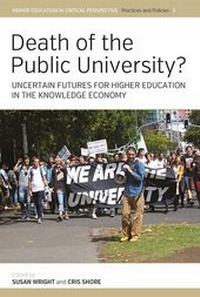
Death of the Public University?
Uncertain Futures for Higher Education in the Knowledge Economy
1st Edition
Published on 1. May 2017
350 pages
978-1-78533-543-3 (ISBN)
Description

Universities have been subjected to continuous government reforms since the 1980s, to make them 'entrepreneurial', 'efficient' and aligned to the predicted needs and challenges of a global knowledge economy. Under increasing pressure to pursue 'excellence' and 'innovation', many universities are struggling to maintain their traditional mission to be inclusive, improve social mobility and equality and act as the 'critic and conscience' of society. Drawing on a multi-disciplinary research project, University Reform, Globalisation and Europeanisation (URGE), this collection analyses the new landscapes of public universities emerging across Europe and the Asia-Pacific, and the different ways that academics are engaging with them.
Reviews / Votes
"...this book makes a unique and ethnographically-based contribution to the study of universities. Chapters are well written and avoid repetition, despite their overlapping concerns. Finally, as Shore and Wright note in their introduction, the volume focuses on contexts in the Global North, where the 'neoliberal' university is seen as most pervasive and enduring. Explorations of public universities elsewhere, which have received virtually no attention to date, may in future build on the work presented here, exposing further radical possibilities." * Anthropological Forum"The book is a challenging approach to higher education studies and beyond. Dynamically questioning the relationship between the university and the dominant political economy at present, this book assumes a multidisciplinary approach and brings together macro and micro level analyses allowing the transformations in contemporary higher education to be mapped." * Antonio M. Magalhaes, University of Porto
More details
Series
Language
English
Place of publication
Oxford
United Kingdom
Target group
Professional and scholarly
Illustrations
Bibliography; Index; 2 Figures; 7 Illustrations; 6 Tables, unspecified
ISBN-13
978-1-78533-543-3 (9781785335433)
DOI
10.3167/9781785335426
Copyright in bibliographic data and cover images is held by Nielsen Book Services Limited or by the publishers or by their respective licensors: all rights reserved.
Schweitzer Classification
Other editions
Additional editions
Susan Wright | Cris Shore
Death of the Public University?
Uncertain Futures for Higher Education in the Knowledge Economy
Book
10/2018
1st Edition
Berghahn Books
€42.30
Shipment within 3-4 weeks
Susan Wright | Cris Shore
Death of the Public University?
Uncertain Futures for Higher Education in the Knowledge Economy
Book
05/2017
1st Edition
Berghahn Books
€147.70
Shipment within 3-4 weeks
Persons
Susan Wright is Professor of Educational Anthropology at Aarhus University and Director of the Centre for Higher Education Futures (CHEF). She coordinated the EU project 'University Reform, Globalisation and Europeanisation' and the EU ITN project 'Universities in the Knowledge Economy' in Europe and the Asia-Pacific Rim. She co-edits (with Penny Welch) the journal LATISS (Learning and Teaching: International Journal of Higher Education in the Social Sciences) and with Cris Shore and Davide Pero published Policy Worlds: Anthropology and the Anatomy of Contemporary Power (2011, Berghahn).
Content
List of Illustrations, Figures and Tables
Acknowledgements
Preface
Introduction: Privatizing the Public University: Key Trends, Countertrends and Alternatives
Cris Shore and Susan Wright
PART I: REDEFINING THE MISSION AND MEANING OF THE UNIVERSITY
Chapter 1. Universities in Britain and the Spirit of '45
John Morgan
Chapter 2. Managing the Third Mission: Reform or Reinvention of the Public University?
Nick Lewis and Cris Shore
Chapter 3. Universities in the Competition State: Lessons from Denmark
Susan Wright and Jakob Williams Orberg
Chapter 4. Leadership in Higher Education: A Critical Feminist Perspective on Global Restructuring
Jill Blackmore
PART II: PERFORMING THE NEW UNIVERSITY - NEW PRIORITIES, NEW SUBJECTS
Chapter 5. Science/ Industry Collaboration: Bugs, Project Barons and Managing Symbiosis
Birgitte Gorm Hansen
Chapter 6. On Delivering the Consumer-Citizen: New Pedagogies and Their Affective Economies
Barbara M. Grant
Chapter 7. Tuning Up and Tuning In: How the European Bologna Process Is Influencing Students' Time of Study
Gritt B. Nielsen and Laura Louise Sarauw
PART III: MANAGING THE RISK UNIVERSITY - RESEARCH, RANKING AND REPUTATION
Chapter 8. The Causes, Mechanisms and Consequences of Reputational Risk Management of Universities and the Higher
Education Sector
Roger Dale
Chapter 9. The Rise and Rise of the Performance-Based Research Fund?
Bruce Curtis
Chapter 10. Evaluating Academic Research: Ambivalence, Anxiety and Audit in the Risk University
Lisa Lucas
Chapter 11. The Ethics of University Ethics Committees: Risk Management and the Research Imagination
Tamara Kohn and Cris Shore
PART IV: REVIVING THE PUBLIC UNIVERSITY - ALTERNATIVE VISIONS
Chapter 12. Who Will Win the Global Hunger Games? The Emerging Significance of Research Universities in the International Relations of States
Christopher Tremewan
Chapter 13. Resistance in the Neoliberal University
Sandra Grey
Chapter 14. The University as a Place of Possibilities: Scholarship as Dissensus
Sean Sturm and Stephen Turner
Chapter 15. Crisis, Critique and the Contemporary University: Reinventing the Future
Susan L. Robertson
Index
Acknowledgements
Preface
Introduction: Privatizing the Public University: Key Trends, Countertrends and Alternatives
Cris Shore and Susan Wright
PART I: REDEFINING THE MISSION AND MEANING OF THE UNIVERSITY
Chapter 1. Universities in Britain and the Spirit of '45
John Morgan
Chapter 2. Managing the Third Mission: Reform or Reinvention of the Public University?
Nick Lewis and Cris Shore
Chapter 3. Universities in the Competition State: Lessons from Denmark
Susan Wright and Jakob Williams Orberg
Chapter 4. Leadership in Higher Education: A Critical Feminist Perspective on Global Restructuring
Jill Blackmore
PART II: PERFORMING THE NEW UNIVERSITY - NEW PRIORITIES, NEW SUBJECTS
Chapter 5. Science/ Industry Collaboration: Bugs, Project Barons and Managing Symbiosis
Birgitte Gorm Hansen
Chapter 6. On Delivering the Consumer-Citizen: New Pedagogies and Their Affective Economies
Barbara M. Grant
Chapter 7. Tuning Up and Tuning In: How the European Bologna Process Is Influencing Students' Time of Study
Gritt B. Nielsen and Laura Louise Sarauw
PART III: MANAGING THE RISK UNIVERSITY - RESEARCH, RANKING AND REPUTATION
Chapter 8. The Causes, Mechanisms and Consequences of Reputational Risk Management of Universities and the Higher
Education Sector
Roger Dale
Chapter 9. The Rise and Rise of the Performance-Based Research Fund?
Bruce Curtis
Chapter 10. Evaluating Academic Research: Ambivalence, Anxiety and Audit in the Risk University
Lisa Lucas
Chapter 11. The Ethics of University Ethics Committees: Risk Management and the Research Imagination
Tamara Kohn and Cris Shore
PART IV: REVIVING THE PUBLIC UNIVERSITY - ALTERNATIVE VISIONS
Chapter 12. Who Will Win the Global Hunger Games? The Emerging Significance of Research Universities in the International Relations of States
Christopher Tremewan
Chapter 13. Resistance in the Neoliberal University
Sandra Grey
Chapter 14. The University as a Place of Possibilities: Scholarship as Dissensus
Sean Sturm and Stephen Turner
Chapter 15. Crisis, Critique and the Contemporary University: Reinventing the Future
Susan L. Robertson
Index
